
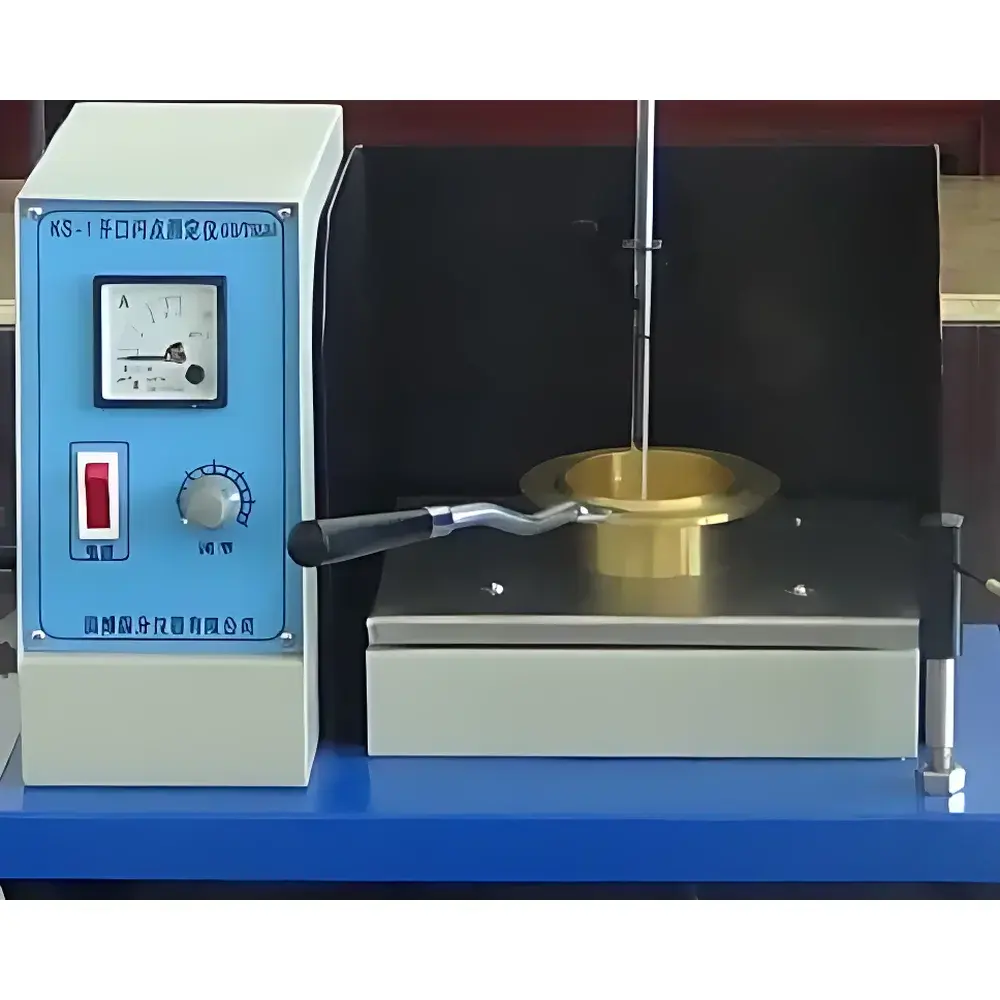
Beifen Sanpu KS-1 Cleveland Open Cup Flash Point Tester
| Brand | Beifen Sanpu |
|---|---|
| Model | KS-1 |
| Standard Compliance | GB/T 3536, ASTM D92 |
| Flash Point Range | Ambient to 400 °C |
| Repeatability | ±2 °C (≤150 °C), ±4 °C (>150 °C) |
| Power Supply | 220 VAC, 50 Hz |
| Power Consumption | 400 W |
| Temperature Control | Solid-State Voltage Regulator (Continuous Ramp) |
| Dimensions (W×D×H) | 285 × 185 × 350 mm |
| Net Weight | 7 kg |
| Origin | Hebei, China |
| Manufacturer Type | OEM/ODM Producer |
Overview
The Beifen Sanpu KS-1 Cleveland Open Cup Flash Point Tester is a precision-engineered instrument designed for the standardized determination of flash point and fire point of petroleum products, lubricants, biodiesel blends, and related hydrocarbon-based fluids. It operates in strict accordance with the Cleveland Open Cup (COC) method defined in GB/T 3536 (Chinese National Standard) and ASTM D92 (American Society for Testing and Materials), ensuring regulatory alignment for quality control laboratories, refinery QC departments, and third-party testing facilities across Asia, the Middle East, and emerging markets requiring dual-standard validation.
Flash point measurement relies on controlled heating of a sample in an open test cup while introducing a standardized ignition source at prescribed temperature intervals. The flash point is recorded as the lowest temperature at which vapors above the sample momentarily ignite when exposed to the test flame—providing critical safety data for storage, transport, and handling classification under UN GHS, OSHA HCS, and CLP regulations. The KS-1 implements a solid-state voltage regulator to deliver continuous, linear temperature ramping, eliminating stepwise heating artifacts and enabling high reproducibility across operator shifts and ambient conditions.
Key Features
- Compliant Cleveland Open Cup configuration per ASTM D92 and GB/T 3536, including standardized brass test cup geometry, thermometer well positioning, and flame applicator clearance specifications
- Microprocessor-controlled solid-state voltage regulation ensures stable, drift-free heating profiles from ambient up to 400 °C, supporting both flash point and fire point determinations
- Integrated digital temperature sensing with NIST-traceable calibration capability; optional external reference thermometer port supports verification per ISO/IEC 17025 internal audit requirements
- Ergonomic benchtop design (285 × 185 × 350 mm footprint, 7 kg net weight) optimized for integration into ISO 17025-accredited laboratory workflows without dedicated ventilation hoods
- Electrical safety certified to IEC 61010-1:2010 for laboratory equipment; 220 VAC, 50 Hz input with 400 W maximum load—compatible with standard industrial power distribution systems
Sample Compatibility & Compliance
The KS-1 accommodates liquid samples with kinematic viscosities up to 150 mm²/s at 40 °C—including base oils, transformer oils, hydraulic fluids, cutting fluids, and used engine oils—without pre-dilution or viscosity adjustment. It is not intended for low-volatility bituminous materials or water-miscible coolants requiring closed-cup methodology (e.g., ASTM D93/Pensky-Martens). All test procedures adhere to mandatory reporting conventions outlined in ASTM E29 (significant figures), ISO 4287 (surface finish tolerances for test cup), and GB/T 8170 (numerical rounding rules for Chinese metrological reporting).
Instrument qualification documentation includes Factory Acceptance Test (FAT) reports verifying thermal ramp linearity, temperature uniformity across cup bottom surface (<±1.5 °C), and flame extinction response time (<0.5 s). Full compliance records are provided for GLP audit readiness and support of 21 CFR Part 11–aligned electronic record retention when paired with validated lab information management systems (LIMS).
Software & Data Management
The KS-1 is a standalone analog-digital hybrid instrument with no embedded software or touchscreen interface. All operational parameters—including observed flash point, fire point, final test temperature, and ambient barometric pressure (manually entered)—are recorded manually in laboratory notebooks or exported to LIMS via structured CSV templates supplied in the user manual. This architecture eliminates firmware validation burdens associated with Class I medical device or pharmaceutical-grade instrumentation, aligning with ISO/IEC 17025:2017 Clause 6.4.10 (software validation scope limitations). Calibration certificates include uncertainty budgets calculated per GUM (JCGM 100:2008) and traceability chains to CNAS-accredited primary standards.
Applications
- Refinery QC labs performing routine flash point screening of crude fractions and finished distillates
- Lubricant manufacturers validating batch consistency against OEM specifications (e.g., SAE J300, API Service Categories)
- Independent testing laboratories conducting ASTM D92-compliant certification for export documentation (e.g., CE marking, SONCAP, SASO)
- University research groups studying thermal stability of bio-derived fuels and synthetic esters
- Maintenance depots assessing in-service oil degradation where elevated flash point may indicate contamination or additive depletion
FAQ
Does the KS-1 support automated flame ignition or detection?
No—the KS-1 requires manual flame application using the included calibrated test flame device, consistent with ASTM D92 procedural requirements.
Can it be used for closed-cup flash point testing?
No—this instrument is exclusively configured for Cleveland Open Cup methodology. For Pensky-Martens (ASTM D93) or Tag Closed Cup (ASTM D56), a separate instrument is required.
Is third-party calibration service available?
Yes—Beifen Sanpu provides CNAS-accredited calibration services with documented uncertainty budgets and traceability to national standards.
What maintenance is required for long-term accuracy?
Annual verification of cup geometry (depth, diameter, rim thickness), thermometer immersion depth, and flame tip diameter (3.2 mm ± 0.2 mm) is recommended per ASTM D92 Annex A1.
Does the unit comply with environmental testing chamber integration protocols?
The KS-1 operates independently of environmental chambers; however, its compact dimensions and low thermal mass allow placement inside temperature-stabilized rooms (±0.5 °C) for enhanced inter-laboratory reproducibility studies.
Related Products






