
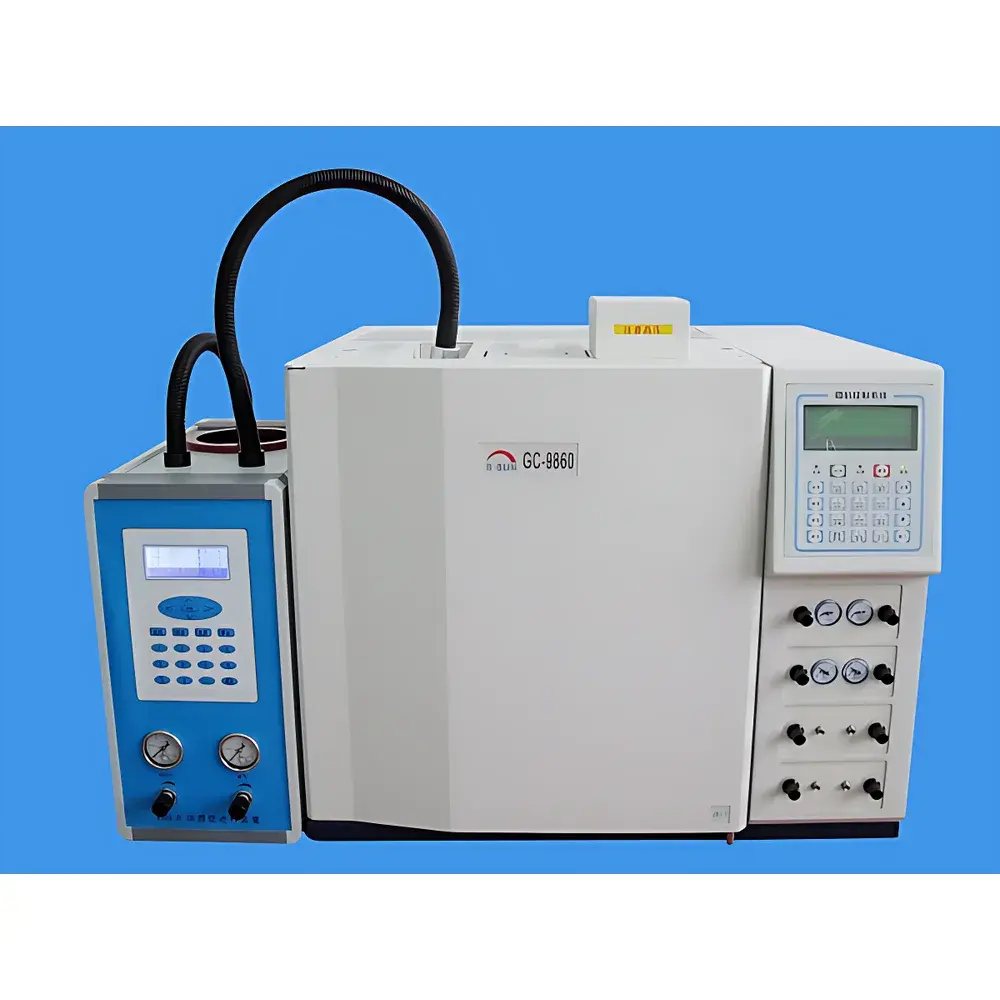
Beifen Sanpu GC-9860III/AHS-610 Integrated TVOC Analysis System for Indoor Air Quality Monitoring
| [Brand | Beifen Sanpu |
|---|---|
| Origin | Beijing, China |
| Manufacturer Type | Original Equipment Manufacturer (OEM) |
| Product Category | Domestic |
| Model | GC-9860III/AHS-610 |
| Temperature Control Range | 450 °C |
| Oven Ramp Rate | 39 °C/min |
| Oven Cool-down Rate | 39 °C/min |
| Carrier Gas Flow Range & Control | 0–1200 mL/min |
| Carrier Gas Pressure Range & Control | 0–450 kPa |
| Injector Maximum Operating Temperature | 450 °C |
| Injector Pressure Setting Range | 0–450 kPa |
| Injector Total Flow Setting Range | 0–1200 mL/min] |
Overview
The Beifen Sanpu GC-9860III/AHS-610 Integrated TVOC Analysis System is a purpose-built, turnkey gas chromatography solution engineered for regulatory-compliant measurement of Total Volatile Organic Compounds (TVOC) and individual aromatic hydrocarbons—including benzene, toluene, ethylbenzene, and xylene isomers (BTEX)—in indoor air samples. This system implements the core analytical methodology specified in key Chinese national standards: GB/T 50325–2020 Control Standard for Indoor Environmental Pollution of Civil Building Engineering and GB/T 18883–2022 Indoor Air Quality Standard. It combines a high-stability dual-flame ionization detector (dual-FID) gas chromatograph with an automated thermal desorption unit (AHS-610), enabling trace-level quantification of target analytes adsorbed onto Tenax-TA or activated carbon sorbent tubes. The system operates on the principle of thermal desorption–gas chromatography–FID detection, delivering reproducible separation, retention time stability, and linear dynamic response across the required concentration range (0.005–1.0 mg/m³ for TVOC per GB/T 50325–2020).
Key Features
- Dual-FID configuration ensures simultaneous, independent quantification of TVOC and BTEX compounds without re-injection—reducing analysis cycle time and improving throughput for batched residential or commercial building assessments.
- Programmable oven temperature control (ambient to 450 °C) with rapid heating (up to 39 °C/min) and active cooling (39 °C/min) supports optimized resolution of complex VOC mixtures using the supplied 50 m × 0.32 mm × 1.0 µm TVOC-specific capillary column.
- Integrated carrier gas management with digital mass flow controllers (0–1200 mL/min) and pressure regulation (0–450 kPa) enables precise method transfer and long-term retention time reproducibility under variable ambient conditions.
- AHS-610 thermal desorber features 30-position sample tray capacity, programmable cold trap focusing (–30 °C), and inert quartz-lined desorption path—minimizing carryover and ensuring compliance with ISO 16000-6:2011 requirements for sorbent tube-based sampling.
- All hardware modules—including BF-300E hydrogen generator (99.999% purity, 0–300 mL/min), BF-2L zero-air generator (oil-free, 0–2000 mL/min), and ZM-102B electronic soap-film flowmeter—are calibrated and validated as a cohesive analytical platform, not as standalone components.
Sample Compatibility & Compliance
This system is validated for use with standardized sorbent sampling media defined in GB/T 50325–2020 and ISO 16000-2:2017, including 6 mm OD Tenax-TA tubes (for TVOC) and activated carbon tubes (for benzene). Sample collection follows prescribed protocols using BS-H2 dual-channel constant-flow air samplers (flow rate: 0.1–1.0 L/min, certified accuracy ±5%). Post-collection, tubes are sealed and stored at 4 °C prior to analysis. The entire workflow—from sampling through thermal desorption, chromatographic separation, and FID detection—meets data integrity requirements for GLP-aligned environmental testing laboratories. Instrument operation adheres to ISO/IEC 17025:2017 clause 5.9 (assuring validity of methods) and supports audit-ready documentation when paired with compliant chromatography data systems (CDS).
Software & Data Management
The GC-9860 workstation software provides full instrument control, sequence scheduling, peak integration, calibration curve generation (multi-point, weighted linear regression), and report export in PDF/CSV formats. It supports user-defined calculation templates aligned with GB/T 50325–2020 Annex D (TVOC quantification via n-decane equivalent), including automatic correction for humidity, atmospheric pressure (DYM-3 barometer input), and sampling volume. Audit trail functionality logs all method changes, integration parameter adjustments, and result modifications with timestamp, operator ID, and reason code—facilitating compliance with internal QA procedures and external accreditation reviews. While the base software does not include 21 CFR Part 11 electronic signature capability, it is compatible with third-party validated CDS platforms meeting FDA and CNAS requirements.
Applications
- Pre-occupancy indoor air quality verification for residential, office, school, and healthcare facilities per GB/T 18883–2022 and GB/T 50325–2020.
- Post-renovation or post-furnishing VOC emission profiling to assess off-gassing from adhesives, coatings, composite wood products, and upholstery.
- Longitudinal monitoring of HVAC system performance and source identification in buildings exhibiting occupant-reported symptoms (e.g., headache, mucosal irritation).
- Reference method validation and inter-laboratory comparison studies conducted under CNAS-accredited environmental testing programs.
- Research applications investigating VOC speciation, seasonal variation, and correlation with ventilation rates or material emission testing (e.g., chamber studies per GB/T 18883–2022 Annex C).
FAQ
What regulatory standards does this system directly support?
It is fully configured to execute test methods referenced in GB/T 50325–2020 (TVOC and benzene), GB/T 18883–2022 (TVOC, benzene, toluene, ethylbenzene, xylenes), and ISO 16000-6:2011 (thermal desorption–GC–FID for VOCs).
Can the system quantify formaldehyde or ammonia?
No—formaldehyde and ammonia require spectrophotometric analysis per GB/T 18204.26 and GB/T 18204.25; the included 723PC spectrophotometer is provided for those parallel determinations.
Is the thermal desorption unit compatible with standard 6 mm sorbent tubes?
Yes—the AHS-610 accepts industry-standard 6 mm OD stainless steel or glass tubes packed with Tenax-TA, Carbopack B, or activated carbon, conforming to ISO 16000-2 geometry specifications.
What maintenance intervals are recommended for routine operation?
FID nozzle cleaning every 200 injections; column trimming every 3 months or after 500 injections; desorber cold trap regeneration quarterly; carrier gas filter replacement every 6 months.
Does the system include calibration standards traceable to NIM (National Institute of Metrology, China)?
The supplied 9-component TVOC standard mixture (10/100/1000 µg/mL in methanol) and single-component benzene/ammonia standards are certified reference materials issued by accredited Chinese CRM providers with documented traceability to NIM SRMs.
Related Products




