
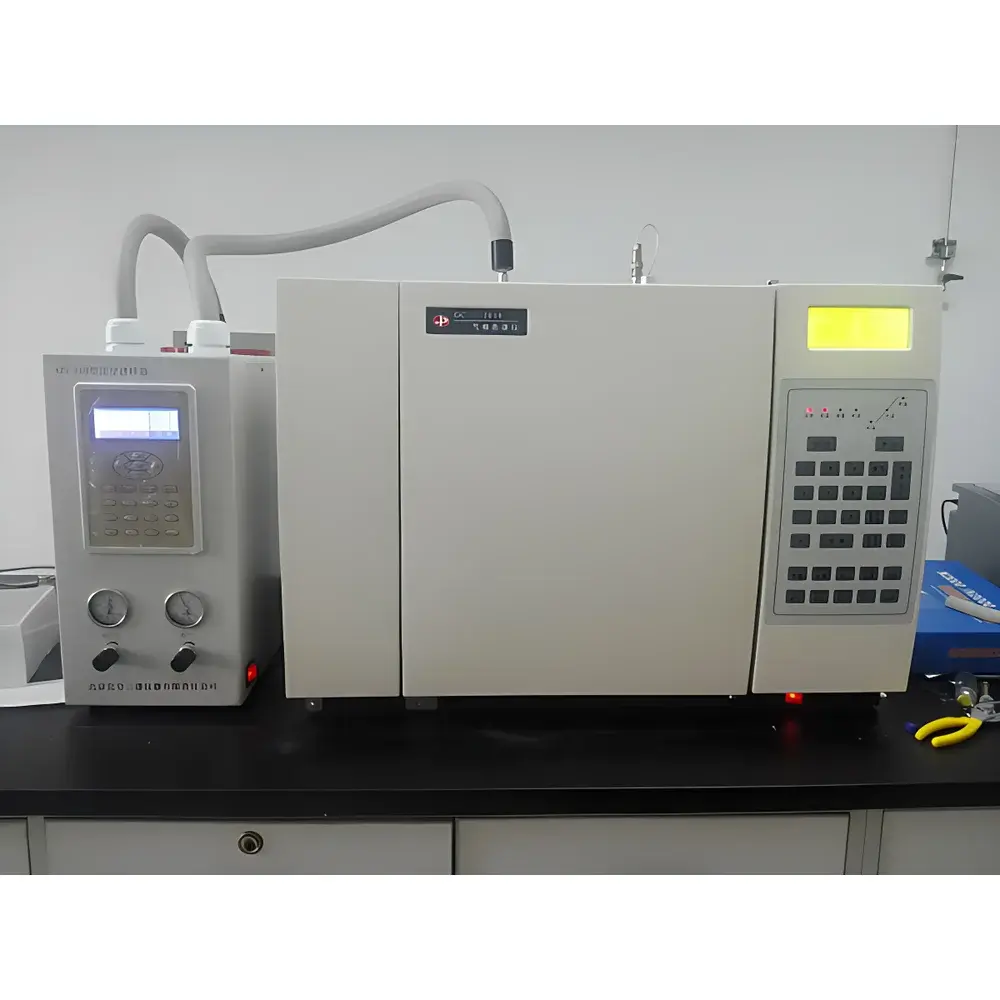
Brookfield GC-2010+AHS-610 Economic Residual Solvent Analysis System for Low-Molecular-Weight Heparin
| Brand | Beifen Sanpu |
|---|---|
| Origin | Beijing, China |
| Manufacturer Type | Manufacturer |
| Instrument Type | Laboratory Gas Chromatograph |
| Application Field | Pharmaceutical Analysis |
| Oven Temperature Range | 400 °C |
| Ramp Rate | 0.1–40 °C/min |
| Cool-down Time | ~10 min (400 °C to 50 °C) |
| Carrier Gas Flow Range & Control | 0–1200 mL/min |
| Carrier Gas Pressure Range & Control | 0–10,000 kPa |
| Injector Max Operating Temperature | 400 °C |
| Injector Pressure Setting Range | 0–1000 kPa |
| Injector Total Flow Setting Range | 0–1200 mL/min |
Overview
The Brookfield GC-2010+AHS-610 Economic Residual Solvent Analysis System is a purpose-engineered gas chromatography solution optimized for the quantitative determination of residual solvents—specifically methanol, ethanol, and dichloromethane—in low-molecular-weight heparin (LMWH) active pharmaceutical ingredients (APIs). LMWHs, including enoxaparin sodium, dalteparin sodium, and nadroparin calcium, are produced via controlled depolymerization of unfractionated heparin using enzymatic or chemical cleavage methods. These processes routinely employ organic solvents such as ethanol for precipitation, methanol in specific synthesis steps (e.g., enoxaparin), and dichloromethane in extraction or purification stages. Residual solvent levels must comply with ICH Q3C(R8) guidelines and pharmacopoeial monographs (USP , EP 2.4.24, ChP 0861), mandating robust, reproducible, and auditable analytical workflows. This system implements headspace gas chromatography (HS-GC) with flame ionization detection (FID), leveraging the thermodynamic partitioning equilibrium between solid/liquid sample matrix and vapor phase to achieve selective, interference-free quantification without derivatization or extensive sample preparation.
Key Features
- Integrated dual-platform architecture: GC-2010 mainframe equipped with precision oven temperature control (±0.1 °C stability) and AHS-610 automated headspace sampler with programmable vial heating, incubation, and pressurized loop injection.
- High-temperature compatibility: Injector and oven both rated to 400 °C, enabling method robustness for high-boiling solvents and facilitating rapid column conditioning and carryover mitigation.
- Advanced pneumatic control: Digital mass flow controllers (MFCs) for carrier gas (N₂, He, or H₂), with independent pressure and flow regulation across inlet, detector, and split/splitless modes—ensuring retention time reproducibility <0.02 min RSD (n=6).
- Optimized thermal management: Rapid cool-down capability (400 °C → 50 °C in ~10 min) reduces cycle time per sample, supporting throughput requirements for QC laboratories processing multiple LMWH batches daily.
- Modular gas generation: On-site BF-300 nitrogen generator and BF-300E hydrogen generator eliminate cylinder dependency, enhancing lab safety and long-term operational cost efficiency.
Sample Compatibility & Compliance
The system is validated for direct analysis of lyophilized or aqueous LMWH samples (e.g., sodium enoxaparin, calcium nadroparin) following USP Method I (Headspace GC). Sample vials (20 mL crimp-top) accommodate 0.2–0.5 g API or reconstituted solution. The DB-624 fused-silica capillary column (0.53 mm ID × 30 m, 3.0 µm film thickness) provides baseline separation of methanol, ethanol, and dichloromethane under isothermal or gradient conditions, with resolution (Rs) >2.5 between adjacent peaks. All hardware and software components support GLP/GMP compliance: electronic audit trails, user access levels, method versioning, and raw data integrity per FDA 21 CFR Part 11 requirements. Instrument qualification includes IQ/OQ documentation aligned with ASTM E2656 and ISO/IEC 17025:2017 criteria.
Software & Data Management
N2000 Chromatography Workstation (Zhejiang University) provides full instrument control, real-time signal acquisition, peak integration, calibration curve generation (linear/non-linear), and report export in PDF, CSV, and XML formats. The software supports multi-level user authentication, electronic signatures, and automatic backup to network drives or NAS devices. All acquisition parameters, integration events, and manual reprocessing actions are timestamped and logged with operator ID—enabling full traceability from injection to final certificate of analysis (CoA). Data files are stored in vendor-neutral formats compliant with laboratory information management systems (LIMS) interfaces.
Applications
- Quantitative assay of Class 2 and Class 3 residual solvents in LMWH drug substances per ICH Q3C(R8) limits (e.g., methanol ≤3000 ppm, ethanol ≤5000 ppm, dichloromethane ≤600 ppm).
- Batch release testing for enoxaparin sodium, dalteparin sodium, and nadroparin calcium APIs in accordance with USP-NF, Ph. Eur., and Chinese Pharmacopoeia specifications.
- Process validation support: monitoring solvent removal efficiency across lyophilization cycles and downstream purification steps.
- Stability-indicating method development for accelerated and long-term storage studies assessing solvent re-absorption or degradation-related volatile byproducts.
- Cross-compatibility with other heparinoid APIs and polysaccharide-based biologics requiring residual solvent screening.
FAQ
What regulatory standards does this system meet for pharmaceutical residual solvent analysis?
This configuration complies with USP , EP 2.4.24, ChP 0861, and ICH Q3C(R8) for method suitability, specificity, linearity, accuracy, precision, and limit of quantitation (LOQ) verification.
Can the system be upgraded for compliance with 21 CFR Part 11?
Yes—the N2000 workstation supports electronic signatures, audit trail activation, and role-based access control when deployed on a domain-authenticated Windows environment with appropriate IT infrastructure.
Is column selection flexible for alternative solvent panels?
Yes—DB-624 is recommended for polar and moderately volatile solvents; alternative columns (e.g., DB-WAX, CP-Wax 52CB) can be installed for expanded analyte coverage including acetone, isopropanol, or ethyl acetate.
What maintenance intervals are recommended for routine operation?
Injector liner replacement every 100–200 injections; FID jet cleaning monthly; GC column trimming every 3–6 months depending on sample load; annual preventive maintenance including leak checks, detector optimization, and pneumatic calibration.
Does the system include validation documentation?
Yes—factory-provided IQ/OQ protocols, system suitability test (SST) templates, and blank/standard/spike recovery data sets are supplied with installation and commissioning.




