
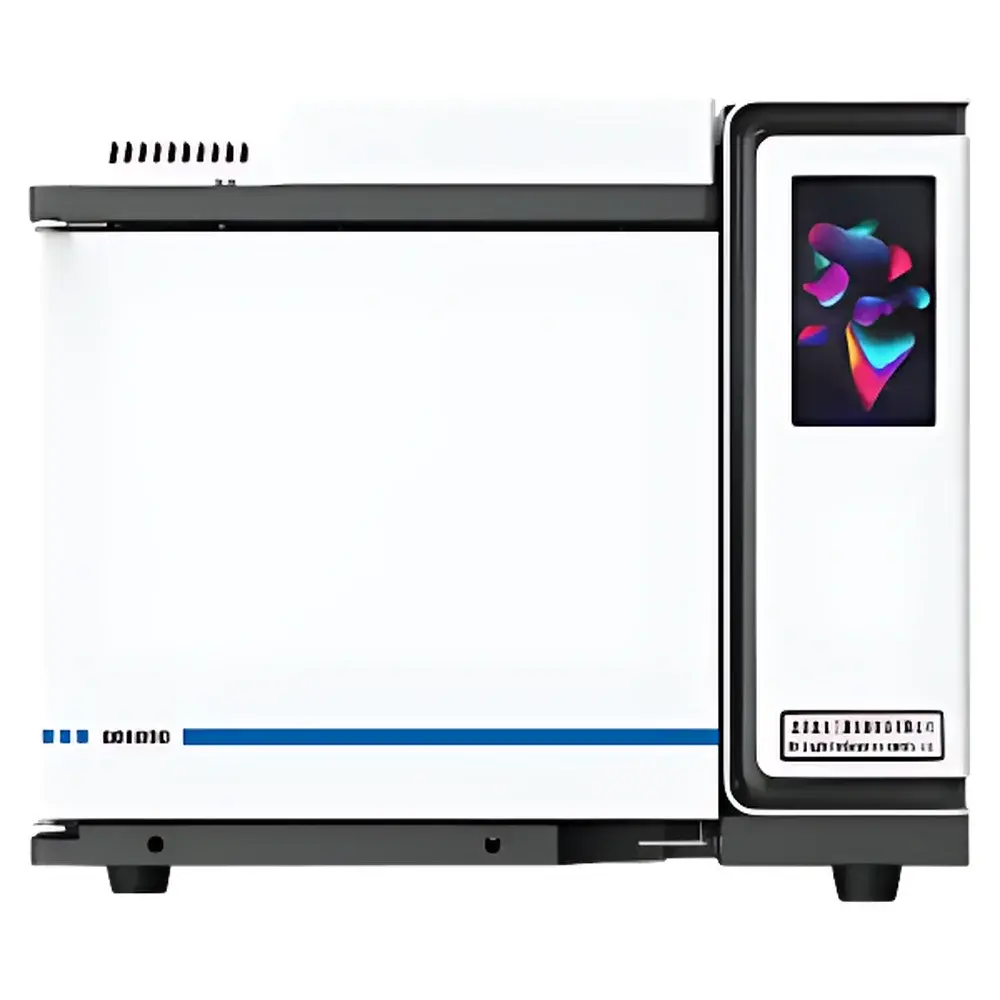
Beifen Sanpu GC-8890 Gas Chromatograph
| Brand | Beifen Sanpu |
|---|---|
| Origin | Hebei, China |
| Manufacturer Type | Direct Manufacturer |
| Instrument Type | Laboratory Gas Chromatograph |
| Application Scope | General-Purpose |
| Temperature Control Range | 5°C above ambient to 380°C |
| Programmable Temperature Ramping | 32 Steps / 33 Platforms |
| Detector Options | FID, TCD, ECD, FPD, NPD, PDHID (selectable up to 3 simultaneously) |
| EPC Control | 6th-Generation Electronic Pressure Control |
| Data Interface | 10/100M Adaptive Ethernet, RS-232, Bluetooth 5.0 |
| Column Oven Cooling/Heating Rate | Optimized via Inverter-Driven Air Circulation System |
| Software Platform | DOTHUNET Workstation (supports up to 300 instruments, Modbus/TCP server, LIMS/DCS integration) |
| Compliance Framework | Designed for GLP/GMP-aligned workflows |
Overview
The Beifen Sanpu GC-8890 is a modular, network-enabled laboratory gas chromatograph engineered for precision, reproducibility, and long-term operational stability in regulated and research-intensive environments. It employs capillary or packed column separation coupled with carrier gas flow control (helium, hydrogen, or nitrogen) and detector-specific signal transduction to resolve, identify, and quantify volatile and semi-volatile organic compounds. The system’s core architecture integrates sixth-generation Electronic Pressure Control (EPC), inverter-driven column oven thermal management, and a fully embedded Linux-based control firmware — enabling deterministic timing, sub-milliliter-per-minute flow resolution, and <±0.01°C temperature stability across eight independently controlled zones. Designed for compliance-ready deployment, the GC-8890 supports method validation protocols aligned with ISO 17025, ASTM D3606/D5504, USP , and EPA Methods 8021B/8260D, making it suitable for environmental monitoring, petrochemical QA/QC, food safety residue analysis, and pharmaceutical impurity profiling.
Key Features
- Sixth-generation EPC system with dual-mode operation: constant pressure, constant flow, programmed pressure ramping, and programmed flow ramping — calibrated for 0–0.6 MPa pressure and 0–100 mL/min (or 0–500 mL/min for air) flow ranges
- Inverter-controlled column oven with rapid heating/cooling kinetics and 32-step/33-platform programmable temperature programming
- Multi-detector compatibility: simultaneous installation and independent configuration of up to three detectors — FID, TCD, ECD, FPD, NPD, or PDHID — each with factory-calibrated sensitivity and linearity verification
- 7-inch capacitive touchscreen interface with bilingual (English/Chinese) OS selection, intuitive icon-driven navigation, and real-time parameter visualization
- Integrated Bluetooth 5.0 module for wireless instrument status polling, remote diagnostics, and mobile-initiated sequence launch
- DOTHUNET workstation software with centralized fleet management (up to 300 units), full instrument reverse control, and native Modbus/TCP server for DCS/SCADA integration
- 10/100M adaptive Ethernet port with embedded TCP/IP stack, supporting LIMS connectivity, HTTP-based remote access, and time-synchronized data logging
- Modular mechanical design with tool-less detector and inlet module swaps, minimizing downtime during maintenance or method reconfiguration
- FID auto-ignition logic with flame failure detection, automatic gas purging on shutdown, and configurable standby mode to reduce carrier gas consumption
- Preconfigured driver support for multiple autosamplers (e.g., CTC PAL, Gerstel MPS) and external sample introduction systems including headspace samplers, thermal desorbers, and gas-tight syringe manifolds
Sample Compatibility & Compliance
The GC-8890 accommodates liquid, gaseous, and solid-phase samples via compatible inlet systems — split/splitless injectors, PTV, and direct capillary coupling. It meets essential performance criteria for routine analysis of hydrocarbons, pesticides, residual solvents, VOCs, and halogenated compounds. Its hardware and firmware architecture support traceability requirements under GLP and GMP frameworks. When deployed with version-locked DOTHUNET software and enabled audit trail logging, the system satisfies FDA 21 CFR Part 11 criteria for electronic records and signatures. All detector specifications (e.g., FID detection limit ≤3×10⁻¹² g/s on n-hexadecane, ECD ≤1×10⁻¹⁴ g/s on β-HCH) are verified per IUPAC-recommended calibration protocols and documented in出厂 calibration certificates supplied with each unit.
Software & Data Management
DOTHUNET is a Windows-based chromatography data system (CDS) developed in-house to ensure tight firmware-software synchronization. It provides peak integration using iterative Gaussian deconvolution, retention time locking (RTL), and multi-point calibration curve generation with weighting options (1/x, 1/x²). Raw data files are stored in vendor-neutral .CDF format compliant with ASTM E1947. The built-in Modbus/TCP server enables bidirectional communication with industrial automation systems, allowing chromatographic results to populate MES or DCS dashboards without middleware. Networked installations support role-based user permissions, electronic signature workflows, and automated backup to NAS or cloud storage via configurable SFTP policies.
Applications
The GC-8890 serves as a primary analytical platform across diverse sectors: environmental labs use it for EPA Method 8260D (VOCs in water/soil) and 8021B (aromatics in wastewater); food testing laboratories apply it to EU Regulation (EC) No 396/2005 pesticide residue screening; petroleum refineries deploy it for ASTM D3606 (benzene/toluene in gasoline) and D5504 (sulfur compounds); pharmaceutical QC labs rely on its USP compliance for residual solvent testing per ICH Q2(R2). Its expandable inlet and detector architecture also supports method development for emerging contaminants, including PFAS precursors and nitrosamines.
FAQ
Does the GC-8890 support 21 CFR Part 11 compliance?
Yes — when operated with validated DOTHUNET software v3.2+, configured audit trail logging, and electronic signature modules, the system meets predicate rule requirements for record integrity, user authentication, and change control.
Can the instrument be integrated into an existing LIMS environment?
Yes — via its native Ethernet interface and HL7/ASTM-compliant data export functions, or through custom API endpoints provided under OEM integration agreements.
What is the maximum number of temperature program steps supported?
The column oven supports up to 32 ramping steps across 33 temperature platforms, with hold times configurable from 0.01 to 999.99 minutes.
Is remote diagnostic support available?
Yes — Bluetooth-assisted local diagnostics and secure remote desktop access (via TLS-encrypted VNC) are supported for troubleshooting and firmware updates.
Are calibration standards and certification documents included?
Each shipment includes NIST-traceable calibration verification reports for all installed detectors, along with factory-installed column conditioning protocols and EPC flow verification data.




