
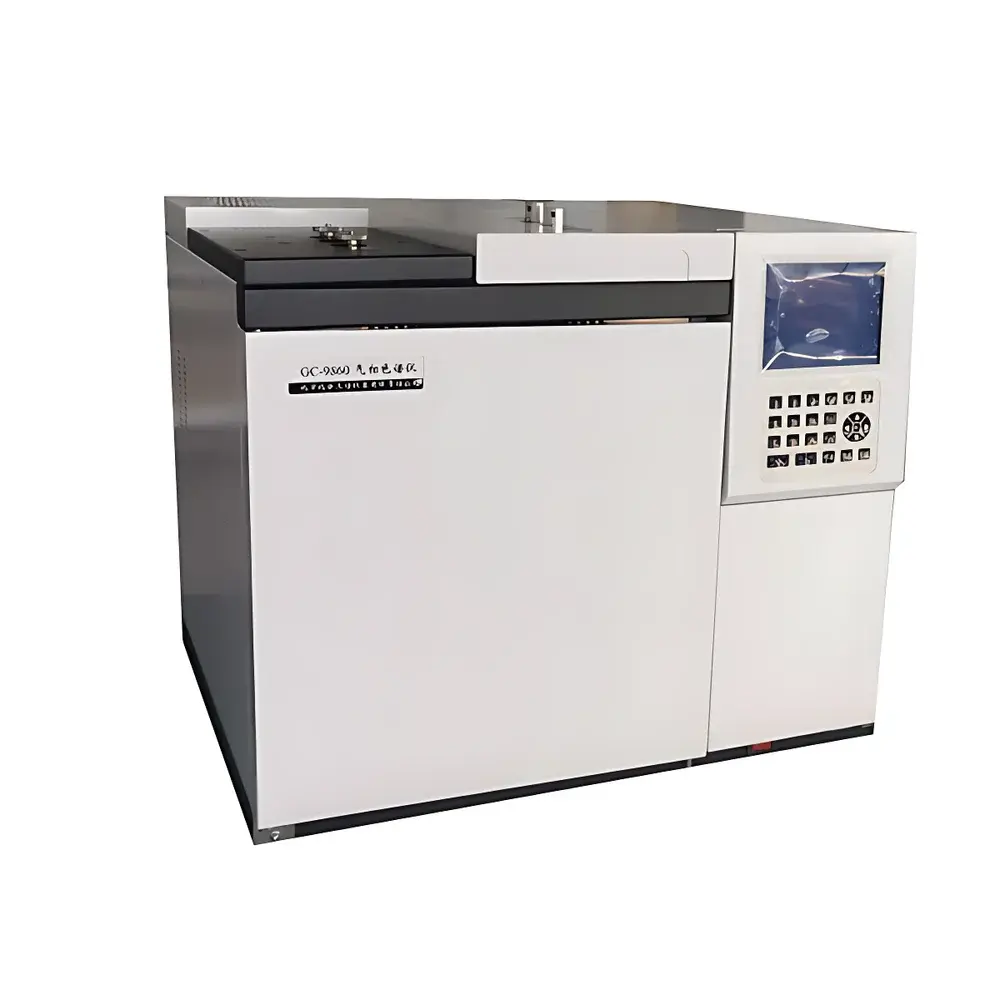
Beifen Sanpu GC-9860II Laboratory Gas Chromatograph for Baijiu (Chinese Liquor) Analysis
| Brand | Beifen Sanpu |
|---|---|
| Origin | Beijing, China |
| Manufacturer Type | Direct Manufacturer |
| Instrument Type | Laboratory Gas Chromatograph |
| Model | GC-9860II |
| Temperature Control Range | Ambient to 400 °C |
| Oven Ramp Rate | Up to 40 °C/min |
| Oven Cool-down Rate | Up to 40 °C/min |
| Carrier Gas Flow Range & Control | 0–1200 mL/min |
| Carrier Gas Pressure Range & Control | 0–970 kPa |
| Injector Maximum Operating Temperature | 450 °C |
| Injector Pressure Setting Range | 0–970 kPa |
| Injector Total Flow Setting Range | 0–1200 mL/min |
Overview
The Beifen Sanpu GC-9860II is a dedicated laboratory gas chromatograph engineered for high-reproducibility quantitative and qualitative analysis of volatile and semi-volatile compounds in baijiu (Chinese distilled spirit). Based on capillary gas chromatography with flame ionization detection (FID), the system delivers precise separation and quantification of key analytes—including methanol, fusel oils (e.g., propanol, isobutanol, butanol, isoamyl alcohol, amyl alcohol), esters, aldehydes, and higher alcohols—critical to sensory profile assessment, quality control, and regulatory compliance. Its robust thermal management architecture enables rapid temperature programming and stable isothermal operation, essential for routine batch analysis in distillery QC labs, provincial food safety inspection centers, and national technical supervision institutes. The instrument conforms to core methodological requirements outlined in GB/T 10345–2007 (National Standard of the People’s Republic of China for Baijiu Analysis) and supports alignment with ISO/IEC 17025:2017 accredited testing workflows.
Key Features
- Programmable oven with precise temperature control from ambient to 400 °C and linear ramp rates up to 40 °C/min, ensuring reproducible retention time stability across multi-analyte methods.
- Dual-FID configuration option (standard single-FID; upgradeable to dual-FID) for simultaneous detection of oxygenated and hydrocarbon compounds without column switching or valve modulation.
- High-pressure, high-flow precision electronic pressure control (EPC) modules for carrier (N₂), fuel (H₂), and makeup (air) gases—supporting consistent flow delivery across 0–1200 mL/min and pressure regulation from 0–970 kPa.
- Split/splitless injector with maximum operating temperature of 450 °C and independently controllable pressure and total flow settings, optimized for trace-level volatile compound introduction using narrow-bore capillary columns.
- Integrated hardware synchronization with BF-2002白酒专用色谱工作站 (Baijiu-Specific Chromatography Software), enabling automated peak integration, calibration curve generation, and report export compliant with internal QA documentation standards.
Sample Compatibility & Compliance
The GC-9860II is validated for direct injection of diluted or headspace-derived baijiu samples, accommodating complex matrices with high ethanol content (up to 65% v/v) and low-concentration flavor congeners (ppb–ppm range). It supports analysis of over 40 target compounds defined in national baijiu standards, including methyl alcohol (methanol), ethyl acetate, ethyl lactate, and β-phenylethanol. System design adheres to general principles of GLP (Good Laboratory Practice) and facilitates audit readiness for laboratories subject to CNAS (China National Accreditation Service) or provincial market regulation authority inspections. While not pre-certified to FDA 21 CFR Part 11, its data acquisition architecture supports implementation of electronic signature and audit trail protocols when deployed with validated software configurations and documented SOPs.
Software & Data Management
The BF-2002 chromatography workstation provides method-driven acquisition, real-time baseline correction, and customizable reporting templates aligned with baijiu factory QC checklists and provincial inspection forms. Raw data (.dat) and processed results (.xls/.pdf) are stored with embedded metadata (operator ID, injection time, method version, instrument serial number), enabling full traceability. The software supports multi-level user permissions, password-protected method editing, and export of CSV files compatible with LIMS integration. All chromatograms and calibration records are timestamped and digitally signed upon finalization—meeting minimum documentation requirements for internal quality audits and inter-laboratory comparison exercises.
Applications
- Quantitative determination of methanol and fusel oil content for compliance with GB 2757–2012 (Food Safety Standard for Distilled Spirits).
- Routine monitoring of base liquor (mijiu) composition to support computer-assisted blending (micro-blending) and consistency control across production batches.
- Profiling of aroma-active compounds—including esters, terpenoids, and phenolic derivatives—to correlate chromatographic fingerprints with sensory evaluation panels.
- Forensic analysis by technical supervision bureaus and CDC laboratories to detect adulteration, identify counterfeit products, and verify geographical origin claims.
- Method development for specialty baijiu styles (e.g., strong-aroma, sauce-aroma, sesame-aroma) using extended-length or specialized stationary-phase capillary columns (e.g., 60-m LZP-930, 0.32 mm ID, 0.5 µm film).
FAQ
What detector configurations are supported?
The standard configuration includes one FID; an optional dual-FID module is available for parallel detection channels—ideal for method validation or concurrent analysis of polar and non-polar compound classes.
Is the system compatible with third-party data systems?
Yes—raw data files adhere to ASTM E1947-compliant formats and can be imported into commercial chromatography data systems (CDS) such as OpenLab CDS or Chromeleon via ASCII export.
What maintenance intervals are recommended for routine operation?
We recommend quarterly inspection of injector liners, septa, and FID jet assemblies; annual verification of oven temperature accuracy and EPC linearity per ISO 17025 Annex A.3 guidelines.
Can the GC-9860II be used for non-baijiu applications?
Yes—the platform supports generic volatile organic compound (VOC) analysis in food, environmental, and pharmaceutical matrices when paired with appropriate columns and method parameters.
Does the instrument include factory calibration certificates?
Each unit ships with a factory-generated temperature and flow verification report, traceable to NIM (National Institute of Metrology, China) reference standards.
Related Products






