
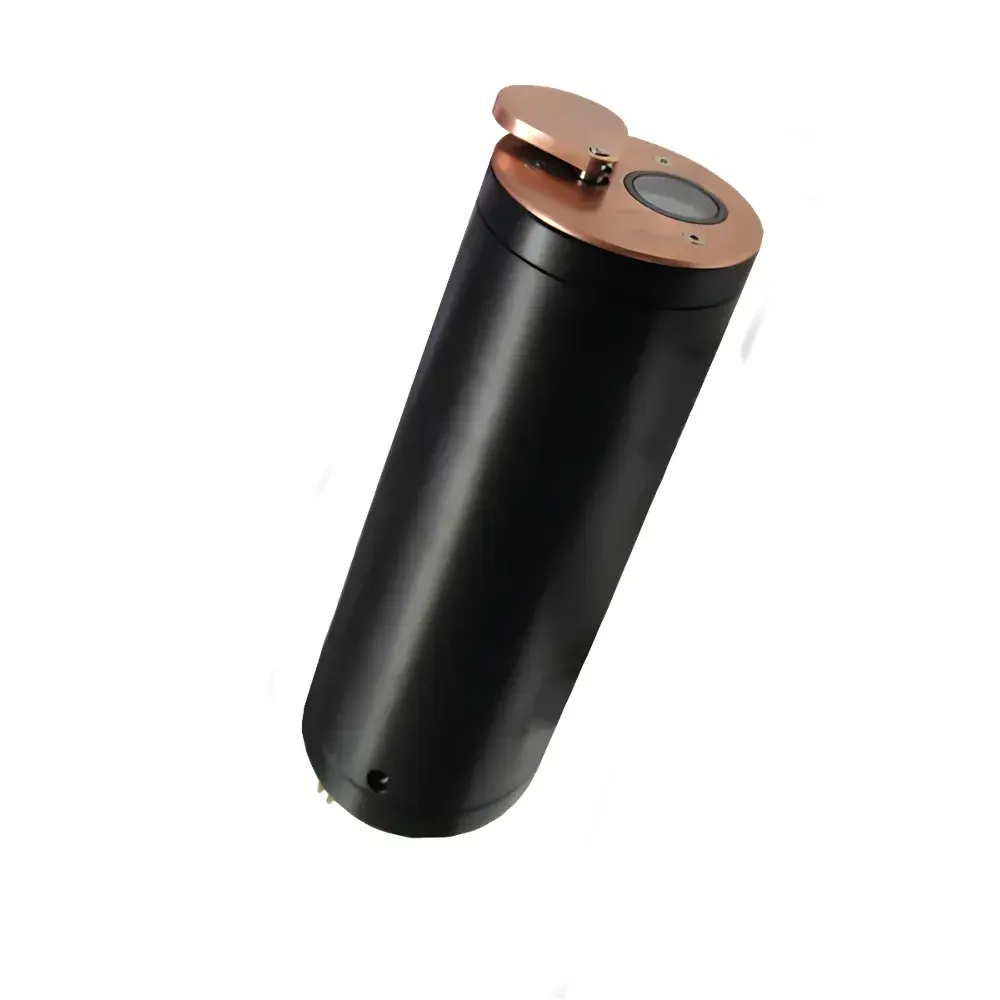
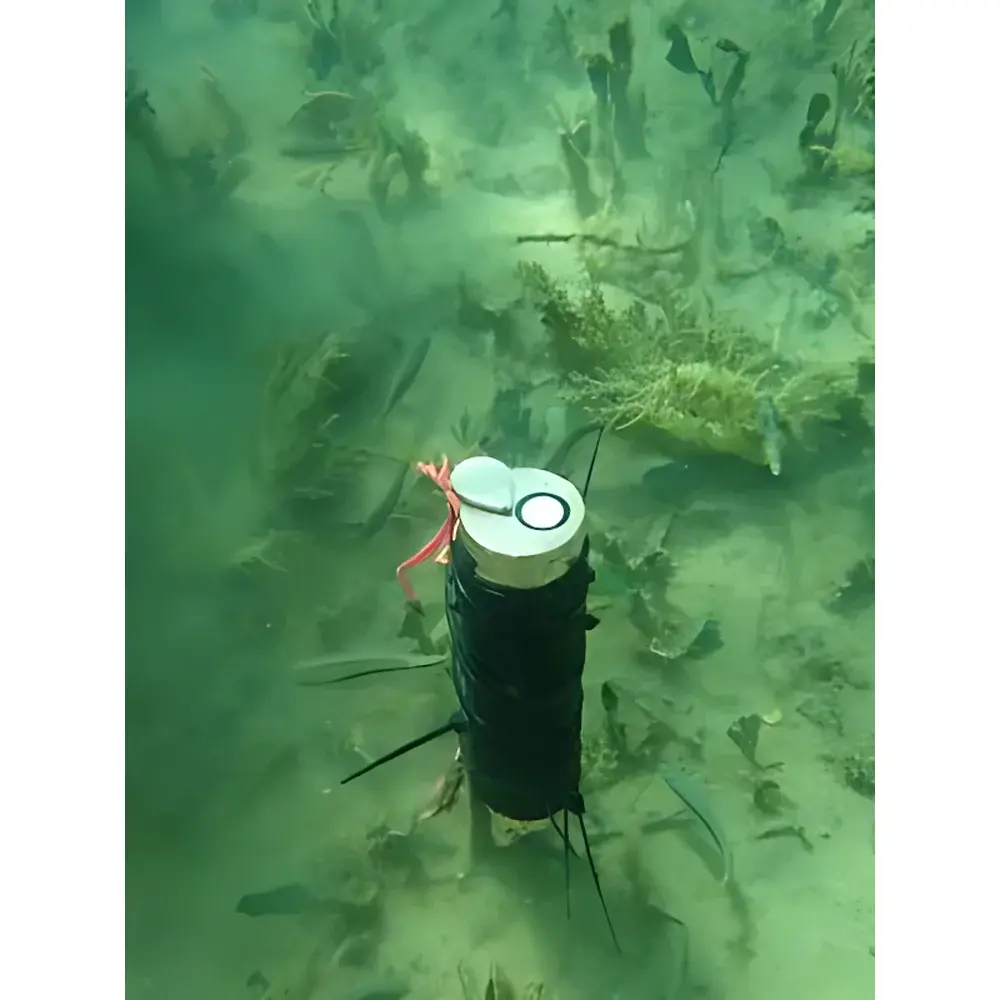
MS9 Multi-Spectral Underwater Radiometer
| Brand | In-situ Marine |
|---|---|
| Origin | Australia |
| Model | MS9 |
| Detector Array | 9 silicon photodiodes |
| Wavelengths (nm) | 410, 440, 490, 510, 550, 610, 660, 685, 710 |
| Spectral FWHM | 10 nm |
| Irradiance Cosine Error | < 3% (0–60°) |
| Radiance FOV | 5° (in air) |
| Calibration | NIST-traceable radiometric calibration |
| Measurement Range | 0–400 μW·cm⁻²·nm⁻¹ (factory-customizable) |
| NEI (Noise-Equivalent Irradiance) | 2.5×10⁻³ μW·cm⁻²·nm⁻¹ |
| ADC Resolution | 9 independent 24-bit ADCs |
| Max Sampling Rate | 5 Hz |
| Interface | RS-232 (configurable baud rate) |
| Connector | Micro WET-CON MCBH6M |
| Operating Voltage | 7–24 VDC |
| Current Draw | 40 mA (sampling), 250 mA (brush cleaning), 60 µA (sleep mode) |
| Dimensions | 148 mm length (plus 36 mm connector), 67 mm diameter |
| Weight | 650 g (air), 150 g (water) |
| Housing Material | Acetal body, PTFE or quartz diffuser, copper anti-fouling panel/brush |
| Operating Temperature | 0–40 °C |
| Max Deployment Depth | 300 m |
| Optional Sensors | Integrated pressure and temperature sensors |
| Data Storage | Internal calibration coefficients stored onboard |
| Real-Time Clock & Tilt Sensor | Integrated |
| Power Management | Programmable low-power sleep mode |
Overview
The In-situ Marine MS9 Multi-Spectral Underwater Radiometer is a precision-engineered optical sensor designed for quantitative in situ measurement of spectral irradiance and radiance in marine environments. Operating on the principle of discrete-band radiometry, the MS9 employs nine thermally stabilized silicon photodiodes, each optically filtered to a specific center wavelength—410, 440, 490, 510, 550, 610, 660, 685, and 710 nm—with a spectral full-width at half-maximum (FWHM) of 10 nm. This configuration enables high-fidelity characterization of underwater light fields critical to phytoplankton photoacclimation, photosynthetic active radiation (PAR) partitioning, and remote sensing algorithm validation. All optical components are calibrated against NIST-traceable standards under controlled laboratory conditions, ensuring metrological integrity across deployments. The instrument’s pressure-rated housing (300 m depth rating), cosine-corrected irradiance response (< 3% error up to 60° incidence), and narrow 5° field-of-view for radiance measurements support rigorous adherence to ISO 17025-compliant measurement protocols in both coastal and open-ocean settings.
Key Features
- Integrated copper anti-fouling system with rotating copper-brush cleaning mechanism—minimizes biofilm accumulation without biocides or consumables
- Programmable sampling schedule with ultra-low-power sleep mode (60 µA @ 12 VDC), enabling multi-month autonomous deployments on battery or mooring power systems
- Onboard real-time clock (RTC) and dual-axis tilt sensor for time-synchronized, orientation-aware data acquisition and post-deployment attitude correction
- Embedded non-volatile memory storing factory-applied calibration coefficients, wavelength-specific responsivities, and optical corrections—ensuring traceability and eliminating manual coefficient loading
- RS-232 serial interface with configurable baud rates (up to 115.2 kbps); compatible with standard oceanographic data loggers, AUVs, and mooring controllers
- Optional integrated pressure and temperature sensors provide concurrent environmental context for optical data normalization and QA/QC flagging
- Modular design with Micro WET-CON MCBH6M wet-mateable connector—enabling rapid deployment/recovery and in-field cable replacement
Sample Compatibility & Compliance
The MS9 is optimized for direct immersion in seawater, brackish, and freshwater systems. Its acetal housing and PTFE or quartz optical diffusers resist chemical degradation and UV-induced aging. The copper-based anti-fouling architecture complies with IMO and regional regulatory frameworks restricting biocidal antifoulants (e.g., EU Biocidal Products Regulation No. 528/2012). Calibration documentation includes uncertainty budgets per ISO/IEC 17025 requirements and supports GLP-aligned field studies. Data output formats adhere to CF (Climate and Forecast) Metadata Conventions v1.8, facilitating ingestion into ERDDAP, THREDDS, and OceanSITES-compatible infrastructure. The device meets IEC 60529 IP68 ingress protection and MIL-STD-810G environmental stress specifications for shock, vibration, and thermal cycling.
Software & Data Management
The MS9 operates without proprietary host software; configuration and data retrieval use ASCII-based command sets over RS-232. Users may integrate it into existing Python, MATLAB, or LabVIEW workflows via standard serial libraries. Calibration coefficients are embedded and automatically applied during data conversion. Optional WiFi-enabled download modules (sold separately) support secure, encrypted post-recovery data extraction without physical disconnection. All firmware updates follow signed binary verification to ensure integrity. Audit trails—including timestamped configuration changes, cleaning actuation logs, and sensor health diagnostics—are retained in non-volatile memory and retrievable via command query. The system supports FDA 21 CFR Part 11-compliant electronic records when deployed with validated data acquisition platforms.
Applications
- Long-term monitoring of spectral scalar irradiance and planar irradiance for primary production modeling and photo-biological parameterization
- In situ validation of satellite-derived ocean color products (e.g., MODIS, VIIRS, Sentinel-3 OLCI) through match-up analysis
- Quantification of spectral attenuation coefficients (Kd(λ)) and diffuse attenuation lengths for optical water classification (e.g., UNESCO Type I–III)
- Time-series studies of phytoplankton community structure using diagnostic absorption features (e.g., chlorophyll-a peak at 685 nm, phycocyanin at 620 nm)
- Integration into cabled observatories (e.g., Ocean Networks Canada, EMSO) for real-time spectral light monitoring with automated quality control
- Calibration and intercomparison campaigns supporting IOCCG (International Ocean Colour Coordinating Group) protocols
FAQ
Can the MS9 be deployed on autonomous platforms such as gliders or profiling floats?
Yes—the low mass (150 g in water), compact form factor, and RS-232 interface make it compatible with Slocum, SeaGlider, and Deepglider platforms. Power management settings allow synchronization with platform telemetry cycles.
Is factory recalibration required annually?
While not mandatory, In-situ Marine recommends recalibration every 24 months for mission-critical applications or after exposure to extreme fouling events. Field verification using stable LED reference sources is supported via built-in diagnostic modes.
How is cosine error characterized and corrected?
Cosine response is measured empirically across 0–80° incidence angles using a collimated tunable laser source and goniometric stage. Correction factors are stored per channel and applied in real time during irradiance computation.
Are custom wavelength configurations available?
Yes—In-situ Marine offers factory-configurable filter sets within the 350–800 nm range, subject to photodiode quantum efficiency and optical packaging constraints. Lead time and NIST traceability apply.
Does the MS9 support synchronous triggering with other sensors?
Yes—TTL-level external trigger input is available via the RS-232 port’s RTS line, enabling hardware-synchronized sampling with CTDs, fluorometers, or acoustic Doppler profilers.







