
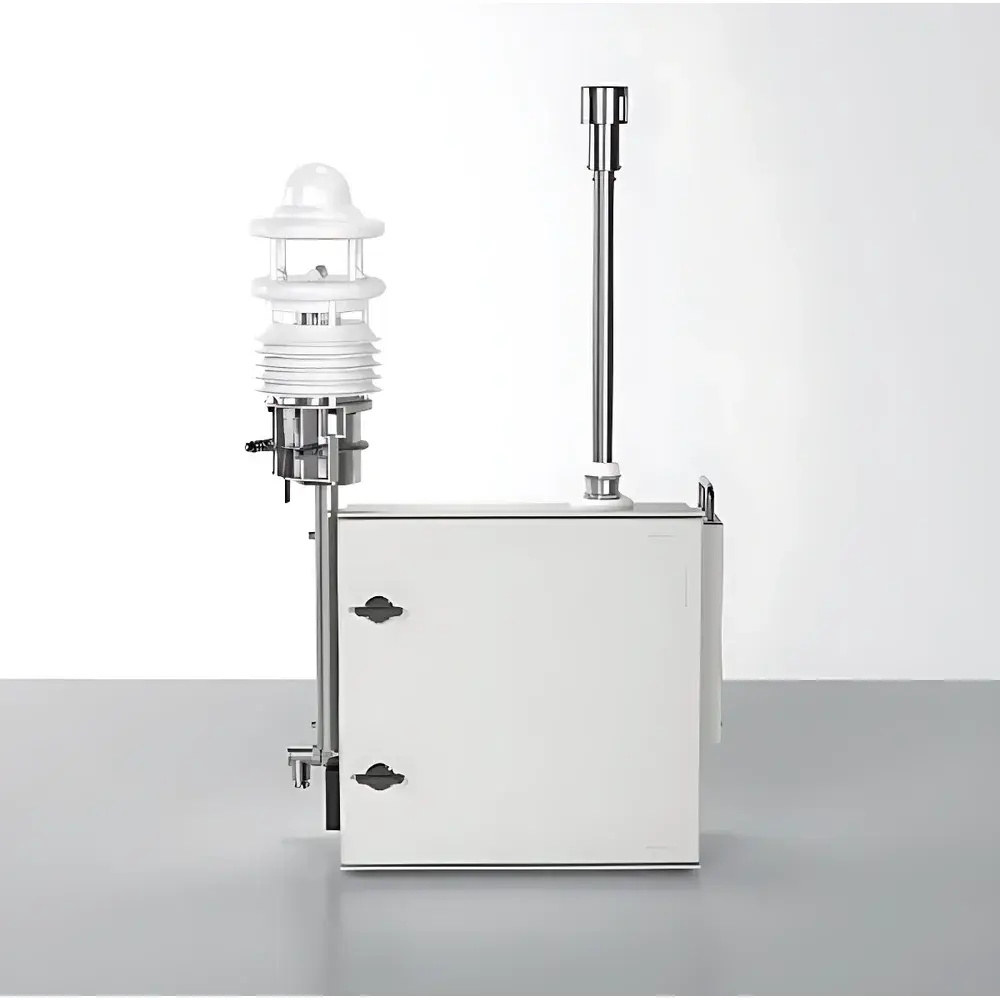
GRIMM EMD264 Environmental Particle Continuous Monitoring System
| Brand | GRIMM |
|---|---|
| Origin | Germany |
| Model | EMD264 |
| Measurement Principle | Optical Light Scattering (90° Single-Particle Detection) |
| Sampling Flow Rate | 1.2 L/min ±3% (constant-flow, ISO 21501-1 compliant) |
| Particle Size Range | 0.253–35.15 µm |
| Number Concentration Range | 0–5,300,000 particles/L |
| Size Channels | 31 equidistant logarithmic channels |
| Mass Concentration Range | 0–100 mg/m³ |
| Time Resolution | 6 s (standard), configurable to 1.5/10/15/30/60 min |
| Operating Temperature | −20 °C to +40 °C |
| Relative Humidity | <99% RH (non-condensing) |
| Pressure Range | 553–1133 mbar (altitude ≤5000 m) |
| Power Supply | 100–240 VAC, 50/60 Hz or 12 VDC |
| Dimensions (housing) | 44 × 45 × 21 cm |
| (with probe & sensors) | 73 × 51 × 23 cm |
| Weight | 10 kg (housing only) |
| Self-Cleaning Air Flow | 0.4 L/min |
| GPS Accuracy | >97% repeatability (ISO 21501-1) |
Overview
The GRIMM EMD264 Environmental Particle Continuous Monitoring System is a field-deployable, ISO 21501-1 compliant optical particle spectrometer engineered for long-term, unattended outdoor aerosol characterization. At its core lies a patented 90° single-particle light scattering detection cell, optimized for high-fidelity size-resolved counting and sizing of ambient particulate matter across a broad aerodynamic diameter range—from submicron nucleation-mode particles (0.253 µm) to coarse-mode dust and biological fragments (up to 35.15 µm). Unlike conventional filter-based or beta-attenuation monitors, the EMD264 delivers real-time, multi-parameter aerosol metrics—including number, surface area, and mass concentration—without time-integrated sampling artifacts. Its constant-flow sampling architecture (1.2 L/min, actively regulated up to 5000 m altitude) ensures consistent aspiration efficiency and minimizes diffusion losses, particularly critical for fine and ultrafine particle quantification under variable atmospheric pressure and temperature conditions.
Key Features
- 31 equidistant, traceable size channels calibrated with PSL reference spheres per ISO 21501-1, enabling robust inter-instrument comparability;
- Simultaneous real-time output of TSP, PM10, PM4, PM2.5, PM1.0, and PMcoarse, plus health-relevant fractions defined in EN 481: inhalable, thoracic, and respirable;
- Integrated self-cleaning airflow (0.4 L/min) directed across the optical path to suppress contamination buildup on laser diode and photodetector surfaces—reducing zero drift and extending calibration interval stability;
- Modular environmental sensor suite (optional): integrated temperature, pressure, relative humidity, wind speed/direction, rainfall, and GPS geotagging for spatiotemporal context;
- Dual-mode data acquisition: local storage on embedded industrial-grade data logger + remote telemetry via LTE, Wi-Fi, or Ethernet (TCP/IP), supporting secure remote configuration and firmware updates;
- Ruggedized IP65-rated enclosure with heated inlet (Sigma2 sampling head) and condensation-resistant thermal management for operation in −20 °C to +40 °C ambient conditions;
- Low-maintenance design: no consumables required for optical measurement; optional SVOC-removing inlet available for semi-volatile organic compound correction in source apportionment studies.
Sample Compatibility & Compliance
The EMD264 is validated for continuous monitoring of ambient air, fugitive emissions, construction site plumes, forest fire smoke, and industrial fence-line aerosols. Its optical detection principle exhibits minimal bias for spherical and near-spherical particles (e.g., sulfate, ammonium nitrate, combustion soot), while shape-dependent scattering corrections are applied algorithmically for non-spherical mineral dust using Mie theory approximations. All size channel boundaries and mass conversion algorithms adhere to EN 481 and ISO 7708 definitions for occupational and environmental exposure assessment. The instrument meets the metrological requirements of ISO 21501-1 for optical particle counters and supports audit-ready data logging compliant with GLP principles—including timestamped metadata, operator ID, and instrument status flags. Optional configurations support 21 CFR Part 11-compliant electronic signatures when paired with GRIMM’s certified data management software.
Software & Data Management
Data acquisition and post-processing are managed through GRIMM’s proprietary GRIMM LabSuite software (Windows-based), which provides real-time visualization of size distribution evolution, time-series plots of regulatory PM fractions, and export to CSV, NetCDF, or EPA AQS-compliant formats. The onboard data logger maintains dual redundancy: primary buffer (RAM) for high-frequency 6-second resolution and secondary flash memory archive with automatic rollover and cyclic overwrite protection. Remote access enables live dashboarding via web browser or mobile interface, with configurable alarm thresholds for exceedance events (e.g., PM2.5 > 35 µg/m³ over 24 h). All raw scatter pulse data—including amplitude, width, and peak position—is preserved for retrospective reanalysis or machine learning–based classification of particle types.
Applications
- Urban and rural background air quality networks requiring high-temporal-resolution PM speciation;
- Fugitive emission monitoring at landfills, quarries, and bulk material handling facilities;
- Construction site compliance tracking against local PM10/PM2.5 thresholds;
- Wildfire smoke dispersion modeling and early warning systems;
- Source apportionment studies leveraging multi-channel size distribution fingerprints;
- Indoor-outdoor penetration factor analysis using synchronized co-located units;
- Mobile monitoring campaigns (vehicle-mounted or tripod-deployed) with GPS-tagged trajectory mapping.
FAQ
Does the EMD264 require annual recalibration?
Yes—GRIMM recommends traceable recalibration every 12 months using NIST-traceable PSL standards, especially after extended deployment in high-humidity or high-dust environments.
Can the system operate autonomously on solar power?
Yes—the EMD264 supports 12 VDC input and is compatible with off-grid solar power systems rated up to 150 W, including charge controller integration and battery backup management.
Is the Sigma2 sampling head heated to prevent hygroscopic growth artifacts?
Yes—the inlet incorporates active heating to maintain sample temperature above dew point, minimizing water-induced particle swelling and improving accuracy for hygroscopic aerosols such as sea salt and ammonium sulfate.
How is mass concentration calculated from optical counts?
Mass is derived using preloaded density assumptions (e.g., 1.65 g/cm³ for urban aerosol) and Mie-scattering cross-sections, with user-selectable density profiles for site-specific applications (e.g., 2.65 g/cm³ for mineral dust).
What meteorological parameters are natively supported?
Standard configuration includes integrated temperature, pressure, and relative humidity sensors; wind speed/direction and rainfall sensors are available as plug-and-play modules with synchronized timestamp alignment.







