
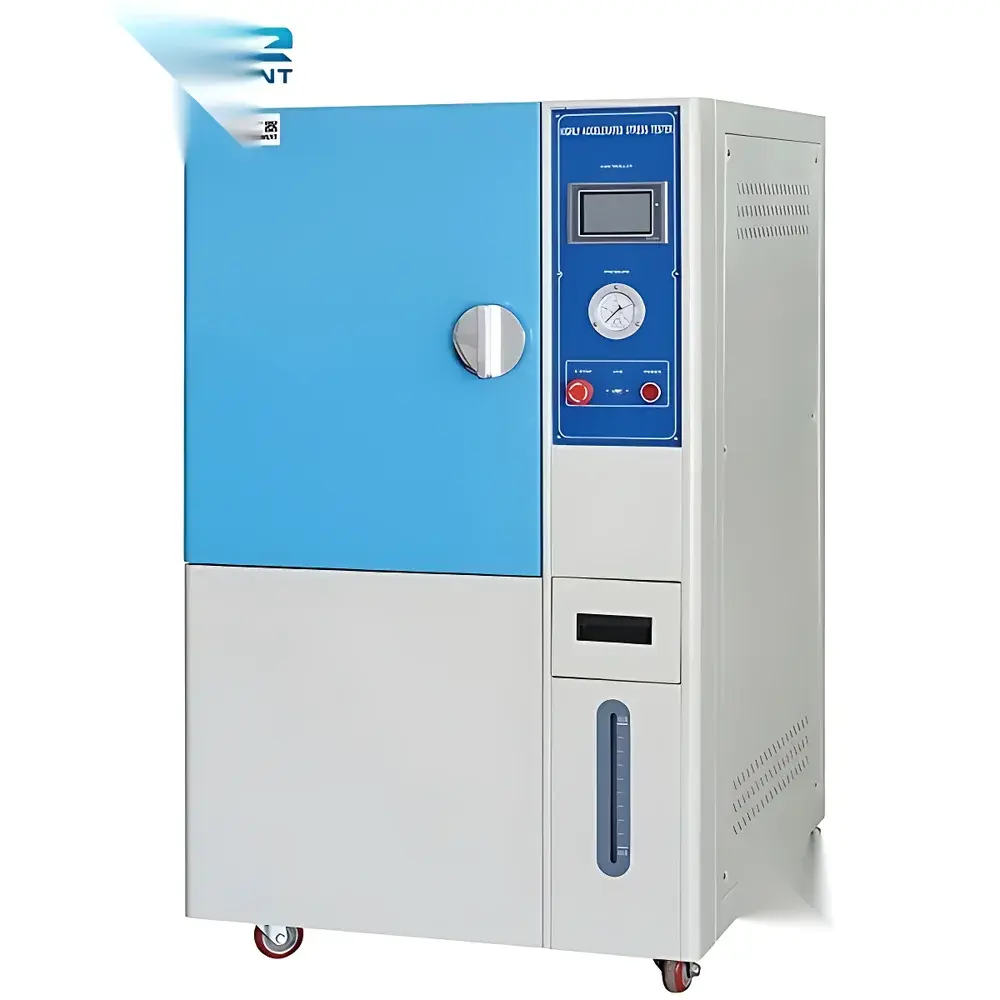
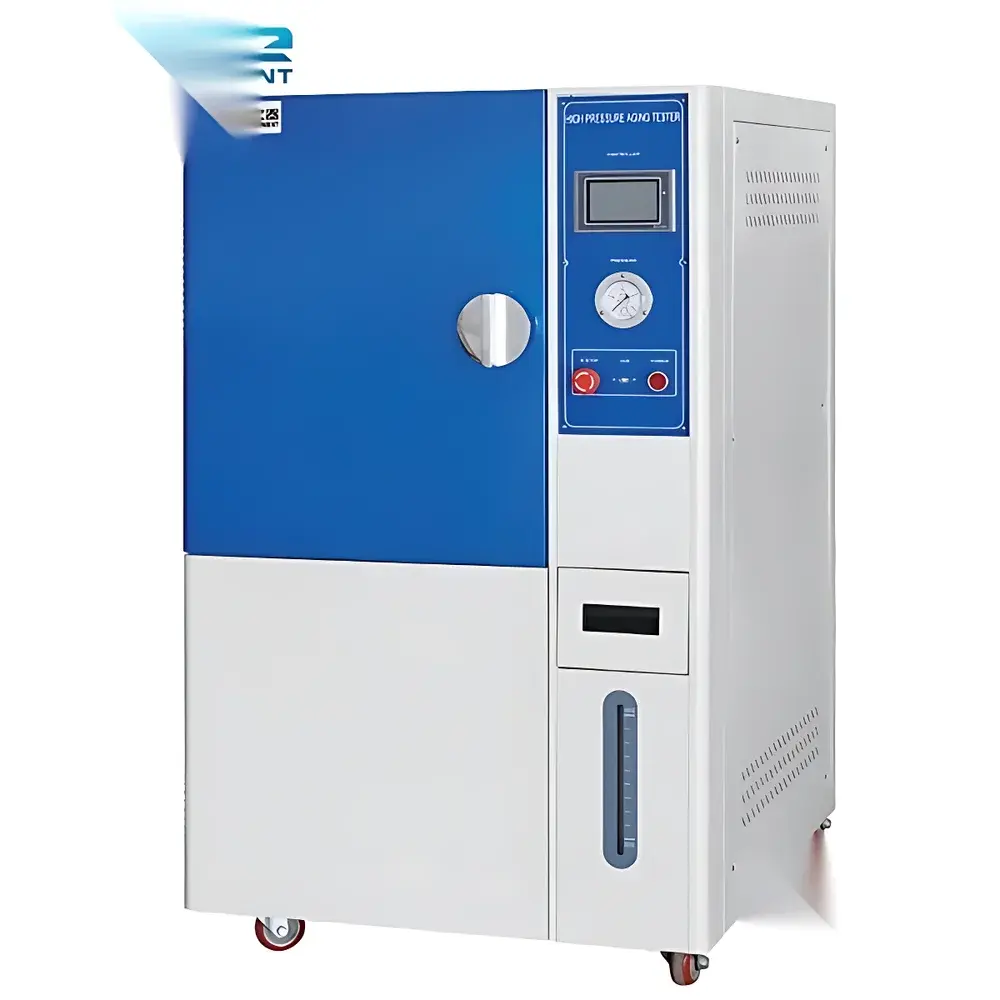
PCT High-Pressure Aging Test Chamber
| Brand | OEM |
|---|---|
| Origin | Imported |
| Manufacturer Type | Authorized Distributor |
| Price | USD 3,950 (FOB) |
| Temperature Range | 105–135 °C (up to 143 °C optional) |
| Humidity Range | 70–100 % RH |
| Pressure Range | 0.0–2.0 kg/cm² (gauge), relative to ambient atmospheric pressure |
| Internal Dimensions (Φ×H, mm) | Φ250×300 / Φ300×450 / Φ450×500 / Φ650×600 |
| External Dimensions (W×H×D, mm) | 500×500×700 / 580×850×650 / 800×750×900 / 950×900×1100 |
| Safety Systems | Low-water cutoff, overpressure relief, interlocked door safety switch, automatic venting |
| Power Supply | AC 220 V / 380 V, 50/60 Hz |
| Standard Accessories | Two stainless-steel adjustable shelves |
| Compliance | Designed per JEDEC JESD22-A108, JESD22-A110, and IEC 60068-2-66 test methodologies |
Overview
The PCT High-Pressure Aging Test Chamber is an engineered environmental stress test system designed for accelerated reliability assessment of electronic components and materials under high-temperature, high-humidity, and elevated-pressure conditions. Operating on the principle of saturated or near-saturated steam exposure—commonly referred to as Highly Accelerated Stress Test (HAST) or Pressure Cooker Test (PCT)—this chamber subjects devices to thermodynamic stress levels that significantly exceed standard 85 °C/85 % RH testing. By increasing both temperature and partial vapor pressure above ambient, the chamber accelerates moisture diffusion into encapsulants, die attach interfaces, and printed circuit board laminates, thereby revealing latent failures such as wire bond corrosion, delamination, popcorning, and solder joint degradation within hours rather than weeks. Its design adheres to industry-standard test protocols including JEDEC JESD22-A108 (Steady-State Moisture Resistance), JESD22-A110 (Unbiased HAST), and IEC 60068-2-66 (Test Td: Damp Heat, Forced Condensation, High Pressure), enabling direct correlation with field failure mechanisms in automotive, aerospace, medical electronics, and photovoltaic applications.
Key Features
- Automated water replenishment system with level sensing: maintains consistent steam saturation during extended test cycles without operator intervention.
- Digital LED temperature controller with ±0.5 °C accuracy and programmable ramp/soak profiles for precise thermal setpoint management.
- Start-delayed digital timer synchronized to chamber temperature stabilization—ensures elapsed time recording begins only after target temperature is reached and held for ≥5 minutes.
- Calibrated dual-scale pressure/temperature gauge displays real-time absolute pressure (kg/cm² gauge) and corresponding saturation temperature, supporting traceable process verification.
- Forced-convection steam circulation via integrated axial blower and optimized internal duct geometry—minimizes thermal stratification and ensures uniform humidity distribution across the test volume.
- One-piece molded silicone door gasket with compression-set resistance >10,000 hours at 135 °C, ensuring long-term sealing integrity and leak rate <1.0 × 10⁻⁵ mbar·L/s (He).
- Electropolished 316 stainless-steel interior chamber surface with Ra ≤ 0.4 µm finish—resists oxidation, facilitates cleaning, and prevents particulate shedding during high-humidity operation.
- Interlocked safety architecture: power remains disabled unless door latch is fully engaged and verified by redundant mechanical and magnetic sensors.
Sample Compatibility & Compliance
The chamber accommodates a wide range of sample configurations—including bare dies, packaged ICs (QFP, BGA, CSP), LED modules, PCB assemblies, magnetic components, and photovoltaic cell interconnects—within its four scalable internal volumes. All models meet structural requirements for Class II electrical safety (IEC 61010-1) and incorporate fail-safe protection layers: low-water cutoff prevents dry-heating of immersion heaters; pressure-relief valves rated to 2.5 kg/cm² burst pressure provide redundant overpressure mitigation; and automatic depressurization sequences initiate upon power loss or emergency stop activation. The system supports audit-ready validation documentation packages compliant with ISO/IEC 17025, GLP, and FDA 21 CFR Part 11 when paired with optional data logging hardware and electronic signature-enabled software.
Software & Data Management
While the base configuration features standalone analog/digital controls, optional Ethernet-enabled data acquisition modules support continuous logging of temperature, pressure, and runtime at 1-second intervals. Export formats include CSV and PDF reports with embedded calibration certificates, user-defined test IDs, and timestamped event markers (e.g., “start”, “stabilization achieved”, “test complete”). Firmware supports password-protected parameter locking to prevent unauthorized modification during qualification runs. For regulated environments, optional 21 CFR Part 11-compliant software adds electronic signatures, audit trails with immutable timestamps, and role-based access control—fully traceable to individual operators and QA reviewers.
Applications
- Qualification of moisture-sensitive devices (MSL) per IPC/JEDEC J-STD-020.
- Failure mode analysis of conformal-coated assemblies under cyclic pressure-humidity stress.
- Reliability screening of wafer-level packaging before burn-in and final test.
- Material compatibility testing of underfill epoxies, mold compounds, and flex substrate adhesives.
- Accelerated life testing of EV battery management system (BMS) PCBs exposed to under-hood thermal-humidity transients.
- Validation of hermetic seal integrity for MEMS sensors and optoelectronic housings.
FAQ
What distinguishes HAST from traditional 85/85 testing?
HAST replaces ambient-pressure humidification with pressurized saturated steam, raising the dew point and accelerating moisture ingress by up to 10× compared to 85 °C/85 % RH—enabling detection of interface weaknesses not revealed in standard damp heat tests.
Can the chamber operate at 143 °C?
Yes—models designated with “HT” suffix support 143 °C operation using upgraded heating elements, pressure-rated seals, and enhanced thermal insulation; however, maximum allowable pressure is reduced to 1.5 kg/cm² at this temperature to maintain safety margins.
Is third-party calibration certification available?
Factory calibration includes NIST-traceable verification of temperature and pressure sensors; full UKAS or DAkkS-accredited calibration reports are available as an add-on service with documented uncertainty budgets.
How is steam quality maintained during long-duration tests?
A dedicated condensate purge cycle activates every 30 minutes to remove non-condensable gases and subcooled droplets, preserving >95 % steam purity (dryness fraction) throughout the test envelope.
Does the system support remote monitoring?
Via optional RS-485 or Modbus TCP interface, users can integrate chamber status signals (door open/closed, alarm active, cycle running) into centralized MES or SCADA platforms for real-time line-level visibility.



