
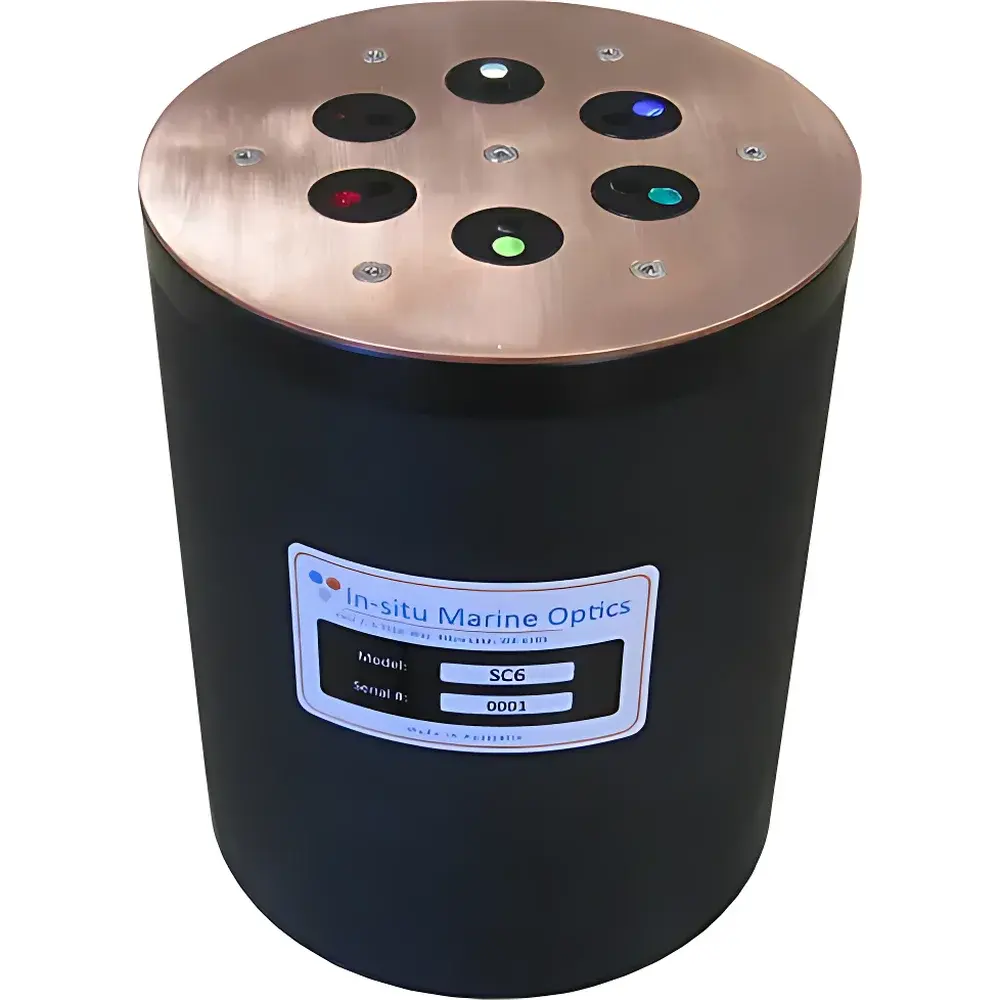
In-situ Marine SC6-LPT Backscatter Sensor
| Brand | In-situ Marine |
|---|---|
| Origin | Australia |
| Manufacturer Status | Authorized Distributor |
| Origin Category | Imported |
| Model | SC6-LPT |
| Pricing | Upon Request |
Overview
The In-situ Marine SC6-LPT is a high-precision, multi-wavelength optical backscatter sensor engineered for long-term, in situ monitoring of marine and freshwater optical properties. It operates on the principle of calibrated 120° off-axis backscattering measurement—distinct from nephelometric forward scattering—to quantify the volume scattering function at a defined angle critical for ocean color remote sensing validation and particulate matter characterization. The instrument integrates six independently controlled LED light sources with factory-configurable excitation/emission wavelengths, enabling simultaneous quantification of total particulate backscattering coefficient (Bb(λ)), chlorophyll-a (Chl-a) fluorescence, colored dissolved organic matter (CDOM) absorption proxies, and hydrocarbon presence via spectral discrimination. Its optical architecture employs non-yellowing, scratch-resistant fused silica windows and precision-machined acetal housing to ensure long-term radiometric stability under biofouling-prone conditions. Built-in pressure and temperature sensors, real-time clock, and tilt compensation provide essential environmental context for data correction and deployment metadata integrity.
Key Features
- Six independently tunable optical channels with user-selectable excitation/emission bands—optimized for Chl-a, CDOM, hydrocarbon, and broadband Bb retrieval
- Integrated pressure transducer (0–200 m depth rating) and high-stability thermistor for in situ thermal and hydrostatic compensation
- Onboard 16-bit ADC with 7 Hz nominal sampling rate (configurable), delivering >100 dB dynamic range and noise floor <5×10⁻⁴ m−1 (typ.)
- Dual-reference design: synchronous LED reference photodiode per channel eliminates source drift and thermal gain variation
- Embedded real-time clock (RTC) and 3-axis tilt sensor for time-synchronized, orientation-aware deployments
- 16 GB microSD card with FAT32 formatting supports >12 months of continuous logging at 1 Hz (default configuration)
- RS-232 serial interface with configurable baud rates (up to 115.2 kbps); optional Wi-Fi module enables post-deployment data download without physical recovery
- Wide-input power range (7–24 VDC); ultra-low quiescent current during sleep mode (<10 µA)
Sample Compatibility & Compliance
The SC6-LPT is designed for direct immersion in natural aquatic environments—including estuaries, coastal zones, lakes, and rivers—without external housings. Its acetal (polyoxymethylene) body, copper grounding panel, and fused quartz optical windows meet ASTM D638 tensile strength and ISO 10993 biocompatibility benchmarks for prolonged seawater exposure. The 200 m depth rating complies with IEC 60529 IP68 specifications. Data output protocols adhere to Sea-Bird Electronics’ SBE/SeaBird ASCII format conventions, ensuring interoperability with standard oceanographic data acquisition systems (e.g., CTDs, moorings, AUVs). All firmware and data logging routines support GLP-compliant timestamping, checksummed packet transmission, and audit-ready metadata embedding—including sensor calibration coefficients, deployment ID, and environmental context tags.
Software & Data Management
The SC6-LPT interfaces natively with In-situ Marine’s open-source SC-Link software suite (Windows/macOS/Linux), which provides real-time telemetry visualization, firmware updates, and batch calibration file management. Raw binary logs are converted to NetCDF-4 format compliant with CF-1.8 metadata conventions, enabling seamless ingestion into Ocean Data View (ODV), MATLAB, Python (xarray/netCDF4), or ERDDAP servers. Internal data storage includes full traceability: each recorded value carries embedded UTC timestamp (±10 ms), pressure-corrected temperature, tilt vector, battery voltage, and channel-specific dark-offset and gain coefficients. Optional firmware upgrade enables 21 CFR Part 11–compliant electronic signatures and audit trails for regulated water quality applications.
Applications
- Validation of satellite-derived ocean color products (e.g., NASA OC-CCI, ESA OLCI) through in situ Bb(λ) profiling
- Long-term turbidity and suspended sediment concentration (SSC) trend analysis in reservoirs and estuarine systems
- Phytoplankton bloom dynamics tracking via high-temporal-resolution Chl-a fluorescence time series
- CDOM spectral slope (S275–295) estimation for watershed land-use impact studies
- Hydrocarbon detection and differentiation in port monitoring and spill response scenarios
- Integration into autonomous platforms (gliders, profilers, moored buoys) requiring low-power, high-reliability optical sensing
FAQ
What is the angular definition of “backscatter” in the SC6-LPT? Why 120°?
The SC6-LPT measures scattered radiance at precisely 120° relative to the incident beam axis—a geometry optimized to minimize Fresnel reflection artifacts while maintaining strong sensitivity to particle size distributions relevant to oceanic optics (Mie regime dominance for 0.5–10 µm particles). This differs from traditional 180° backscatter and aligns with NASA’s recommended geometry for vicarious calibration of spaceborne ocean color sensors.
Can the Bb(λ) calibration be extended beyond 1 m−1?
Yes—factory recalibration options support extended ranges up to 10 m−1, with corresponding adjustments to internal gain staging and dark-current compensation algorithms. Extended-range units include NIST-traceable calibration certificates.
Is the internal lithium battery certified for air transport?
The 11.1 V, 5.2 Ah Li-ion pack complies with IATA Packing Instruction 965 Section II and UN 3480 requirements for cargo aircraft transport; full safety documentation is supplied with each unit.
How is ambient light interference suppressed?
Each optical channel employs frequency-modulated LED drive signals with unique carrier frequencies; the synchronous detector rejects out-of-band irradiance—including solar glint and bioluminescence—via narrowband demodulation, achieving >60 dB ambient rejection without mechanical shutters.
Does the SC6-LPT support external triggering or synchronization?
Yes—TTL-compatible trigger input allows hardware-synchronized sampling with co-located CTDs, fluorometers, or acoustic Doppler profilers, enabling multi-sensor event capture with sub-millisecond alignment.







