
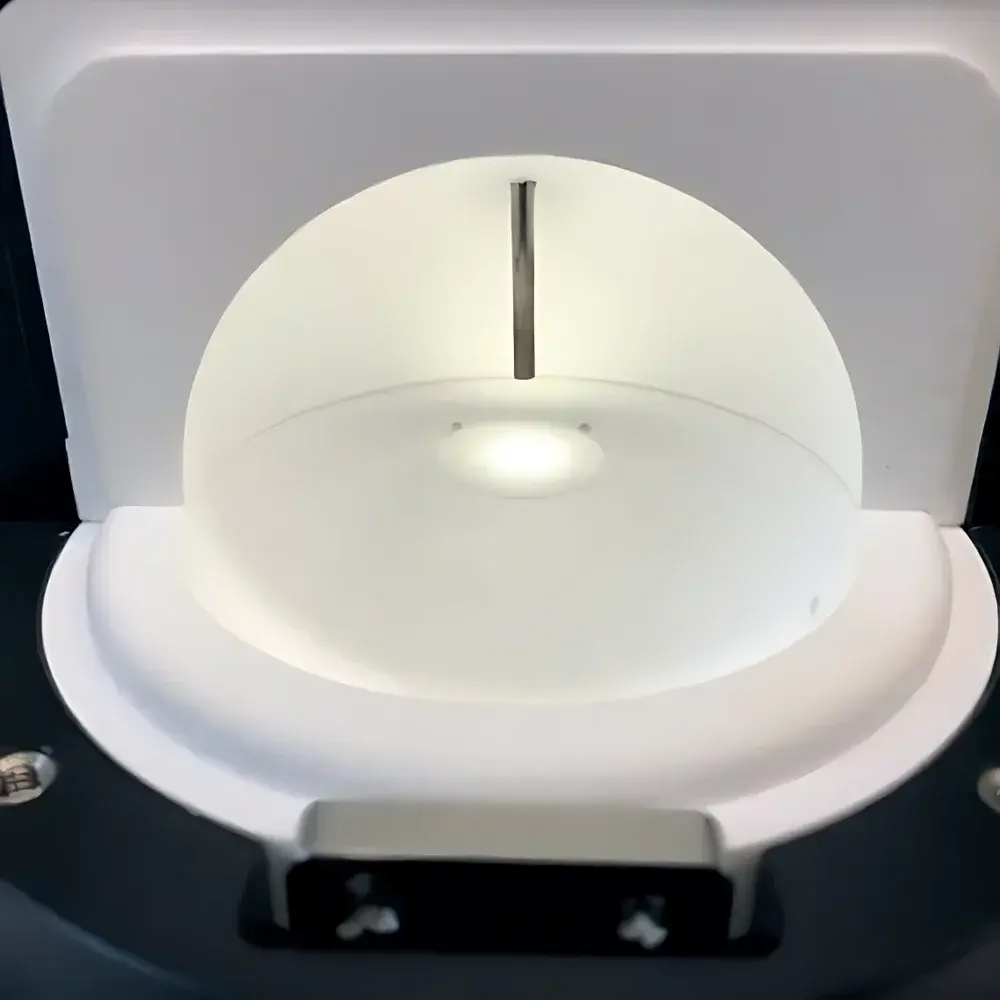
Sunstone QFT-ICAM Quantitative Filter Technique Integrating Cavity Absorption Meter
| Brand | Sunstone |
|---|---|
| Origin | USA |
| Manufacturer Type | Authorized Distributor |
| Origin Category | Imported |
| Model | QFT-ICAM |
| Pricing | Available Upon Request |
Overview
The Sunstone QFT-ICAM Quantitative Filter Technique Integrating Cavity Absorption Meter is an optically engineered instrument designed for high-fidelity, in situ or laboratory-based measurement of spectral absorption by particulate matter collected on filters—particularly phytoplankton, detritus, and colored dissolved organic matter (CDOM) in aquatic systems. Unlike conventional transmission spectrophotometers, the QFT-ICAM implements a rigorously validated integrating cavity architecture based on the quantitative filter technique (QFT), originally developed by Dr. Rüdiger Röttgers at Helmholtz-Zentrum Geesthacht (Germany). Its core principle relies on diffuse reflectance and multiple internal reflections within a high-albedo PTFE-coated spherical cavity (8 cm internal diameter), enabling near-ideal Lambertian integration of all non-absorbed light. This eliminates angular dependence, minimizes scattering artifacts, and delivers absorption coefficients with traceable uncertainty—critical for ocean color validation, biogeochemical modeling, and satellite algorithm development.
Key Features
- Integrating cavity design with >99% diffuse reflectance PTFE interior surface ensures uniform illumination and high signal-to-noise ratio across 350–800 nm
- Compact, field-deployable form factor (16 × 16 cm footprint, 2.5 kg mass) optimized for shipboard, dockside, or remote lab use
- Integrated 150 W halogen source with 12-position motorized filter wheel, supporting dark-current correction and selective excitation for chlorophyll-a fluorescence detection (660–750 nm)
- High-resolution spectrometer (Avantes SpecSence 2048XL-ULS) with 300–850 nm spectral range, 2.3 nm optical resolution, and 100 µm entrance slit
- Optical path defined by custom quartz fiber optics (600 µm core), with detector oriented at ~90° to incident beam to exclude direct transmission—only collecting multiply scattered or cavity-reflected photons
- Filter mounting system using tensioned nylon threads enables precise positioning of 25 mm or 47 mm diameter filters at the cavity center, accommodating both standard GF/F and polycarbonate membranes
Sample Compatibility & Compliance
The QFT-ICAM is compatible with filtration media commonly used in marine and freshwater biogeochemistry, including glass fiber (GF/F, GF/C), polycarbonate, and silver membrane filters. It supports quantitative absorption measurements of particulate absorption spectra (aph(λ)), non-algal particle absorption (aNAP(λ)), and CDOM absorption when coupled with appropriate blank subtraction protocols. The instrument adheres to established best practices outlined in IOCCG Protocols (2019) and follows ASTM D5885-18 guidelines for spectral absorption measurement of suspended particulates. Its optical configuration satisfies requirements for GLP-compliant data acquisition when paired with timestamped metadata logging and instrument calibration certificates traceable to NIST SRM 2036.
Software & Data Management
Data acquisition is managed via Sunstone’s ICAM Control Suite—a cross-platform application supporting real-time spectral preview, automated filter wheel sequencing, dark/blank/sample cycling, and OD-to-absorption coefficient conversion using cavity-specific geometric factors. All raw spectra are saved in HDF5 format with embedded metadata (filter type, filtration volume, date/time, operator ID, cavity temperature). The software enforces audit-trail functionality compliant with FDA 21 CFR Part 11 when configured with user authentication and electronic signature modules. Export options include CSV, ASCII, and NetCDF-4 for interoperability with Ocean Optics’ OOILib, NASA’s SeaDAS, or MATLAB-based inversion workflows.
Applications
- Validation of ocean color satellite products (e.g., MODIS, VIIRS, Sentinel-3 OLCI) through match-up analysis of in situ particulate absorption
- Time-series studies of phytoplankton community composition via spectral shape analysis of aph(λ) and derivative indices (e.g., spectral slope Sd, peak ratio aph(440)/aph(675))
- Quantification of light attenuation budgets in turbid estuaries and coastal zones under climate-driven sediment loading scenarios
- Method development for standardized QFT protocols in international intercomparisons (e.g., AERONET-OC, Bio-Argo)
- Calibration and verification of hyperspectral underwater radiometers and ac-9 instruments
FAQ
What filter types are recommended for optimal performance?
Standard GF/F (Whatman) and 0.4 µm polycarbonate filters are validated for use; pore size and thickness must be documented for accurate pathlength correction.
Does the QFT-ICAM require external calibration standards?
Yes—NIST-traceable neutral density filters and calibrated reflectance standards (e.g., Labsphere Spectralon) are required annually for photometric and wavelength calibration.
Can the instrument measure absorption in highly scattering suspensions?
No—the QFT-ICAM measures only filter-collected particles; it does not support in-line flow-through or cuvette-based liquid-phase measurements.
Is fluorescence correction applied automatically during acquisition?
Yes—the integrated low-pass filter (650FL07-25) enables dual-channel acquisition: one for total absorption and another for chlorophyll-a fluorescence contribution, which is subtracted post-acquisition using published quantum yield models.
What environmental conditions limit field operation?
Operating temperature range is 5–40 °C; relative humidity must remain below 80% non-condensing; direct solar exposure on the cavity port must be avoided during deployment.
Related Products







