
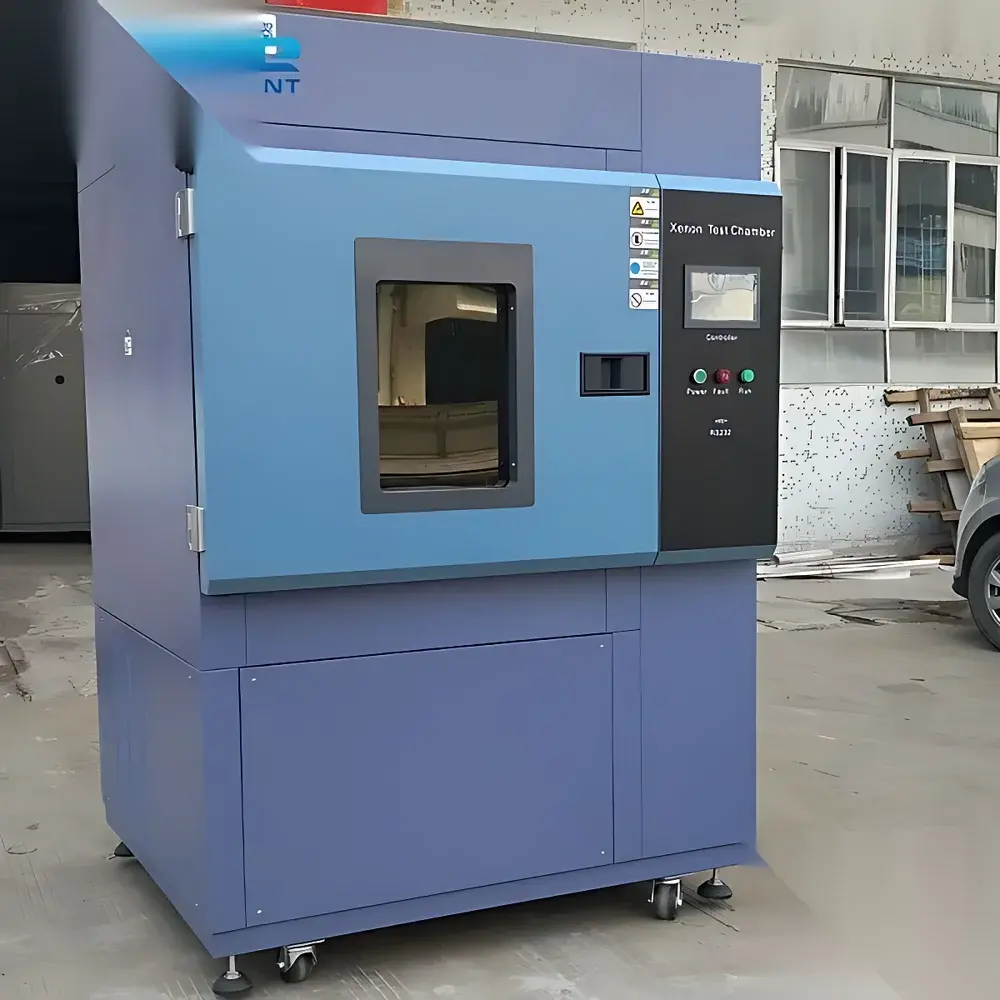
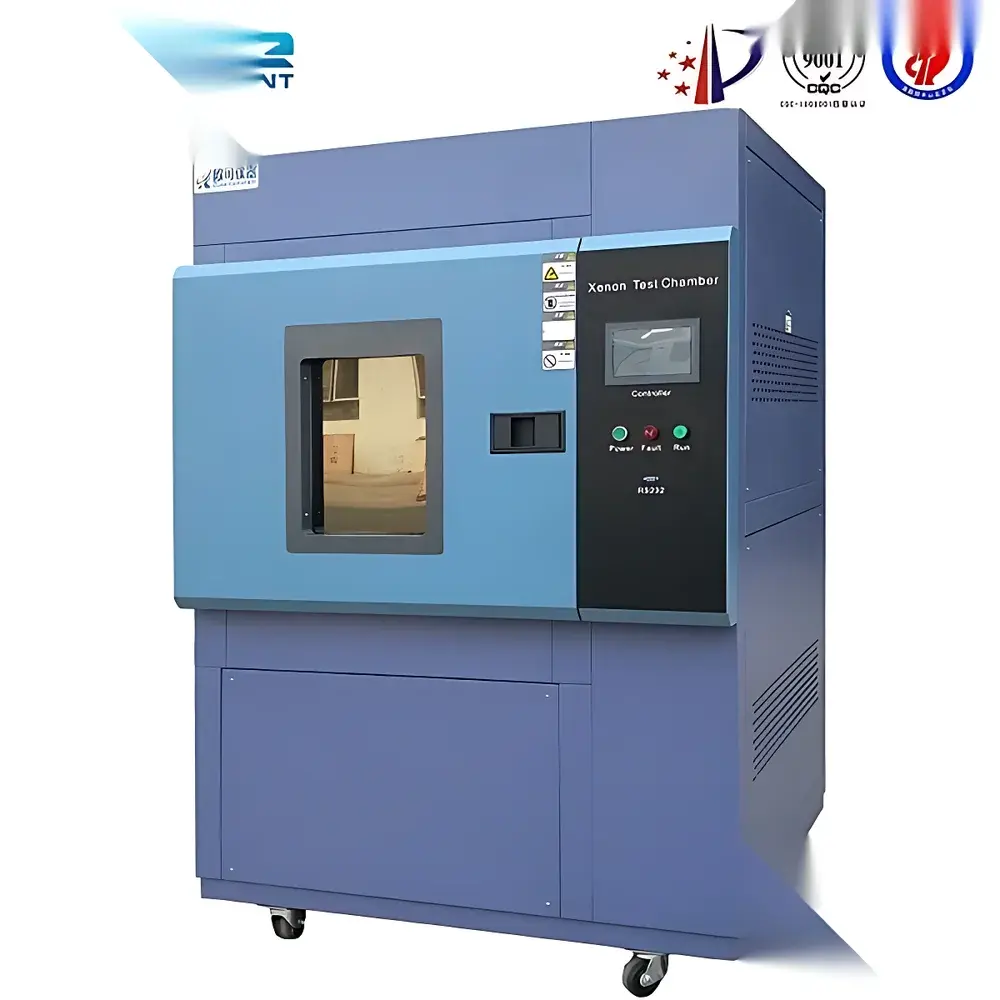
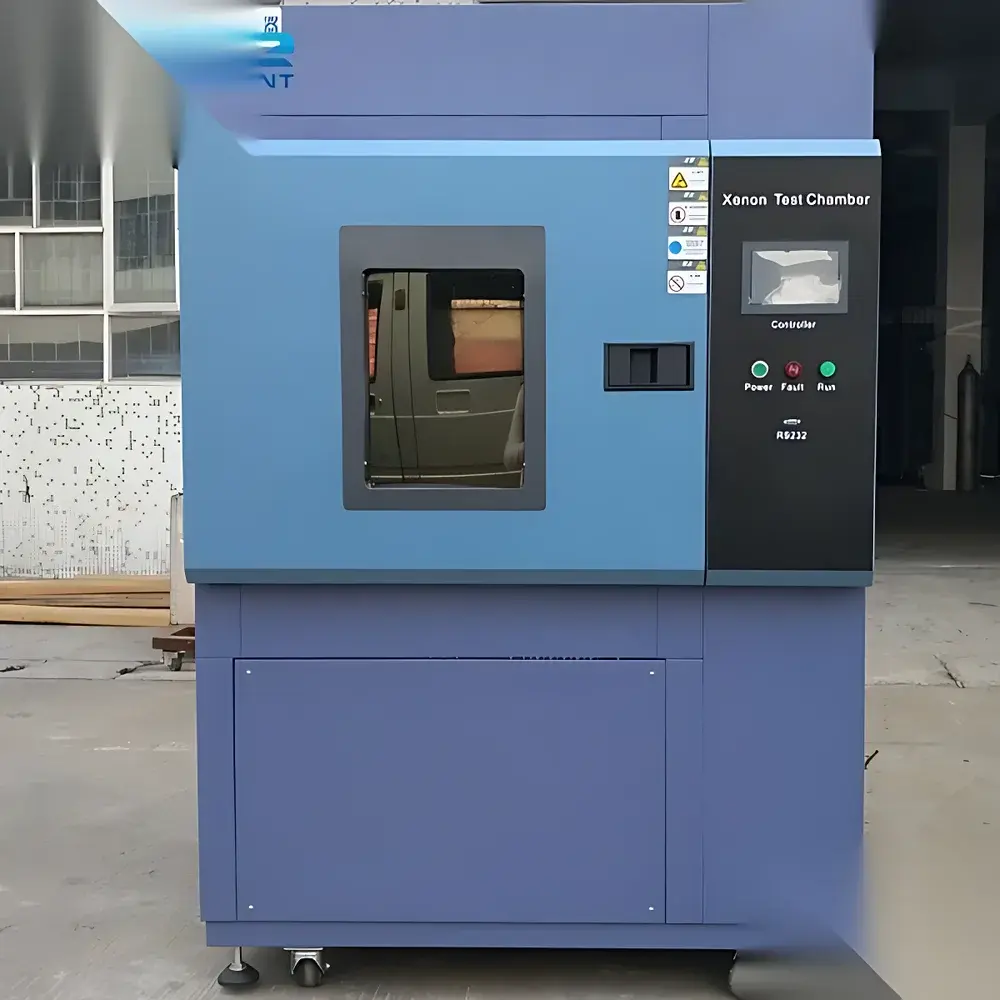
Xenon Arc Weathering Test Chamber OK-XD Series
| Brand | Other Brands |
|---|---|
| Origin | Imported |
| Manufacturer Type | General Distributor |
| Price | USD 5,300 (Reference Only) |
| Chamber Models | OK-XD-100 / OK-XD-225 / OK-XD-500 / OK-XD-1000 |
| Internal Dimensions (W×D×H, cm) | 50×50×40 / 50×75×60 / 80×80×80 / 100×100×100 |
| Temperature Range | 0–150°C (Chamber), 40–85°C (Black Panel) |
| Humidity Range | 20–75% RH (Light Cycle), 20–98% RH (Dark Cycle) |
| Control Accuracy | ±0.5°C / ±2.0% RH |
| Uniformity | ±2.0°C / ±3.0% RH |
| Spectral Range | 300–800 nm (550 W/m² ±10%) and 300–1200 nm (1000 W/m² ±10%) |
| Xenon Lamp Power | 1.8 kW / 2.5 kW / 6 kW |
| Lamp Life | ~1,500 h |
| Spray Duration | 1–999 min (intermittent or continuous) |
| Spray Pressure | 70–127 kPa |
| Sample Mounting | Dual-layer flat mesh rack or 500 mm diameter rotating turntable (0–3 rpm) |
| Construction | Interior – SUS304 stainless steel |
| Power Supply | AC 380 V ±5%, 50 Hz ±0.5 Hz |
Overview
The OK-XD Series Xenon Arc Weathering Test Chamber is an engineered environmental simulation system designed to replicate the full spectrum of solar radiation—including UV, visible, and near-infrared wavelengths—alongside controlled temperature, humidity, and moisture exposure. Based on the principle of xenon arc irradiation, it employs long-arc, air-cooled xenon lamps filtered to closely match natural sunlight (CIE 85:1989, ISO 4892-2), enabling accelerated evaluation of photodegradation, color fading, chalking, cracking, and gloss loss in materials exposed to outdoor conditions. Unlike UV fluorescent lamp testers, xenon arc systems provide broad-spectrum fidelity critical for assessing real-world weathering behavior across polymers, coatings, textiles, automotive trim, and architectural finishes.
Key Features
- Full-spectrum xenon arc light source with precision optical filtering to maintain spectral power distribution (SPD) compliance with ISO 4892-2 and ASTM G155 requirements;
- Integrated water spray system with adjustable pressure (70–127 kPa) and programmable duration (1–999 min), supporting both intermittent and continuous wetting cycles;
- Dual-mode humidity control: independent regulation during light and dark phases (20–75% RH in irradiation; 20–98% RH in condensation/dark periods);
- Black panel thermometer (BPT) and chamber air temperature monitoring with ±0.5°C control accuracy and ±2.0°C uniformity across test volume;
- Flexible sample mounting options: standard dual-layer flat mesh racks or motorized 500 mm diameter turntables (0–3 rpm) for uniform irradiance distribution;
- Modular lamp assembly with quick-release design—lamp replacement requires no recalibration and can be completed in under 15 minutes;
- SUS304 stainless steel interior construction ensures corrosion resistance and long-term stability under cyclic thermal, humid, and aqueous conditions;
- Comprehensive safety architecture including overtemperature cutoff, lamp arc-failure detection, door interlock, and emergency stop circuitry.
Sample Compatibility & Compliance
The OK-XD series accommodates diverse specimen geometries—from flat textile swatches and painted panels to irregular automotive components—via customizable fixture interfaces. Its modular chamber configurations (OK-XD-100 to OK-XD-1000) support internal volumes from 100 L to 1000 L, permitting validation of large-format composites or multi-sample batches per test cycle. The system complies with internationally recognized weathering standards including ISO 4892-2 (xenon arc methods), ASTM D529 (plastics), GB/T 16422.2 (China), GB/T 8427 (textile colorfastness), and GB/T 14576 (lightfastness of dyes). All operational parameters—including irradiance, temperature, humidity, and spray timing—are logged with timestamped records suitable for GLP-compliant laboratories and FDA 21 CFR Part 11–aligned data integrity workflows when paired with optional audit-trail software modules.
Software & Data Management
Equipped with a 7-inch industrial-grade touchscreen controller, the OK-XD platform supports up to 100 programmable test profiles with nested cycles (light/dark, spray/no-spray, ramp/soak). Real-time graphs display irradiance (W/m²), black panel temperature, chamber humidity, and spray status. Data export is available via USB 2.0 in CSV format for traceability and post-test analysis. Optional PC-based software provides extended logging (≥30-day buffer), remote monitoring via Ethernet, alarm notification via email/SMS, and automated report generation aligned with ISO/IEC 17025 documentation requirements. All firmware updates are delivered via signed binary packages to ensure cryptographic integrity and version control.
Applications
- Evaluation of colorfastness and photostability in dyed textiles, leather, and nonwovens per ISO 105-B02 and AATCC TM16;
- Accelerated aging of automotive exterior plastics, seals, and headlamp lenses under SAE J2527 and ISO 20695 protocols;
- UV resistance testing of architectural coatings, roofing membranes, and PVC window profiles per ASTM D4329 and EN 1062-6;
- Validation of photostabilizer efficacy in polymer formulations (PP, PE, ABS, PC) under controlled radiant exposure;
- Correlation studies between laboratory xenon exposure and real-world field performance using reciprocal irradiance dosimetry (J/m²);
- Support for R&D quality gates in electronics enclosures, signage materials, and outdoor furniture OEM supply chains.
FAQ
What spectral filters are used to meet ISO 4892-2 daylight requirements?
The system integrates borosilicate inner and outer filters (typically Daylight-Q/B or equivalent) to deliver a spectral match within ±10% of CIE Standard Illuminant D65 across 300–800 nm.
Can the chamber operate without water spray for dry-heat-only cycles?
Yes—spray function is fully programmable and may be disabled independently in any phase of the test sequence.
Is calibration traceable to NIST or other national metrology institutes?
Radiometric calibration of irradiance sensors is performed using traceable reference cells; full-system verification reports are provided with each unit shipment.
How is uniformity of irradiance verified across the sample plane?
Uniformity is validated per ISO 4892-2 Annex B using a calibrated scanning radiometer at nine defined grid points prior to factory shipment.
Does the controller support user-defined irradiance setpoints outside default ranges?
Yes—advanced mode allows manual input of target irradiance values between 300–1200 nm, subject to lamp power and filter configuration constraints.



