
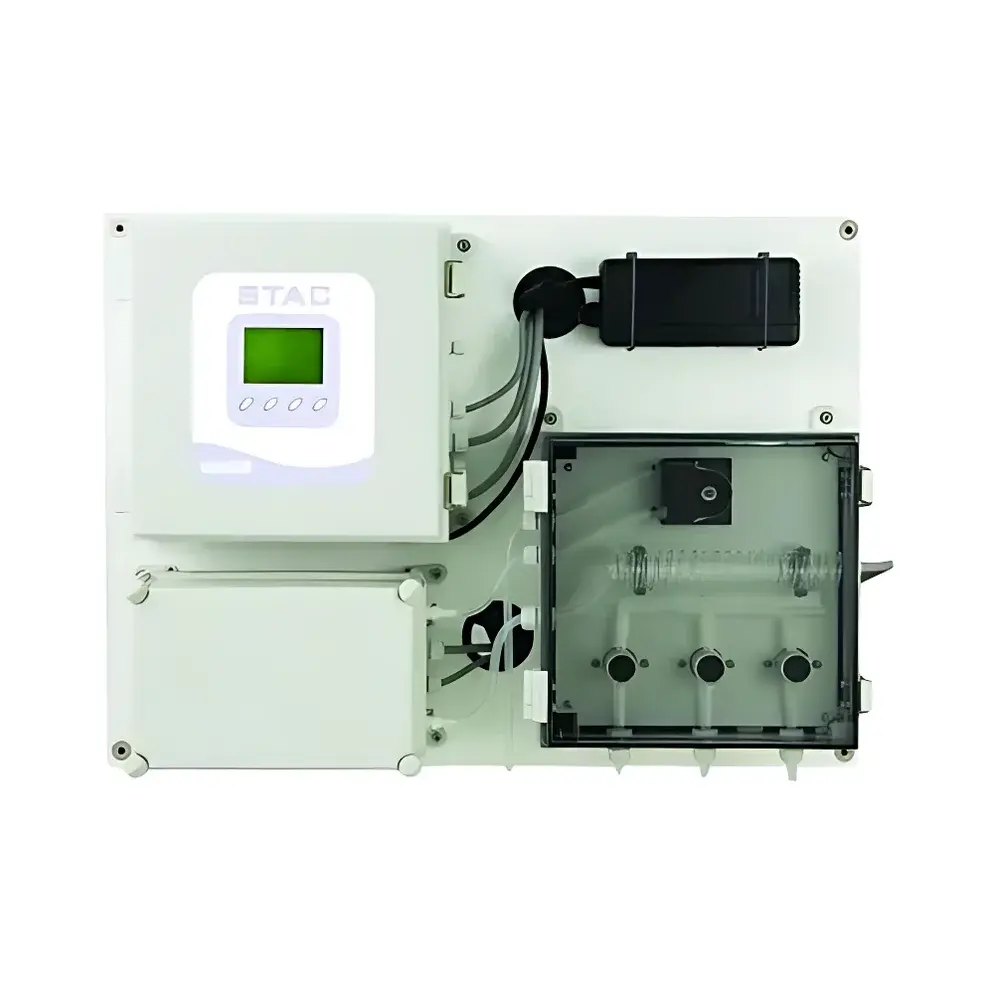
AQUALABO STAC Online Water Quality Early-Warning System
| Brand | AQUALABO |
|---|---|
| Origin | France |
| Manufacturer Type | Authorized Distributor |
| Origin Category | Imported |
| Model | STAC Online Water Quality Early-Warning System |
| Pricing | Available Upon Request |
Overview
The AQUALABO STAC Online Water Quality Early-Warning System is an advanced, non-invasive ultraviolet (UV) absorption spectroscopy-based monitoring platform engineered for continuous, real-time assessment of surface water, drinking water sources, and wastewater influents. Unlike conventional wet-chemistry analyzers, STAC operates on the principle of multi-wavelength UV spectral fingerprinting—leveraging characteristic absorption bands in the far-UV range (204–323 nm) to simultaneously detect and differentiate organic contaminants, suspended solids, nitrate, and structurally diverse micropollutants—including priority pesticides and aromatic compounds. Its physics-based measurement architecture eliminates reagents, electrodes, or membrane-based sensors, ensuring long-term stability, minimal drift, and immunity to biofouling under variable field conditions. Designed for deployment at critical watershed entry points, intake stations, or protected zone perimeters, STAC delivers actionable early-warning intelligence—not just compliance-grade concentration values—but qualitative identification of contamination events within <5 minutes of sample introduction.
Key Features
- UV diode array spectrophotometer with high-stability deuterium pulsed lamp (204–323 nm), enabling high signal-to-noise ratio spectral acquisition
- Optical path using 50 mm quartz flow cell with integrated auto-cleaning and recirculating rinse loop
- Reagent-free, maintenance-light operation: no consumables, no calibration standards required for baseline spectral referencing
- True dual-mode capability: quantitative estimation of COD (5–30 mg/L), BOD (2–20 mg/L), TOC (5–30 mg/L), TSS (5–100 mg/L), and NO₃⁻ (1–20 mg/L), plus qualitative classification of 12+ pesticide classes and aromatic hydrocarbons
- Electrical isolation between hydraulic and electronic modules—compliant with IEC 61000-6-2/6-4 for industrial environments
- Programmable sampling interval (5–30 min), with pinch-valve-driven 8 mm fluid handling to preserve particulate integrity for accurate TSS quantification
- Native support for 4–20 mA analog output, RS-232 serial interface, and Modbus RTU protocol for integration into SCADA, DCS, or PLC-based infrastructure
Sample Compatibility & Compliance
STAC accepts raw, unfiltered water samples—including turbid river water, reservoir inflows, and pre-treated effluents—with no pretreatment or filtration required. Its optical design accommodates suspended solids up to 100 mg/L without signal saturation or scattering artifacts. The system meets EN ISO/IEC 17025 requirements for method validation in environmental laboratories and supports audit-ready data logging aligned with GLP principles. While not a certified reference method per ASTM D1252 (COD) or ISO 8245 (TOC), STAC’s spectral correlation models are validated against accredited laboratory results across >200 site-specific calibration datasets—enabling traceable surrogate monitoring under EU Water Framework Directive (WFD) Article 7 reporting frameworks and national early-warning protocols (e.g., French ONEMA guidelines).
Software & Data Management
UV Pro software provides full spectral archive management, time-series visualization, event-triggered alerting (email/SMS via SMTP gateway), and spectral library expansion tools. All raw absorbance spectra (0.5 nm resolution), processed parameter estimates, and metadata (timestamp, temperature, flow status) are stored in encrypted SQLite databases compliant with GDPR retention policies. Audit trails record user actions, configuration changes, and firmware updates—supporting FDA 21 CFR Part 11 readiness when deployed in regulated utilities or pharmaceutical water supply networks. Remote diagnostics and over-the-air firmware updates are accessible via secure HTTPS tunnel.
Applications
- Early detection of accidental or illicit discharges upstream of drinking water intakes
- Monitoring agricultural runoff events containing atrazine, diuron, paraquat, or simazine
- Tracking seasonal organic load variations in karst aquifers and low-flow rivers
- Supporting dynamic risk assessment in UNESCO biosphere reserves and Natura 2000 sites
- Providing complementary spectral context to traditional online analyzers (e.g., ion-selective nitrate probes or turbidimeters)
- Enabling adaptive sampling strategies in automated water quality surveillance networks
FAQ
Does STAC require daily calibration or standard solutions?
No. STAC relies on spectral pattern recognition rather than endpoint absorbance calibration; it uses factory-characterized lamp and detector response curves, updated only during firmware revisions.
Can STAC distinguish between biodegradable and recalcitrant organic matter?
Yes—through multivariate analysis of spectral shape features (e.g., peak ratios at 220 nm vs. 254 nm), STAC classifies organic fractions consistent with BOD/COD ratio trends observed in parallel lab testing.
Is remote firmware update supported?
Yes, via authenticated HTTPS connection through UV Pro software or optional LTE gateway module.
What is the minimum detectable concentration for atrazine?
Based on field validation studies, the practical limit of detection is ~0.5 µg/L under typical ambient water matrix conditions.
How does STAC handle high-turbidity samples (>50 NTU)?
The 8 mm pinch-valve sampling path and 50 mm flow cell minimize particle settling; spectral deconvolution algorithms correct for Mie scattering contributions without requiring physical filtration.







