
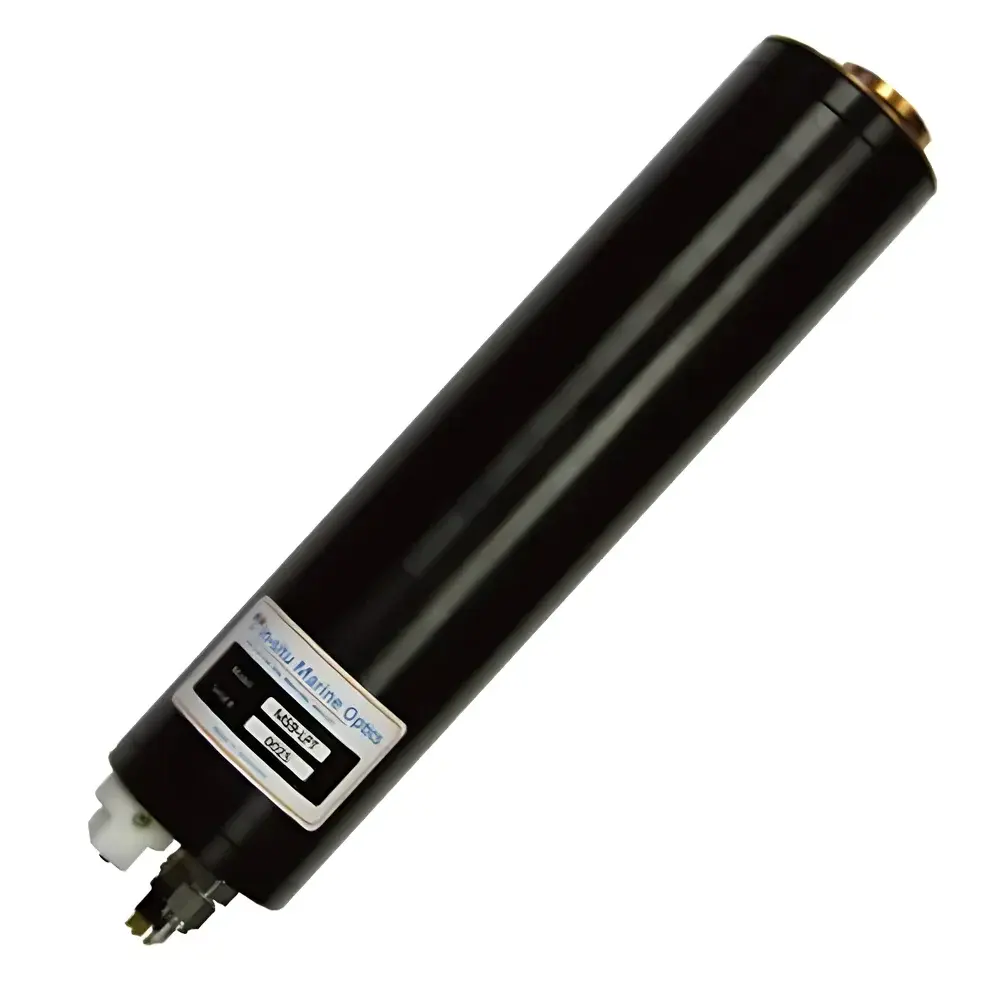
In-situ Marine MS9-LPT Self-Contained Multispectral Radiometer
| Brand | In-situ Marine |
|---|---|
| Origin | Australia |
| Manufacturer Status | Authorized Distributor |
| Origin Category | Imported |
| Model | MS9-LPT |
| Pricing | Upon Request |
| Detector | 9 silicon photodiodes |
| Wavelengths | 410, 440, 490, 510, 550, 610, 660, 685, 710 nm (factory-customizable) |
| Spectral Bandwidth (FWHM) | 10 nm |
| Cosine Response Error | < 3% (0–60° incidence) |
| Radiance Field of View | 5° (in air) |
| Calibration | NIST-traceable radiometric calibration |
| Measurement Range | 0–400 μW·cm⁻²·nm⁻¹ (factory-customizable) |
| Noise-Equivalent Irradiance (NEI) | 2.5×10⁻³ μW·cm⁻²·nm⁻¹ |
| ADC Resolution | 24-bit per channel (9 independent channels) |
| Max Sampling Rate | 5 Hz (user-configurable) |
| Interface | RS-232 (baud rate configurable) |
| Data Transfer | Wi-Fi download support |
| Operating Voltage | 7–24 VDC |
| Current Draw | 40 mA (sampling), 250 mA (cleaning), 60 μA (sleep mode) |
| Connector | Micro WET-CON MCBH6M |
| Internal Battery | Rechargeable 11.1 V, 5.2 Ah Li-ion |
| Dimensions | 285 mm length (including 36 mm connector), 67 mm diameter |
| Mass | 1.4 kg (air), 0.3 kg (buoyant in seawater) |
| Housing Material | Acetal body, PTFE or quartz diffuser, copper cleaning panel/brush |
| Operating Temperature | 0–40 °C |
| Maximum Deployment Depth | 300 m |
Overview
The In-situ Marine MS9-LPT is a self-contained, submersible multispectral radiometer engineered for high-fidelity, long-term optical monitoring in marine and freshwater environments. It operates on the principle of spectral irradiance and radiance quantification using an array of nine discrete, thermally stabilized silicon photodiodes—each optically filtered to a specific narrowband wavelength (410–710 nm). Unlike externally powered or cabled systems, the MS9-LPT integrates all critical subsystems—including pressure and temperature sensing, real-time clock (RTC), tilt detection, non-volatile memory, and a rechargeable lithium-ion battery—within a single, compact, pressure-rated housing. Its measurement architecture adheres to established radiometric conventions defined by ISO 17123-6 and ASTM E275 for optical sensor performance, ensuring traceability to NIST standards through factory-applied, wavelength-specific responsivity coefficients stored onboard. Designed explicitly for autonomous deployment, it delivers calibrated spectral data without requiring surface telemetry during operation—making it suitable for moored arrays, profiling floats, benthic landers, and AUV-integrated payloads.
Key Features
- Integrated environmental sensing: Co-located pressure and temperature sensors enable real-time correction of spectral responsivity drift and hydrostatic depth referencing.
- Active biofouling mitigation: Patented copper-brush cleaning mechanism combined with a copper-panel substrate provides continuous, low-energy antifouling action—validated under ISO 19966-1 for marine sensor durability.
- Ultra-low-power architecture: Sleep-mode current draw of only 60 µA extends deployment duration up to 12 months (typical, depending on sampling interval and cleaning frequency).
- Onboard calibration persistence: Factory-derived NIST-traceable calibration coefficients are permanently stored in non-volatile memory and applied in real time during data acquisition.
- High-resolution spectral digitization: Nine independent 24-bit analog-to-digital converters eliminate inter-channel crosstalk and ensure dynamic range >110 dB per band.
- Flexible configuration and retrieval: User-programmable sampling schedules via RS-232; post-deployment data extraction via Wi-Fi or microSD card (up to 16 GB).
Sample Compatibility & Compliance
The MS9-LPT is optimized for in situ optical measurements in natural aquatic media—including coastal seawater, estuarine brackish water, oligotrophic lakes, and coral reef lagoons. Its cosine-corrected irradiance head meets IEC 60879 and ISO 9060:2018 Class A specifications for angular response (error <3% up to 60°), while its 5° radiance field-of-view complies with protocols for phytoplankton absorption and remote-sensing reflectance validation (e.g., NASA SeaBASS, IOCCG Protocols). The acetal housing and PTFE/quartz optical diffusers resist UV degradation and chloride corrosion per ASTM G154 and ISO 12944-6. All firmware and data logging routines conform to GLP-aligned metadata tagging requirements—including timestamp (RTC-synchronized), tilt angle, pressure-derived depth, and battery voltage—with optional audit-trail logging for regulated environmental monitoring programs.
Software & Data Management
Instrument configuration, calibration management, and data export are supported through In-situ Marine’s cross-platform desktop application (Windows/macOS/Linux), which implements secure parameter encryption and version-controlled firmware updates. Raw binary files follow a documented, open binary format with embedded header metadata (IEEE 754 floating-point timestamps, sensor IDs, and calibration matrix indices). Export options include CF-compliant NetCDF4 (with CF-1.8 attributes), CSV (time-series aligned), and MATLAB .mat structures. For integration into larger observatory networks, the device supports Modbus RTU over RS-232 and can be interfaced with Teledyne RDI, WHOI Mooring OS, or OOI Node Control Systems via custom protocol adapters. All data files include SHA-256 checksums for integrity verification and support automated ingestion into ERDDAP or THREDDS catalog services.
Applications
- Long-term PAR (Photosynthetically Active Radiation) and spectral scalar irradiance profiling for primary productivity modeling.
- Validation of ocean color satellite products (e.g., Sentinel-3 OLCI, Landsat-9 OLI-2) via match-up analysis at AERONET-OC and BOUSSOLE sites.
- In situ characterization of CDOM (colored dissolved organic matter) and phytoplankton absorption spectra using spectral shape analysis (e.g., Q-factor, spectral slope Sd).
- Optical closure studies integrating inherent optical properties (IOPs) with apparent optical properties (AOPs) in biogeochemical process investigations.
- Real-time bio-optical feedback for adaptive sampling on autonomous platforms (e.g., triggering fluorescence or nutrient sensor activation upon detection of chlorophyll-a absorption peaks).
FAQ
Can the MS9-LPT be deployed in turbid estuarine environments without frequent fouling intervention?
Yes—the copper-brush cleaning system has been tested in high-sediment, high-bacterial-load settings (e.g., Chesapeake Bay and Thames Estuary deployments), demonstrating >90% optical transmission stability over 90-day intervals without manual servicing.
Is the internal battery replaceable in the field?
No—the 11.1 V, 5.2 Ah Li-ion pack is potted and sealed within the pressure housing; battery replacement requires return to an In-situ Marine certified service center per IEC 62133 safety compliance.
Does the device support synchronized multi-sensor deployments?
Yes—via external trigger input (TTL-compatible) and precise RTC synchronization (±10 ms over 30 days), enabling time-aligned acquisition with co-located CTDs, fluorometers, or acoustic Doppler profilers.
Are custom wavelength configurations available beyond the standard 9-band set?
Yes—subject to minimum order quantity and optical filter availability, custom bandpasses (e.g., 488 nm for Raman scattering rejection or 780 nm for NIR phytoplankton detection) can be factory-installed with full NIST-traceable recalibration.
What data security protocols apply to Wi-Fi data transfer?
Wi-Fi communication uses WPA2-Enterprise with 802.1X authentication; all transmitted files are AES-256 encrypted and digitally signed using ECDSA-P256 keys provisioned during initial commissioning.
Related Products







