
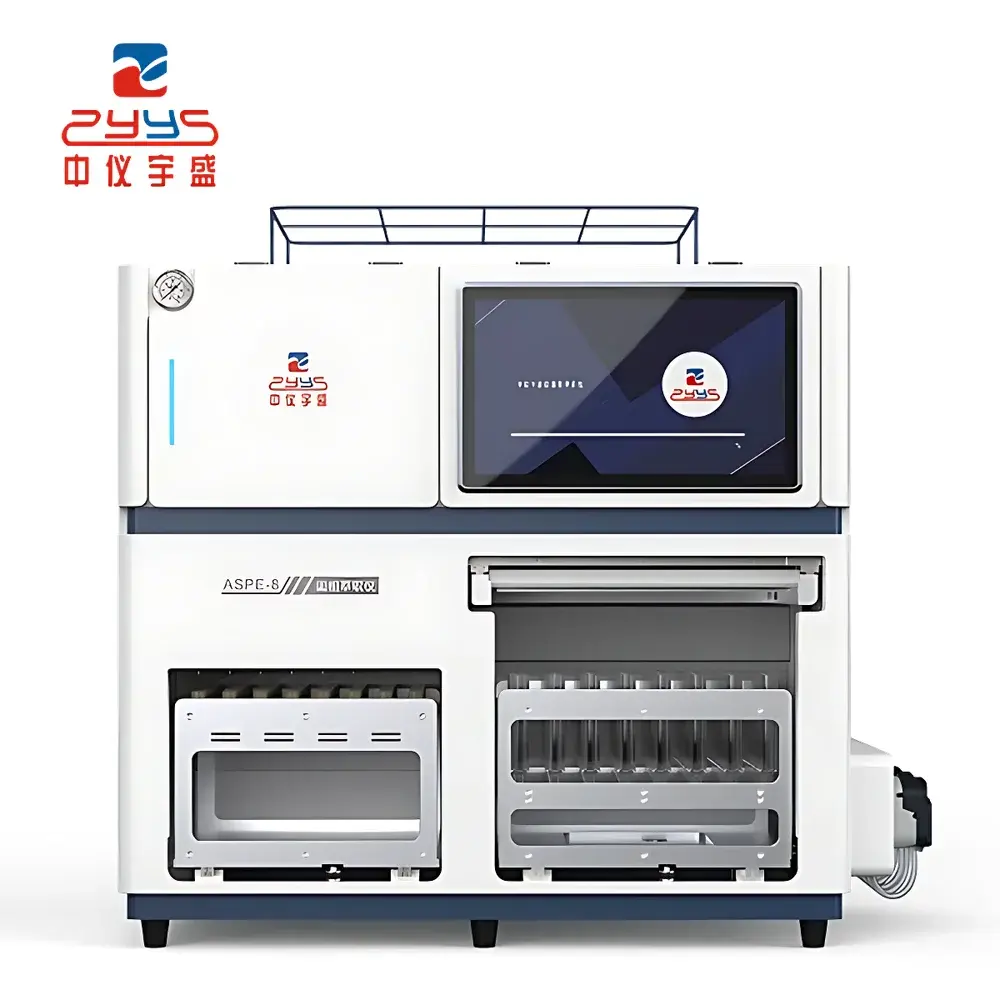
ZHYUASPE ASPE-8 Fully Automated Solid Phase Extraction System
| Brand | ZHYUASPE |
|---|---|
| Model | ASPE-8 |
| Automation Level | Fully Automatic |
| Number of Channels | 8 Parallel Channels |
| Extraction Format | Cartridge-Based (Column) SPE |
| Solvent Selection | 8 Independent Solvent Lines |
| Sample Throughput | Up to 80 Samples Unattended |
| Simultaneous Processing Capacity | 8 Samples (Variable Volume, Including Large-Volume Aqueous Samples) |
| Sample Loading Volume | Adjustable, Unlimited Range |
| Wetted Materials | Stainless Steel (316L), Polytetrafluoroethylene (PTFE), Borosilicate Glass, Polyetheretherketone (PEEK) |
| Origin | Beijing, China |
| Manufacturer | ZHYUASPE Instrument Co., Ltd. |
Overview
The ZHYUASPE ASPE-8 is a fully automated, high-throughput solid phase extraction (SPE) system engineered for reproducible, trace-level analyte enrichment and matrix removal in regulated and research laboratories. It operates on the principle of selective adsorption–desorption chromatography, where analytes are retained on functionalized sorbent cartridges (e.g., C18, silica, ion exchange, or mixed-mode phases) under controlled flow conditions, followed by sequential washing and elution with precisely metered solvents. Designed for method robustness and walk-away operation, the ASPE-8 integrates precision fluid handling, intelligent motion control, and chemically inert wetted-path architecture to support compliance-critical workflows across environmental monitoring, clinical toxicology, food safety, and pharmaceutical QC.
Key Features
- Eight independent syringe pump modules and parallel fluidic channels enable true concurrent processing of eight samples—eliminating batch delay and maximizing instrument utilization.
- Large-volume direct loading path (optional) bypasses the sample probe entirely, allowing metered delivery of up to liters of aqueous matrices without needle carryover or pressure-induced variability.
- High-integrity 12-position rotary valves provide precise, low-dead-volume switching between eight distinct eluents and wash solvents—enabling complex multi-step protocols including conditioning, loading, washing, drying, and elution—all programmable per sample or group.
- Integrated immersion-style needle wash station uses dual-solvent rinse cycles with adjustable dwell time and aspiration volume, minimizing cross-contamination risk below detection thresholds for ultra-trace analysis.
- Four dedicated waste discharge lines driven by peristaltic pumps ensure continuous, pressure-stable evacuation—preventing overflow, backpressure buildup, or solvent vapor accumulation in shared waste reservoirs.
- Motorized, independently addressable XYZ stages position the sample rack, collection rack, and SPE cartridge holder with sub-millimeter repeatability; auto-alignment algorithms confirm cartridge seating and tube centering prior to fluid transfer.
- On-board nitrogen manifold delivers regulated, pulse-free gas flow for post-wash column drying—critical for volatile analyte retention and solvent compatibility in GC- and LC-MS workflows.
- Collection tube auto-centering mechanism engages prior to elution, ensuring accurate tip-to-tube alignment and eliminating splashing or off-target deposition during low-volume (<100 µL) eluate collection.
- Modular large-volume module interface permits external mounting of custom sample containers (e.g., 2–5 L bottles); the system automatically extends the sample rack beyond the chassis boundary, then retracts it post-loading—preserving sealed environment integrity.
- Embedded 15.6-inch industrial touchscreen PC runs deterministic real-time motion and fluid control firmware—no external computer dependency required for routine operation or method execution.
Sample Compatibility & Compliance
The ASPE-8 accommodates standard 1 mL, 3 mL, 6 mL, and 12 mL SPE cartridges—including stacked-bed and mixed-mode formats—as well as custom-packed columns with compatible footprints. Its chemically resistant fluid path (316L stainless steel manifolds, PTFE tubing, borosilicate glass solvent reservoirs, and PEEK valve rotors) ensures long-term stability with aggressive solvents (e.g., dichloromethane, acetonitrile, concentrated acids/bases). The system supports method validation per ISO/IEC 17025, ASTM D5905 (water analysis), USP , and EPA Methods 508.1, 525.3, and 8270. Audit trail logging, user access levels, electronic signatures, and data integrity safeguards align with FDA 21 CFR Part 11 and EU Annex 11 requirements when operated within a validated IT infrastructure.
Software & Data Management
The embedded control software provides intuitive protocol builder functionality with drag-and-drop step sequencing, real-time status visualization (pump position, valve state, pressure feedback), and event-triggered actions (e.g., pause on pressure alarm, resume after manual intervention). All method parameters, run logs, error timestamps, and hardware diagnostics are stored locally in encrypted SQLite databases with optional export to CSV or LIMS-compatible XML. Raw data files include full metadata (operator ID, timestamp, cartridge lot, solvent batch IDs) to satisfy GLP/GMP documentation requirements. Remote monitoring via Ethernet is supported using standard Modbus TCP for integration into centralized lab automation platforms.
Applications
- Environmental: Extraction and concentration of pesticides, PAHs, PCBs, and pharmaceutical residues from surface water, wastewater, and soil leachates (EPA 525.3-compliant).
- Clinical & Forensic: Isolation of drugs of abuse, metabolites, and endogenous steroids from whole blood, plasma, and urine—optimized for LC-MS/MS quantification with minimal phospholipid co-extraction.
- Food & Beverage: Multi-residue analysis of mycotoxins, veterinary drug residues, and adulterants in milk, honey, tea, and infant formula matrices.
- Pharmaceutical: Clean-up of dissolution samples, stability-indicating assays, and impurity profiling prior to HPLC or UPLC analysis.
- Materials Science: Purification of polymer additives, plasticizers, and extractables from packaging films and medical devices.
FAQ
Does the ASPE-8 support method transfer from manual or semi-automated SPE workflows?
Yes—the system accepts standardized cartridge dimensions and common solvent sequences; method translation requires only flow rate, dwell time, and volume mapping within the protocol editor.
Can the system be integrated into a laboratory information management system (LIMS)?
Yes—via configurable CSV/XML export or Modbus TCP interface for bidirectional status and result exchange.
What maintenance intervals are recommended for long-term reliability?
Syringe pump calibration every 6 months; PTFE tubing replacement every 12 months under typical usage; valve rotor inspection quarterly.
Is remote troubleshooting supported?
Yes—secure SSH access and VNC-enabled remote desktop are available for authorized service engineers upon customer consent.
How is data integrity ensured during power interruption?
All critical states (current step, elapsed time, valve position, pump coordinates) are written to non-volatile memory every 2 seconds; recovery resumes from last confirmed stable state upon reboot.



