
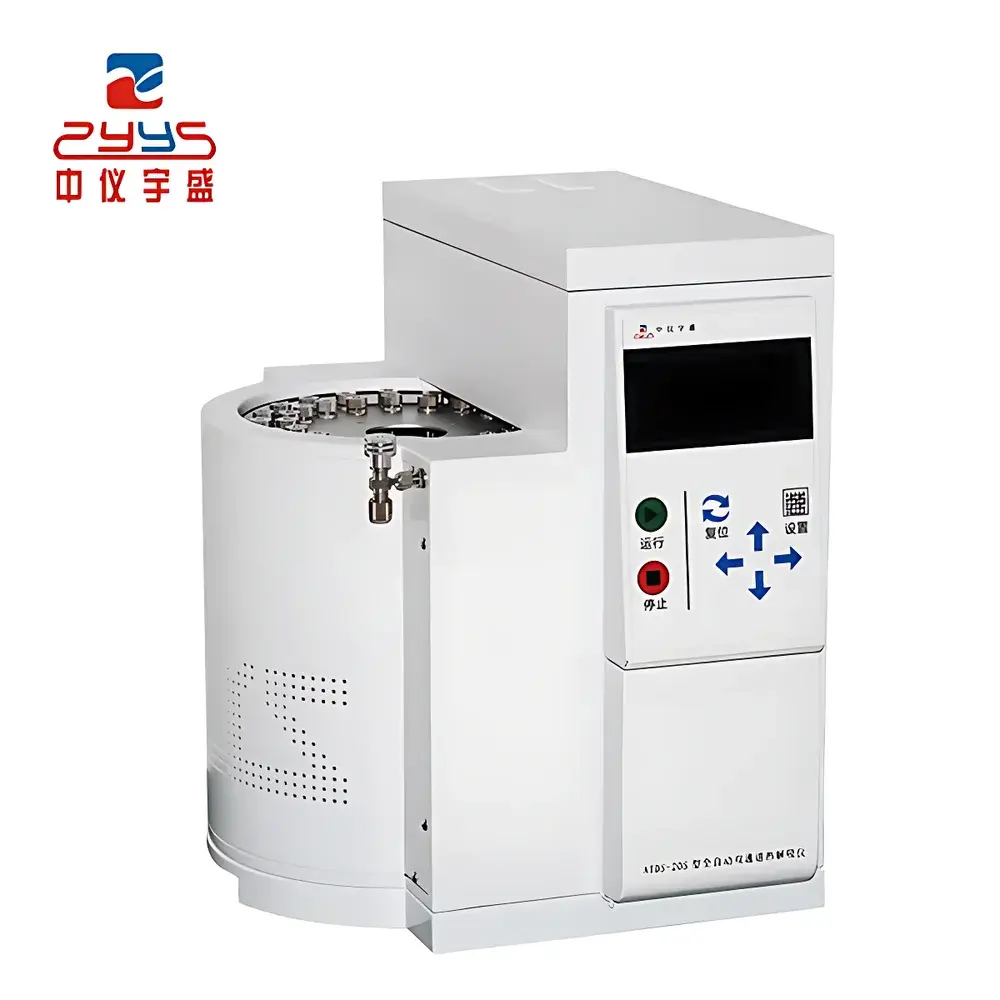
Zhongyi Yusheng ATDS-20S Dual-Channel Fully Automated Thermal Desorber
| Brand | Zhongyi Yusheng |
|---|---|
| Origin | Beijing, China |
| Manufacturer Type | Direct Manufacturer |
| Instrument Type | Single-Stage Thermal Desorber |
| Automation Level | Fully Automated |
| Sample Capacity | Dual 20-Position Carousel (40 total samples) |
| Interface Compatibility | Universal GC inlet coupling (including Agilent, Thermo Fisher, Shimadzu, PerkinElmer) |
| Heating Zones | Independent temperature control for desorption chamber, transfer line, and six-port valve |
| Programmable Functions | Auto-desorption, auto-injection, auto-backflush, tube activation, calibration curve generation via standard spiking |
| Compliance Standards | GB/T 18883-2022, HJ 583-2010, HJ 644-2013, HJ 734-2014, GBZ/T 300.62–68-2017, HJ/T 400-2007, GB 50325-2020, GB 36246-2018, GB/T 18204.2-2014 |
Overview
The Zhongyi Yusheng ATDS-20S Dual-Channel Fully Automated Thermal Desorber is an engineered solution for high-throughput, unattended thermal desorption of volatile organic compounds (VOCs) and semi-volatile organic compounds (SVOCs) from sorbent tubes prior to gas chromatographic analysis. Based on the principle of controlled thermal desorption—where analytes are thermally released from solid-phase adsorbents under inert carrier gas flow—the ATDS-20S enables quantitative transfer of desorbed vapors directly into a gas chromatograph (GC) or GC–MS system. Its dual-channel architecture supports parallel processing of two independent 20-position sample trays (total 40 samples), significantly improving laboratory productivity in environmental monitoring, occupational hygiene, indoor air quality (IAQ), and materials emission testing workflows. Designed for integration with mainstream benchtop GC platforms, the instrument adheres to fundamental requirements of method traceability, thermal stability, and carryover mitigation essential for regulatory-compliant VOC analysis.
Key Features
- Fully automated dual-channel operation: Simultaneous desorption and injection of two independent sample sets (1–20 tubes per channel), eliminating manual intervention across multi-hour sequences.
- Integrated self-diagnostic system: Automatic power-on initialization, real-time hardware status monitoring, fault detection with audible/visual alerts, and precise robotic arm positioning and carousel calibration.
- Multi-zone independent temperature control: Three individually regulated heating zones—desorption oven (ambient to 400 °C), transfer line (ambient to 350 °C), and six-port switching valve (ambient to 250 °C)—ensure optimal analyte transfer without cold spots or condensation.
- Programmable sequence execution: Time-based control of desorption duration, focusing trap cooling (optional secondary desorption module compatible), injection timing, post-injection backflush, and post-run tube reactivation—all configurable via intuitive PC-based software interface.
- Low carryover design: Active backflush of both transfer line and valve using inert gas purge; optional quartz-lined or deactivated fused silica transfer tubing available for reactive analytes (e.g., aldehydes, amines).
- GC synchronization capability: TTL-level trigger output for coordinated start of GC oven ramp and data acquisition; also accepts external start signals from chromatography data systems (CDS) or LIMS.
- Onboard calibration support: Integrated standard spiking function enables direct preparation of calibration curves using certified reference standards loaded onto blank sorbent tubes.
Sample Compatibility & Compliance
The ATDS-20S accommodates standard 6 mm OD × 89 mm length stainless steel or glass sorbent tubes (e.g., Tenax TA, Carbopack B/C, Carboxen series, Graphitized Carbon Black). It supports common tube formats used in EPA TO-17, ISO 16017-1, and Chinese national standards. The system is validated for use in methods requiring compliance with GB/T 18883-2022 (Indoor Air Quality), HJ 644-2013 (VOCs in ambient air by TD-GC–MS), HJ 734-2014 (VOCs in stack emissions), and GB 50325-2020 (indoor pollution control in civil construction). All thermal protocols maintain reproducibility within ±1.5 °C across full operating range, supporting GLP-aligned documentation practices. While not pre-certified to FDA 21 CFR Part 11, audit trails, user access logs, and electronic method storage are software-configurable to meet GxP-aligned validation requirements.
Software & Data Management
Controlled via Windows-based desktop application, the ATDS-20S software provides method editor, real-time status dashboard with animated workflow visualization, run queue management, and event logging. Each method stores complete thermal profiles, timing parameters, and hardware configuration metadata. Raw log files record timestamps for every actuator movement, temperature setpoint change, and valve switching event—enabling full forensic reconstruction of analytical sequences. Export options include CSV-formatted run reports and XML-based method exchange for cross-platform GC method synchronization. Software updates are delivered via secure HTTPS portal; no cloud connectivity is required for routine operation.
Applications
- Environmental air monitoring: Benzene, toluene, ethylbenzene, xylenes (BTEX), C2–C12 aliphatics, chlorinated solvents, and oxygenated VOCs in ambient, workplace, and indoor air matrices.
- Building material emissions testing: Formaldehyde, acetaldehyde, terpenes, and plasticizer volatiles per GB 36246-2018 (synthetic sports surfaces) and GB/T 18204.2-2014 (public health environments).
- Automotive cabin air assessment: Aldehydes, aromatic hydrocarbons, and polymer degradation products per HJ/T 400-2007.
- Industrial hygiene compliance: Solvent gasoline, liquefied petroleum gas (LPG), and styrene derivatives per GBZ/T 300.62–68-2017 series.
- Method development and validation labs: Supports custom thermal ramping, multi-step desorption, and tube regeneration protocols for sorbent evaluation and matrix interference studies.
FAQ
Is the ATDS-20S compatible with my existing Agilent 7890B GC?
Yes—the instrument includes universal mechanical and electrical interfaces for Agilent, Thermo Fisher, Shimadzu, and PerkinElmer GC inlets, with adjustable injection needle depth and standard 1/16″ compression fittings.
Can I perform tube reactivation automatically after analysis?
Yes—built-in tube activation protocol allows programmable heating (up to 350 °C) under nitrogen or helium flow for in-situ cleaning of spent sorbent tubes.
Does the system support secondary desorption?
The base ATDS-20S is configured for single-stage desorption; however, it features standardized mounting points and signal I/O for seamless integration of optional cryo-focused secondary desorption modules.
What is the maximum desorption temperature and accuracy?
Desorption oven range: ambient to 400 °C, calibrated to ±1.5 °C over full span, with ramp rates adjustable from 1 °C/min to 50 °C/min.
How is data integrity ensured during unattended runs?
Every run generates a timestamped binary log file containing all hardware events, temperature readings, and valve positions—retained locally for ≥12 months unless manually archived.
Related Products



