
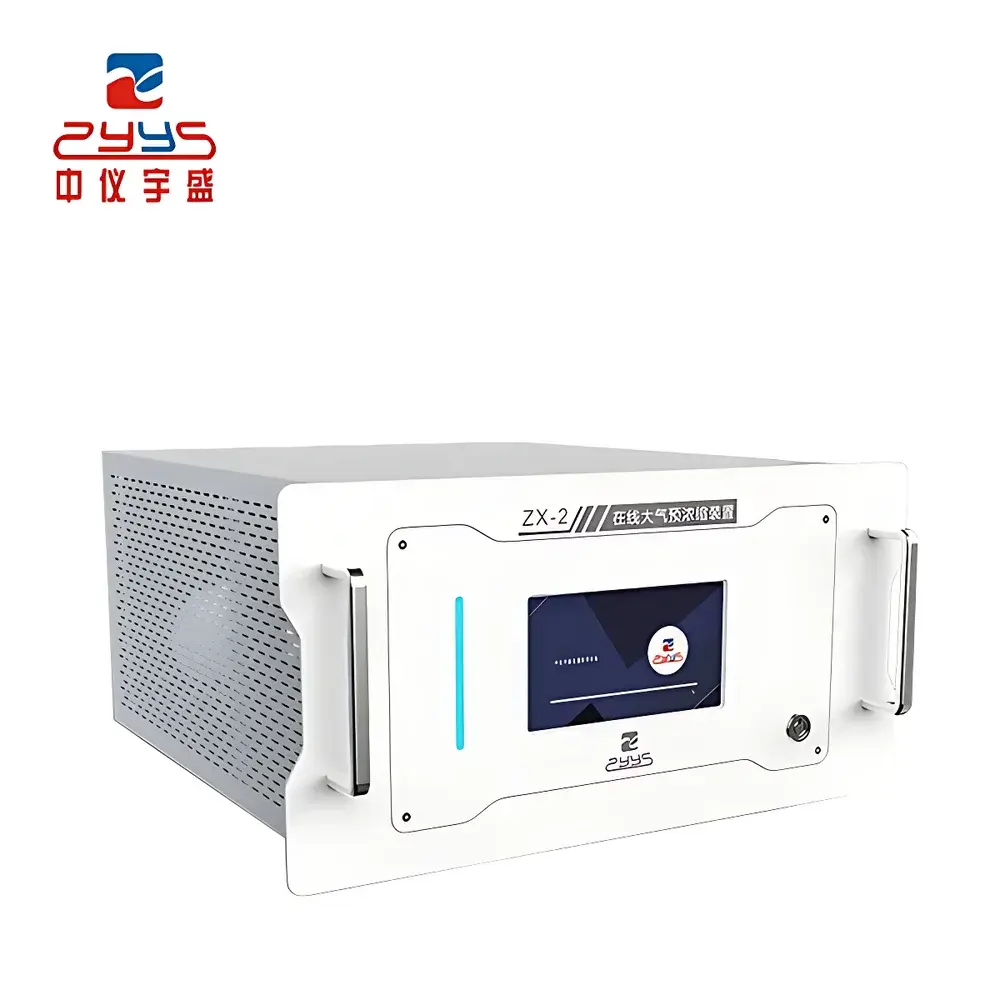
Zhongyi Yusheng ZX-2 Online Atmospheric Pre-concentrator
| Brand | Zhongyi Yusheng |
|---|---|
| Origin | Beijing, China |
| Manufacturer Type | Direct Manufacturer |
| Country of Origin | China |
| Model | ZX-2 |
| Pricing | Upon Request |
Overview
The Zhongyi Yusheng ZX-2 Online Atmospheric Pre-concentrator is an engineered solution for automated, high-sensitivity volatile organic compound (VOC) monitoring in ambient air. Designed to operate seamlessly in series with online gas chromatography (GC) or GC–mass spectrometry (GC–MS) systems, the ZX-2 implements cryogenic pre-concentration based on dual-trap thermal desorption principles. Ambient air is drawn through a calibrated mass flow controller and passed over two independently controlled cold traps operating at sub-ambient temperatures (typically −30 °C to −40 °C). VOCs are selectively adsorbed onto sorbent-packed trap tubes while water vapor and inert gases pass through. The system then thermally desorbs the trapped analytes in a narrow, focused band—delivering enriched, matrix-reduced samples directly to the GC inlet. This architecture enables detection limits in the low-pptv (parts-per-trillion by volume) range for C2–C12 hydrocarbons, oxygenates, halocarbons, and aromatics under continuous unattended operation.
Key Features
- Dual-cryotraps with alternating and cycling operational modes—ensuring zero measurement downtime and eliminating blind intervals during continuous monitoring.
- Electronic Peltier-based cooling system—eliminating reliance on liquid nitrogen or mechanical compressors, thereby enhancing operational safety, stability, and long-term reliability.
- Trap tube lifetime monitoring algorithm—tracks cumulative exposure cycles and thermal stress history, triggering maintenance alerts prior to performance degradation.
- Modular particulate and moisture filtration—integrated upstream filters are tool-free replaceable; a dedicated water removal trap minimizes ice formation and column contamination.
- Quick-change trap cartridge design—enables full sorbent tube replacement in under 90 seconds without tools or system venting.
- Zoned temperature control—individual PID regulation for valve manifold, transfer lines, and both cryotraps ensures precise thermal management and minimizes memory effects.
- Automated calibration gas and blank injection—supports multi-point external standard calibration and system blank verification per ASTM D6196 and EPA TO-17 protocols.
- Programmable internal standard addition—enables quantitative analysis via internal standardization, compliant with ISO 16000-6 and USP requirements for environmental VOC quantification.
- Active backflush capability—automatically purges sample lines and injection valves between analyses to prevent carryover and cross-contamination.
- 6U (267 mm H) 19-inch rack-mount form factor—designed for integration into centralized air quality monitoring cabinets with standardized power, data, and pneumatic interfaces.
- Negative-pressure sampling pump with integrated thermal mass flow meter—provides stable, gravimetrically traceable volumetric flow control across variable ambient pressure and temperature conditions.
Sample Compatibility & Compliance
The ZX-2 is validated for use with common sorbent media including Tenax TA, Carbopack B/C, and graphitized carbon black (GCB) combinations. It accommodates standard 1/4″ OD stainless steel or fused silica trap tubes meeting ASTM D6196 Annex A1 dimensions. The system supports compliance workflows aligned with U.S. EPA Methods TO-14A, TO-15, and TO-17; EU EN 13649-1 and EN 14662; and Chinese HJ 644–2013 and HJ 759–2015 standards. All firmware logs—including trap status, flow calibration events, temperature setpoints, and maintenance timestamps—are timestamped and stored locally with audit trail capability, supporting GLP/GMP documentation requirements.
Software & Data Management
The ZX-2 operates via a built-in embedded Linux platform with a 7-inch capacitive touchscreen interface (Chinese language only). Control logic is configurable through hierarchical menus covering method setup, sequence programming, alarm thresholds, and remote I/O mapping. Device-level communication uses Modbus TCP and RS-485 protocols for integration into SCADA or LIMS environments. Raw event logs and operational metadata (e.g., trap cycle count, flow deviation %, cooling efficiency delta-T) are exportable via USB or Ethernet as CSV files. While native software does not provide FDA 21 CFR Part 11-compliant electronic signatures, the system’s deterministic state logging and immutable timestamping support third-party validation for regulated applications.
Applications
- Real-time ambient air quality monitoring at urban background, traffic, and industrial fence-line sites.
- Continuous emissions monitoring (CEM) for fugitive VOC sources in petrochemical, pharmaceutical, and semiconductor facilities.
- Indoor air quality (IAQ) assessment in office buildings, schools, and cleanrooms per ISO 16000 series.
- Method development and validation laboratories requiring reproducible, automated thermal desorption workflows.
- Mobile monitoring platforms where space, power, and maintenance access are constrained.
FAQ
What sorbent materials are compatible with the ZX-2 cold traps?
Standard configurations support Tenax TA, Carbopack B/C, and multi-bed GCB–Carbopack combinations. Custom trap packing is available upon request.
Does the ZX-2 require liquid nitrogen or external coolant?
No. It utilizes solid-state Peltier coolers with closed-loop thermal management—no consumables or external chillers required.
Can the ZX-2 be integrated with third-party GC or GC–MS systems?
Yes. Trigger signals (TTL), analog outputs (0–10 V), and digital I/O are provided for synchronization with any vendor’s chromatograph.
Is remote diagnostics or firmware update supported?
Firmware updates are performed via USB stick; remote diagnostics are limited to Modbus register polling—no cloud connectivity or remote desktop functionality is implemented.
What maintenance intervals are recommended for routine operation?
Filter replacement every 30 days under typical urban air conditions; trap tubes every 200–500 cycles depending on VOC loading; annual calibration of mass flow sensor and temperature sensors.
Related Products



