
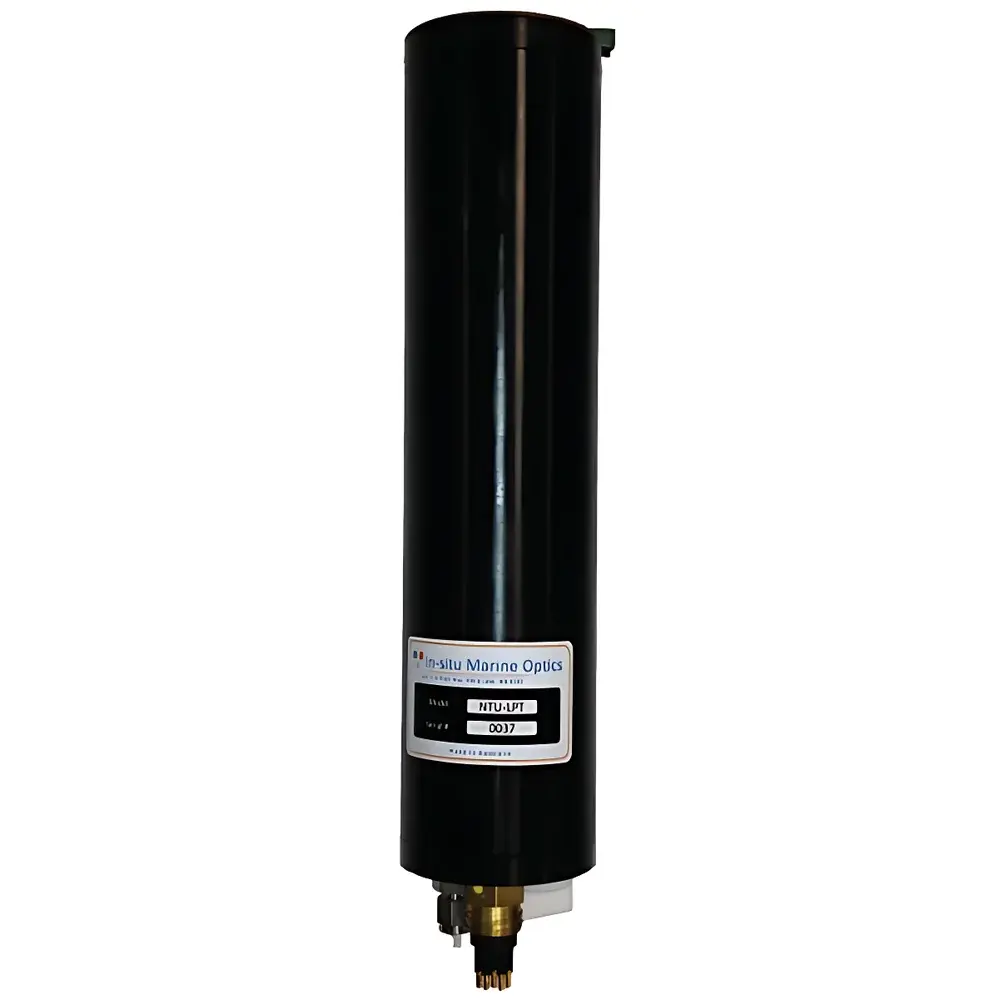
In-situ Marine IMO-NTU-LPT Submersible Turbidimeter
| Brand | In-situ Marine |
|---|---|
| Origin | Australia |
| Model | IMO-NTU-LPT |
| Type | Portable Submersible Turbidimeter |
| Measurement Range | 0–400 NTU (factory-customizable) |
| Resolution | 0.05 NTU |
| Scattering Angle | 120° |
| Light Source | 890 nm LED |
| Detector | Silicon Photodiode |
| ADC | 16-bit |
| Max Sampling Rate | 10 Hz |
| Environmental Light Rejection | Yes |
| Communication | RS-232 (configurable baud rate) |
| Power Input | 7–24 VDC |
| Operating Current | 40 mA (sampling), 250 mA (cleaning), 60 µA (sleep) |
| Internal Battery | 11.1 V, 5.2 Ah Li-ion (rechargeable) |
| Housing Material | Acetal |
| Depth Rating | 300 m |
| Operating Temperature | −10 to +40 °C |
| Dimensions | 285 mm (L, including 36 mm connector), 67 mm (diameter) |
| Weight | 1.4 kg (air), 0.3 kg (water) |
| Data Storage | 16 GB microSD card |
| Built-in Sensors | Pressure, Temperature, Real-time Clock, Tilt Sensor |
| Self-cleaning Mechanism | Integrated copper-brush wiper |
Overview
The In-situ Marine IMO-NTU-LPT is a purpose-engineered submersible turbidimeter designed for high-fidelity, long-term in situ monitoring of suspended particulate matter in aquatic environments. Based on the nephelometric principle—measuring forward-scattered light at a fixed angle of 120° relative to the incident beam—the instrument delivers traceable NTU (Nephelometric Turbidity Units) measurements compliant with ISO 7027-1:2016 and EPA Method 180.1. Its optical architecture features an 890 nm infrared LED source and a calibrated silicon photodiode detector, minimizing interference from natural water coloration (e.g., humic substances) and enabling stable performance across diverse freshwater and marine matrices. The device operates autonomously underwater for extended deployments—up to several months—without maintenance, leveraging ultra-low-power sleep mode (60 µA), internal rechargeable lithium-ion power, and robust acetal housing rated to 300 m depth.
Key Features
- Integrated multi-parameter sensing: Simultaneous measurement of turbidity, pressure (depth), temperature, and tilt—enabling hydrostatic profiling and deployment integrity verification.
- Optical system engineered for marine durability: Non-yellowing, scratch-resistant optics combined with an electromechanically actuated copper-brush self-cleaning mechanism that mitigates biofouling and sediment accumulation on the sensing window.
- High-resolution data acquisition: 16-bit analog-to-digital conversion with configurable sampling up to 10 Hz, supporting both burst-mode profiling and low-frequency environmental trend logging.
- Onboard intelligence: Real-time clock (RTC) for time-stamped data; internal non-volatile memory for calibration coefficients; user-programmable sampling schedules including conditional triggers (e.g., temperature threshold, tilt deviation).
- Flexible telemetry and power management: RS-232 interface with configurable baud rates (up to 115.2 kbps); wide-input DC voltage range (7–24 VDC); dual-power operation (external bus or internal 11.1 V / 5.2 Ah Li-ion battery).
- Ruggedized mechanical design: Sealed acetal housing, corrosion-resistant metal components, and hydrodynamic form factor optimized for mooring, buoy-mounted, or ROV-deployed configurations.
Sample Compatibility & Compliance
The IMO-NTU-LPT is validated for use in natural waters—including rivers, lakes, estuaries, coastal zones, and wastewater effluents—where suspended solids concentrations fall within the 0–400 NTU range. Its 890 nm wavelength and 120° scattering geometry ensure minimal spectral interference from dissolved organic carbon and algal pigments, supporting reliable compliance monitoring under ISO 7027-1 and US EPA guidance. The instrument meets IEC 60529 IP68 ingress protection requirements and is certified for operation in saline environments per ASTM D1129 (Standard Terminology Relating to Water). All firmware and calibration routines are traceable to NIST-traceable turbidity standards. Data logging adheres to GLP principles, with immutable timestamps, sensor metadata, and audit-ready file structures compatible with LIMS integration.
Software & Data Management
Data is stored locally on a removable 16 GB microSD card in standard CSV format, with each record containing turbidity (NTU), temperature (°C), pressure (dBar), tilt (degrees), timestamp (UTC), and diagnostic flags (e.g., cleaning cycle status, low-battery warning). Optional Wi-Fi module enables post-deployment wireless data download without physical retrieval. In-situ’s proprietary LogView software supports batch calibration application, spectral QA/QC flagging, and georeferenced time-series visualization. Raw output files include embedded sensor serial numbers and firmware revision IDs, satisfying 21 CFR Part 11 requirements for electronic records when used in regulated water quality programs.
Applications
- Long-term water quality surveillance in reservoirs, drinking water intakes, and protected watersheds.
- Real-time effluent monitoring at municipal and industrial wastewater treatment plants—supporting discharge permit compliance reporting.
- Hydrodynamic process studies: Sediment resuspension events, stormwater runoff dynamics, dredging plume tracking, and dredge spoil disposal monitoring.
- Environmental impact assessments (EIA) and baseline surveys for offshore construction, aquaculture lease sites, and marine protected areas.
- Integration into autonomous platforms: Moored buoys, gliders, AUVs, and cabled observatory nodes requiring low-power, high-reliability optical sensing.
FAQ
Is factory calibration traceable to international standards?
Yes—each unit ships with a certificate of calibration referencing NIST-traceable Formazin and AMCO AEPA-1 standards, with documented uncertainty budgets per ISO/IEC 17025.
Can the measurement range be extended beyond 400 NTU?
Yes—custom optical pathlengths and gain settings can be configured at the factory for applications requiring up to 3000 NTU, subject to optical saturation analysis and recalibration.
How often does the self-cleaning system activate?
Cleaning frequency is fully programmable via RS-232 command set—users may define fixed intervals (e.g., every 6 hours), event-triggered cycles (e.g., after tilt >5°), or manual initiation.
Does the device support remote firmware updates?
Firmware updates are performed offline via microSD card; no over-the-air (OTA) capability is implemented to preserve data integrity and cybersecurity in operational environments.
What is the expected battery life during continuous operation?
At 15-minute sampling intervals with daily cleaning cycles, typical field endurance exceeds 90 days on internal battery alone; external power extends deployment indefinitely.




