
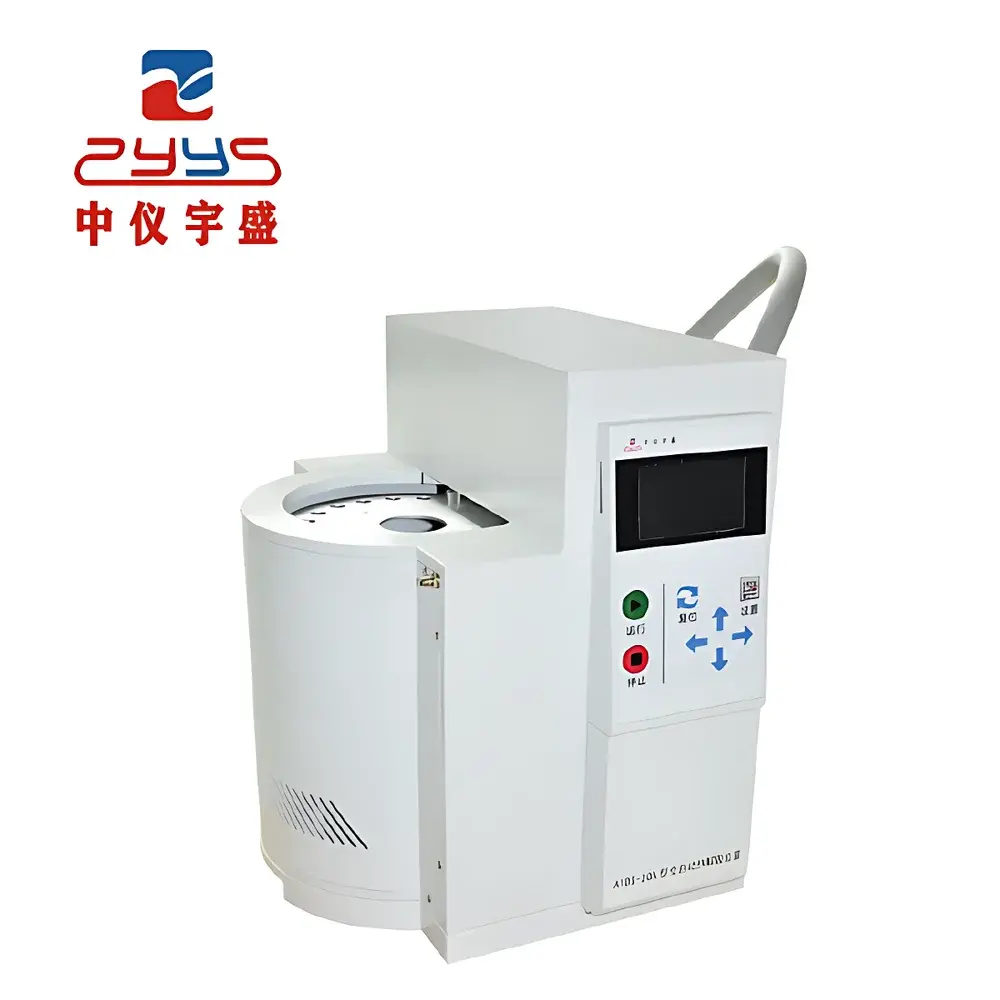
Zhongyi Yusheng ATDS-20A Single-Stage Automated Thermal Desorber
| Brand | Zhongyi Yusheng |
|---|---|
| Origin | Beijing, China |
| Manufacturer Type | Direct Manufacturer |
| Product Category | Domestic |
| Model | ATDS-20A (Single-Stage) |
| Instrument Type | Single-Stage Thermal Desorber |
| Automation Level | Fully Automated |
| Sample Capacity | 20 positions |
| Compliance Standards | HJ 583–2010, GB 50325–2020, GBZ/T 300–2017 |
Overview
The Zhongyi Yusheng ATDS-20A Single-Stage Automated Thermal Desorber is an engineered solution for the quantitative thermal desorption of volatile and semi-volatile organic compounds (VOCs and SVOCs) from sorbent tubes prior to gas chromatographic analysis. Designed around a single-stage desorption architecture, the ATDS-20A operates on the principle of controlled resistive heating of thermally stable sorbent tubes (e.g., Tenax TA, Carbopack B/C, or equivalent), followed by direct transfer of desorbed analytes into the injection port of a coupled gas chromatograph (GC) or GC–MS system via heated transfer lines. This methodology eliminates solvent use, minimizes analyte loss or degradation, and ensures high reproducibility for trace-level environmental, occupational hygiene, and indoor air quality monitoring—fully aligned with internationally referenced standard methods including HJ 583–2010 (China EPA), GB 50325–2020 (Indoor Air Quality Control for Civil Engineering), and GBZ/T 300–2017 (Occupational Health Monitoring).
Key Features
- Fully automated batch processing of up to 20 sorbent tubes without manual intervention—ideal for high-throughput laboratories performing routine compliance testing.
- Integrated self-diagnostic startup sequence with real-time fault detection, audible/visual alerts, and automatic carousel homing and positional calibration.
- Independent, PID-controlled heating zones for the desorption chamber, sampling valve, and transfer line—each programmable to ±0.1 °C stability over full operational range (ambient to 400 °C).
- Time-based method programming enabling sequential execution of desorption, valve actuation, carrier gas flow control, back-flush cleaning, and GC trigger synchronization.
- Dedicated tube activation mode: automated thermal conditioning of used or new sorbent tubes under inert gas flow to remove residual contaminants and restore adsorption capacity.
- Onboard calibration functionality: built-in standard vapor generation capability for constructing linear response curves using certified reference standards directly on the instrument.
- Heated transfer pathway with active back-flush capability at both the valve interface and transfer line—effectively preventing carryover between samples and ensuring analytical integrity across extended runs.
- Universal GC interface compatibility: pre-configured hardware and signal protocols for seamless integration with major domestic and international GC/GC–MS platforms—including Agilent, Thermo Fisher, Shimadzu, PerkinElmer, and domestic OEM systems.
- Optional quartz-lined transfer tubing available for enhanced inertness during analysis of reactive or polar analytes (e.g., aldehydes, organic acids, amines).
Sample Compatibility & Compliance
The ATDS-20A supports standard 6 mm OD × 89 mm (or 110 mm) stainless steel or glass sorbent tubes, compatible with common multi-bed configurations (e.g., Tenax GR + Carbograph 1TD + Carboxen 1000). It meets functional requirements for regulatory applications governed by HJ 583–2010 (determination of benzene series in ambient air), GB 50325–2020 (TVOC, benzene, toluene, xylene limits in residential/commercial buildings), and GBZ/T 300–2017 (workplace air monitoring for 100+ target VOCs). While not certified to ISO/IEC 17025 or FDA 21 CFR Part 11 out-of-the-box, its deterministic timing control, audit-ready method logging, and repeatable thermal profiles support laboratory validation under GLP or internal QA/QC frameworks.
Software & Data Management
Operation is managed via an embedded industrial-grade touchscreen HMI running a deterministic real-time OS. All method parameters—including desorption temperature ramp rates, hold times, valve switching sequences, and GC trigger logic—are stored as encrypted binary files with timestamped version history. The system logs every run with metadata: sample ID, operator ID (optional login), start/stop time, thermal profile deviation alerts, and hardware status snapshots. Raw event logs are exportable in CSV format for LIMS integration or external review. Remote monitoring and method upload/download are supported via Ethernet or USB, though native network authentication or electronic signature features are not implemented.
Applications
- Environmental monitoring: ambient air, stack emissions, and fugitive emission screening per national VOC inventories.
- Indoor air quality (IAQ) assessment in newly constructed buildings, schools, hospitals, and office spaces.
- Occupational exposure assessment in petrochemical plants, paint manufacturing, printing facilities, and semiconductor cleanrooms.
- Product emissions testing: adhesives, sealants, flooring materials, furniture composites, and automotive interior components.
- Method development and validation labs requiring robust, reproducible thermal desorption workflows prior to GC–MS confirmation.
FAQ
Is the ATDS-20A compatible with GC–MS systems?
Yes—it provides TTL-level trigger output and synchronized carrier gas control for direct integration with most benchtop GC–MS instruments.
Does it support dual-stage (cold trap) desorption?
No—the ATDS-20A is configured exclusively for single-stage thermal desorption; optional secondary cryo-focusing modules are not included or supported natively.
Can I validate this instrument per ISO/IEC 17025 requirements?
Instrument performance verification (e.g., temperature accuracy, carryover, precision) can be performed using documented SOPs; however, factory-provided calibration certificates traceable to national standards are not supplied by default.
What maintenance is required for long-term reliability?
Routine tasks include quarterly inspection of O-rings and valve seals, annual verification of thermocouple calibration, and periodic cleaning of the desorption chamber and transfer line using solvent rinses under inert purge.
Is remote software update capability available?
Firmware updates require local USB media loading; over-the-air (OTA) or cloud-based update functionality is not implemented.




