
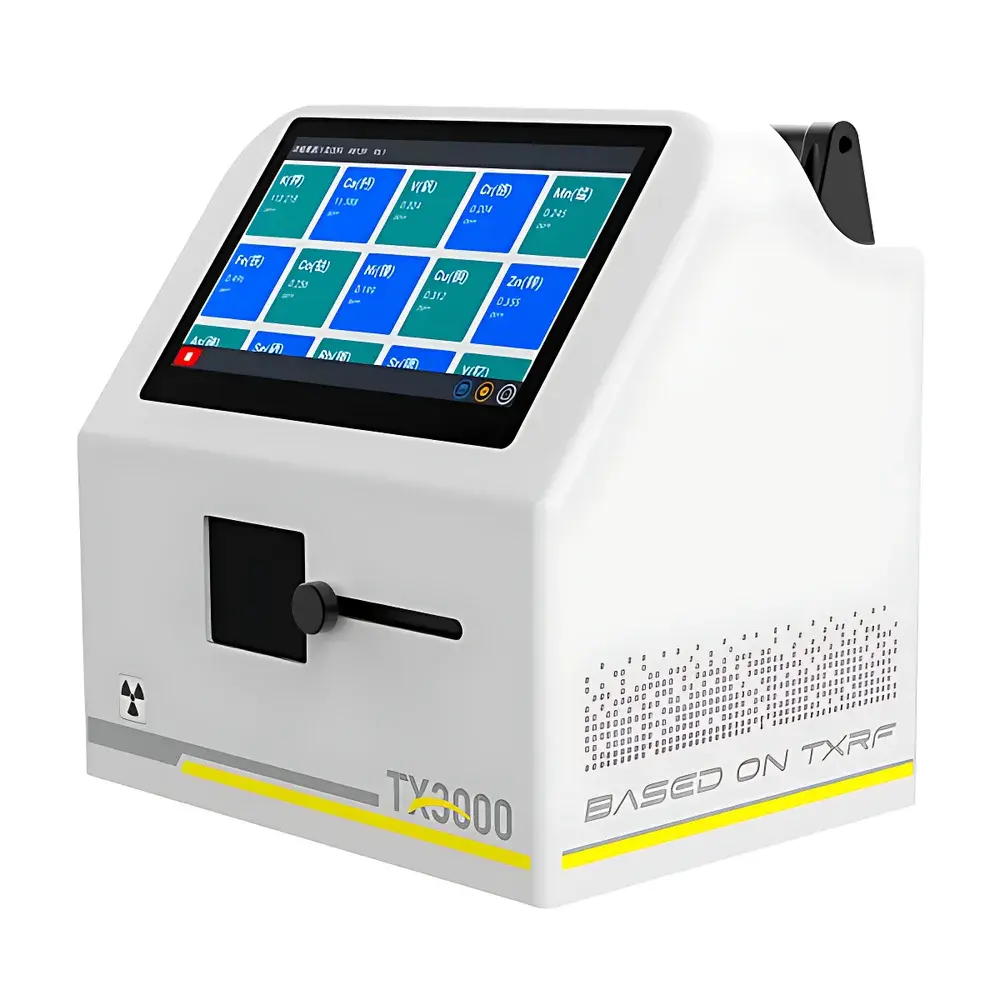
Brookfield LANScientific TX3000 Portable Total-Reflection X-Ray Fluorescence (TXRF) Spectrometer for Heavy Metals in Water
| Brand | LANScientific |
|---|---|
| Origin | Jiangsu, China |
| Manufacturer Type | Direct Manufacturer |
| Country of Origin | Domestic (China) |
| Model | TX3000 |
| Instrument Type | Portable |
| Detection Principle | Total-Reflection X-Ray Fluorescence (TXRF) |
| Sample Form | Liquids, Suspensions, Filtered Water Extracts |
| Key Elements | Cr, Pb, Cd, As, Hg, Ni, Cu, Zn (expandable to ~30 elements) |
| Detection Limit | Sub-pg to low-pg range per element (matrix-dependent) |
| Excitation Source | Pd-target microfocus X-ray tube |
| Optics | Multilayer monochromator + grazing-incidence beam path |
| Detector | Peltier-cooled silicon drift detector (SDD) |
| Software | LANScientific TXRF Suite v4.x with calibration libraries, spectral deconvolution, and quantitative algorithms |
Overview
The LANScientific TX3000 is a field-deployable total-reflection X-ray fluorescence (TXRF) spectrometer engineered for trace-level elemental analysis of aqueous environmental matrices. Unlike conventional energy-dispersive XRF (EDXRF), TXRF employs a grazing-incidence excitation geometry—where the primary X-ray beam strikes the sample at an angle below the critical angle for total external reflection (typically 90% relative to standard EDXRF, enabling detection limits in the sub-picogram range for heavy metals such as Cr, Pb, Cd, As, Hg, Ni, Cu, and Zn directly in water extracts or digested filtrates. The instrument operates without vacuum or helium purge, eliminating infrastructure dependencies and supporting rapid on-site deployment in regulatory monitoring, emergency response, or remote watershed assessments.
Key Features
- True portable TXRF architecture: Integrated microfocus Pd-target X-ray source, multilayer monochromator, and Peltier-cooled SDD detector housed in a single 7.2 kg chassis with internal battery support (up to 4 h operation).
- No sample digestion required for filtered waters: Direct analysis of 10–20 µL droplets deposited onto quartz carriers; compatible with EPA Method 200.8 pre-concentration workflows for sub-ppq detection.
- Multi-element quantification: Simultaneous determination of up to 30 elements (K–U) using fundamental parameter (FP) and empirical calibration modes; certified reference materials (e.g., NIST SRM 1643e) supported.
- Low-dose radiation safety: Beam collimation and shielding meet IEC 61010-1 and GB/T 18871-2002 requirements; typical operator dose rate < 0.5 µSv/h at 10 cm distance during measurement.
- Minimal consumables: Quartz carriers reusable after oxygen plasma cleaning; no gases, cryogens, or high-purity reagents needed—reducing operational cost and logistical footprint.
Sample Compatibility & Compliance
The TX3000 accepts liquid samples following standardized preparation: filtration (0.45 µm), optional acidification (HNO₃), and deposition onto polished quartz carriers. It supports EPA Methods 200.7, 200.8, and 6020B for metals in drinking water, wastewater, and surface water. Data acquisition and reporting comply with GLP documentation standards, including electronic audit trails, user access control, and instrument calibration logs traceable to NIST-traceable standards. While not FDA 21 CFR Part 11–validated out-of-the-box, the software architecture permits configuration for regulated environments via optional validation packages (IQ/OQ/PQ protocols available upon request).
Software & Data Management
LANScientific TXRF Suite v4.x provides full spectral acquisition, peak deconvolution (using iterative least-squares fitting), matrix correction (for Cl, S, Ca interferences), and quantitative reporting in µg/L or ng/L units. Raw spectra and processed results are stored in vendor-neutral .csv and .tdf formats. The software includes built-in uncertainty estimation per element (based on counting statistics and calibration curve residuals), batch processing for multi-sample sequences, and export templates aligned with ISO/IEC 17025 reporting requirements. Remote diagnostics and firmware updates are supported via encrypted HTTPS interface.
Applications
- Regulatory compliance monitoring for WHO, EU Drinking Water Directive (2020/2184), and China’s GB 5749-2022 standards.
- Rapid screening of industrial effluents near electroplating, mining, or battery manufacturing sites.
- Field validation of point-of-use water filters and remediation systems targeting As/Cd/Pb removal.
- Research-grade speciation support when coupled with HPLC-ICP-MS validation workflows (e.g., distinguishing inorganic vs. methylated Hg).
- Emergency response to contamination events—enabling same-day decision-making without lab turnaround delays.
FAQ
Does the TX3000 require acid digestion for raw water samples?
No—digestion is only necessary for turbid or particulate-laden samples. For clear, filtered water (<0.45 µm), direct deposition suffices.
Can it quantify mercury in its volatile form (e.g., Hg⁰)?
No—TXRF detects total elemental Hg. Speciation requires coupling with cold vapor generation or chromatographic separation.
Is calibration transferable between instruments?
Yes, provided identical carrier type, deposition volume, and excitation parameters are maintained; cross-unit verification with CRM-spiked blanks is recommended.
What is the typical measurement time per sample?
60–300 seconds depending on required LOD; 120 s achieves <0.05 µg/L for Pb in deionized water matrix.
Does the system support automated carrier handling?
Not natively—but third-party autosamplers with XYZ stage integration are supported via RS-232 and TTL trigger interface.
Related Products







