
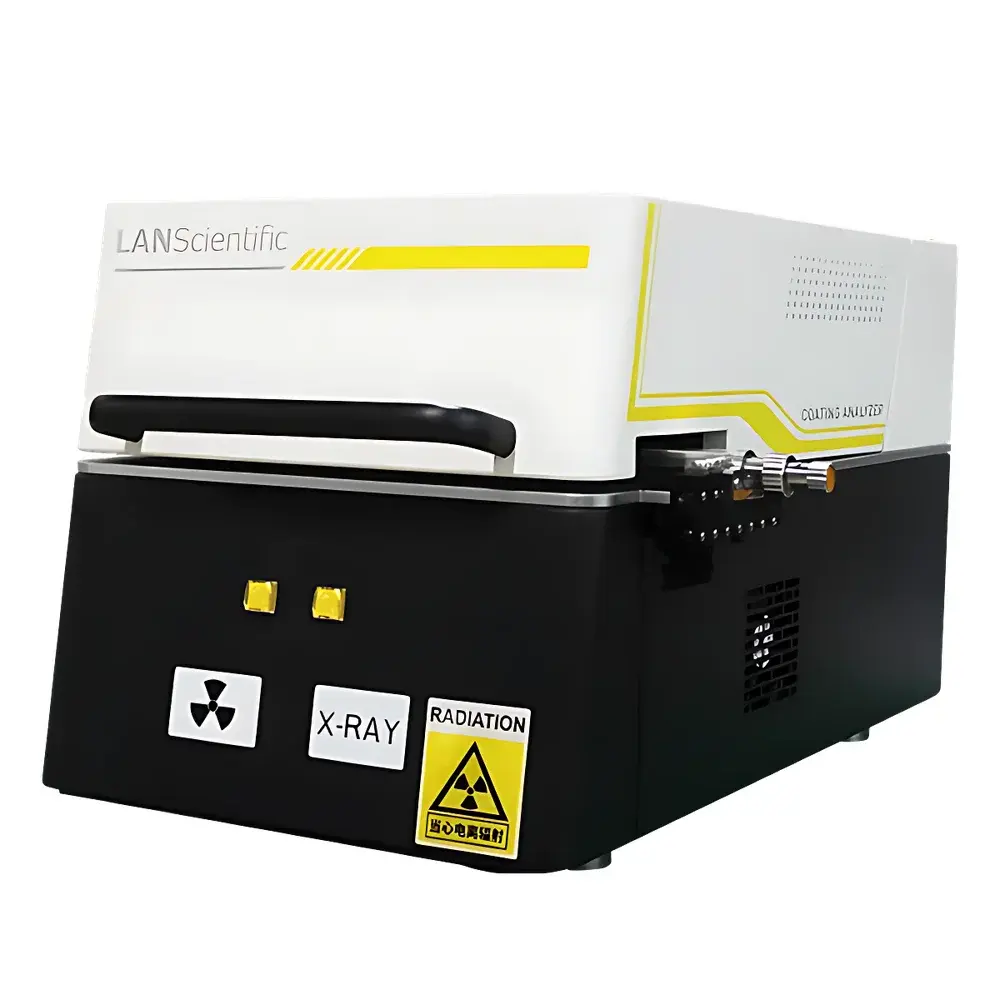
LANScientific ScopeX PILOT Benchtop X-Ray Fluorescence Coating Thickness Analyzer
| Brand | LANScientific |
|---|---|
| Origin | Jiangsu, China |
| Manufacturer Type | Manufacturer |
| Country of Origin | Domestic (China) |
| Model | ScopeX PILOT |
| Pricing | Upon Request |
Overview
The LANScientific ScopeX PILOT is a benchtop energy-dispersive X-ray fluorescence (EDXRF) coating thickness analyzer engineered for precise, non-destructive quantification of metallic and multi-layer coatings on complex substrates. Operating on the fundamental principle of characteristic X-ray emission—where primary X-rays excite atoms in the sample, causing them to emit secondary (fluorescent) X-rays with energies unique to each element—the instrument enables simultaneous determination of coating composition and thickness across up to five layers. Its downward-illumination (bottom-up) optical geometry eliminates manual focusing requirements, ensuring rapid alignment and consistent measurement positioning over irregular, recessed, or miniature components. Designed specifically for in-line process control and final QA/QC verification in surface finishing operations, the ScopeX PILOT meets the metrological rigor demanded by international export standards—including ISO 3497, ASTM B568, and EN ISO 3497—and supports traceable calibration against certified reference materials (CRMs) traceable to NIST or BAM.
Key Features
- Downward-illumination EDXRF architecture: Enables stable, repeatable measurements without re-focusing—even on curved, inclined, or recessed surfaces.
- Muti-FP fundamental parameter algorithm: Delivers matrix-corrected thickness results independent of substrate composition, minimizing reliance on empirical calibrations.
- Micro-focused X-ray excitation: Optional micro-spot collimation (down to 50 µm diameter) allows high-spatial-resolution analysis of fine features, solder pads, connector pins, and jewelry clasps.
- Motorized multi-collimator & filter selection: Software-controlled switching between 4 collimators (Ø0.1 mm to Ø1.0 mm) and 3 primary beam filters optimizes signal-to-background ratio for diverse coating systems (e.g., Au/Ni/Cu on PCBs; Cr/Fe on automotive fasteners).
- Zoom-enabled distance compensation: Integrated auto-focus distance sensor maintains optimal excitation–detection geometry across sample heights from 0 to 30 mm—critical for deep grooves, threaded parts, and stamped housings.
- Manual high-precision X-Y stage: 25 µm resolution mechanical translation facilitates targeted micro-area analysis and mapping of coating uniformity across critical zones.
Sample Compatibility & Compliance
The ScopeX PILOT accommodates samples up to 300 × 300 × 150 mm (W × D × H), including irregularly shaped electroplated hardware, semiconductor leadframes, watch components, and aerospace turbine blades. Its non-destructive nature ensures integrity preservation for precious, heat-sensitive, or post-plating-passivated surfaces. The system complies with IEC 61000-6-3 (EMC) and IEC 61000-6-4, and incorporates radiation safety interlocks per IEC 62495. Measurement protocols align with GLP documentation requirements, supporting audit-ready reporting for ISO 9001-certified production environments. Data integrity is maintained through electronic signatures, user-access controls, and full audit trails compliant with FDA 21 CFR Part 11 when paired with optional secure software licensing.
Software & Data Management
The embedded ScopeX Analyze™ software provides intuitive workflow-driven operation—from method setup and calibration to real-time spectrum acquisition and layer-by-layer deconvolution. All quantitative results include uncertainty estimation based on counting statistics and FP modeling residuals. Reports export in PDF, CSV, and XML formats, with configurable templates for SPC charting (X̄-R, Cpk), batch pass/fail flagging, and integration into MES or LIMS via OPC UA or REST API. Calibration libraries are version-controlled and support multi-instrument synchronization across global manufacturing sites.
Applications
- Real-time monitoring of electroplating bath performance (e.g., Ni, Cu, Sn, Au, Cr, Zn-Ni alloy thickness and composition stability)
- Final inspection of PCB surface finishes (ENIG, ENEPIG, immersion Ag/Sn) per IPC-4552/4556
- Quality gate screening for automotive trim, brake calipers, and fuel system components
- Conformance testing of medical device coatings (e.g., TiN on orthopedic implants) per ISO 10993-15
- Verification of decorative plating on faucets, door handles, and consumer electronics housings
- Research-grade thin-film metrology in academic and R&D labs requiring sub-micron resolution on layered metallizations
FAQ
Does the ScopeX PILOT require annual recalibration?
No—its fundamental parameter (FP) engine eliminates dependency on physical standards for routine use; however, quarterly verification using CRMs is recommended for ISO/IEC 17025 compliance.
Can it measure organic coatings such as paint or anodized layers?
No—it is optimized for elemental metal/metalloid coatings (e.g., Ni, Cr, Sn, Au, Pd, Zn, Cu, Ag) and cannot quantify polymer-based or oxide layers like anodizing or powder coating thickness.
Is remote diagnostics supported?
Yes—via secure TLS-encrypted VNC connection with prior customer authorization; firmware updates and spectral library patches are delivered through LANScientific’s authorized service portal.
What is the minimum detectable thickness for a gold layer on nickel?
Under standard configuration (1 mm collimator, 300 s count time), detection limit is ~0.015 µm for Au on Ni; with micro-focus option and extended dwell, sub-10 nm sensitivity is achievable.
Does it meet RoHS or ELV directive screening requirements?
Yes—its EDXRF platform supports qualitative and semi-quantitative screening for restricted substances (Pb, Cd, Hg, Cr⁶⁺, Br) per IEC 62321-5, though dedicated RoHS mode requires separate method validation.



