
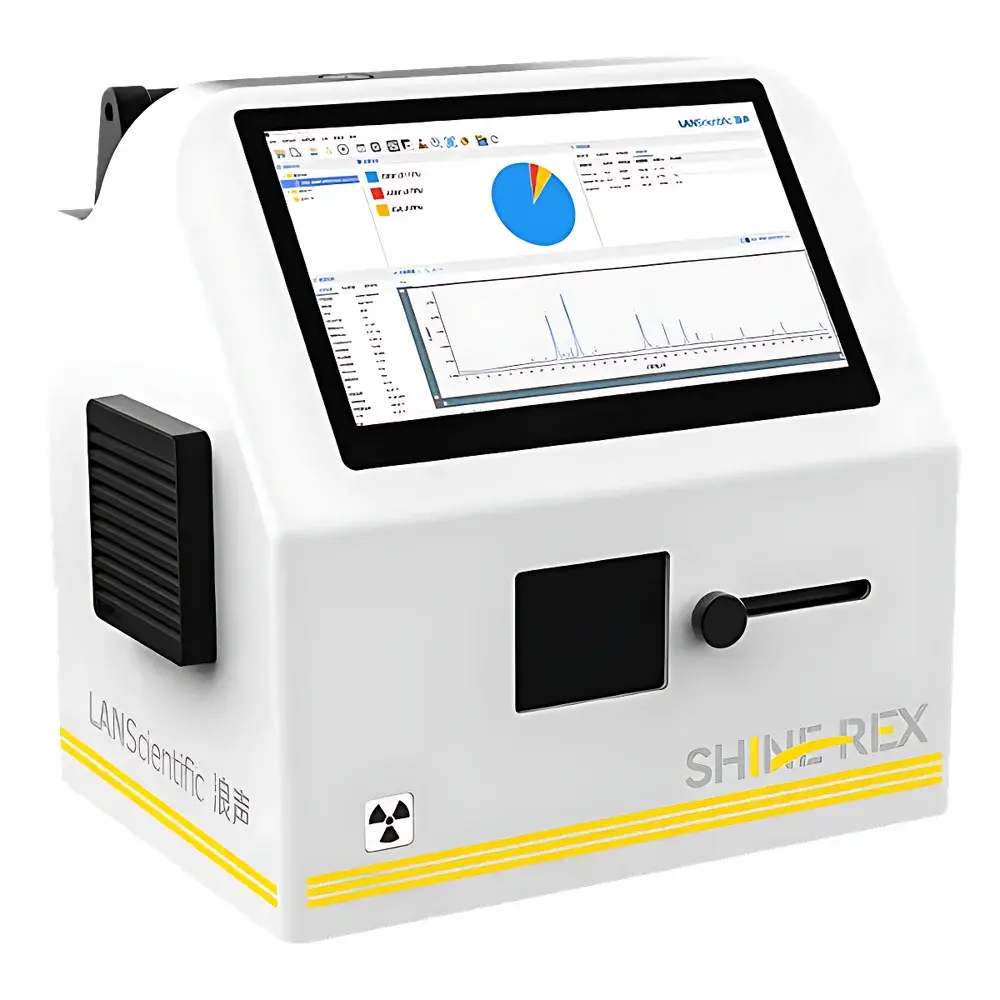
LANScientific SHINE REX900 Portable X-ray Diffractometer
| Brand | LANScientific |
|---|---|
| Origin | Jiangsu, China |
| Manufacturer Type | Original Equipment Manufacturer (OEM) |
| Product Category | Domestic |
| Model | SHINE REX900 |
| Instrument Type | Powder X-ray Diffractometer |
| Geometry | Bragg–Brentano (BB) |
| Portability | Fully Integrated Ruggedized Enclosure |
| Radiation Safety | Fully Shielded, Zero Leakage During Operation |
| Data Output Formats | Excel, PDF |
| Connectivity | USB 2.0, Bluetooth 5.0, Wi-Fi 802.11ac |
| Software | CrystalX — Automated Phase Identification & Quantification Engine |
Overview
The LANScientific SHINE REX900 Portable X-ray Diffractometer is a field-deployable, benchtop-grade powder XRD system engineered for rapid, on-site crystalline phase identification and semi-quantitative analysis. It operates on the fundamental principle of Bragg’s law (nλ = 2d sinθ), utilizing Cu-Kα radiation (λ = 1.5418 Å) to probe lattice spacings in polycrystalline or microcrystalline solid samples. Unlike conventional laboratory diffractometers requiring goniometric alignment and environmental stabilization, the SHINE REX900 integrates a fixed-anode microfocus X-ray source, a high-efficiency silicon-strip detector, and a monolithic Bragg–Brentano (BB) optical geometry—eliminating moving parts while preserving angular resolution and signal fidelity. This architecture enables robust operation under variable ambient conditions (−10 °C to +50 °C, 20–90% RH non-condensing), making it suitable for geoscience surveys, wellsite mineral logging, and industrial raw material screening where lab access is impractical.
Key Features
- True portable XRD platform with integrated shielding: no external lead aprons, interlocks, or site-specific licensing required per IEC 61010-1 and GBZ 131–2020 radiation safety standards.
- Bragg–Brentano parafocusing geometry optimized for powder samples: delivers enhanced peak intensity, reduced background scatter, and improved detection limits for trace phases (e.g., <0.5 wt% quartz in clay-rich soils or magnetite in lateritic ores).
- Extended 2θ angular range up to 120°: captures higher-order reflections critical for distinguishing structurally similar phases (e.g., anatase vs. rutile TiO₂; calcite vs. dolomite) and resolving overlapping peaks in complex mineral assemblages.
- CrystalX analytical software suite: fully automated workflow including real-time diffraction pattern acquisition, dynamic background subtraction, adaptive peak search, ICDD PDF-4+ database matching (v2023), Rietveld-refined quantification, and customizable reporting templates.
- Ruggedized IP54-rated enclosure with shock-absorbing chassis: designed for transport in off-road vehicles, helicopter drop zones, and marine platforms without recalibration or performance degradation.
Sample Compatibility & Compliance
The SHINE REX900 accepts loose powders, pressed pellets, drill cuttings, core fragments, and thin-sections (≤1 mm thickness) with minimal preparation—no grinding, mounting, or vacuum pumping required. Sample volume: 10–100 mg; particle size: <150 µm recommended. The instrument complies with ISO 17025:2017 requirements for testing laboratories when operated within validated SOPs. Its analytical output supports ASTM D7775–15 (mineralogical analysis of soils), ISO 13787:2021 (cementitious materials), and USP (pharmaceutical polymorph screening). All radiation exposure pathways are independently verified to meet IAEA SSG-46 and NCRP Report No. 147 dose limits (<1 µSv/h at 5 cm from surface).
Software & Data Management
CrystalX provides audit-trail-enabled data handling compliant with FDA 21 CFR Part 11 (electronic signatures, user-level permissions, immutable log files). Raw .xye and .raw files are stored locally with embedded metadata (operator ID, GPS coordinates, timestamp, instrument serial number). Export options include ANSI-standard XRDML, CSV for third-party Rietveld refinement (e.g., TOPAS, FullProf), and publication-ready vector graphics (SVG/PDF). Remote firmware updates and spectral library synchronization occur over encrypted Wi-Fi or TLS-secured cloud portal—no physical media required.
Applications
- Geological field mapping: real-time identification of alteration minerals (kaolinite, smectite, illite), ore indicators (jarosite, hematite), and gangue phases during prospecting.
- Petroleum wellsite logging: downhole cuttings analysis for clay typing, carbonate quantification, and diagenetic stage assessment without sample return delays.
- Industrial quality control: batch verification of synthetic minerals (fluorspar, titanium dioxide), slag composition in metallurgical processes, and phase stability in battery cathode precursors (e.g., LiCoO₂ vs. layered/spinel impurities).
- Environmental forensics: detection of heavy-metal-bearing crystalline phases (e.g., PbCrO₄, BaSO₄) in contaminated soils and sediments.
- Academic research: teaching crystallography fundamentals, validating synchrotron-derived structural models, and supporting GLP-compliant mineralogical studies.
FAQ
Does the SHINE REX900 require annual calibration or certification by an external agency?
No. The BB geometry and fixed-source/detector configuration ensure long-term angular stability. A built-in Si standard reference is used for daily verification; full system validation reports are generated automatically.
Can CrystalX perform quantitative phase analysis (QPA) without internal standards?
Yes. It implements the Reference Intensity Ratio (RIR) method and supports external standardless QPA using matrix-normalized intensities derived from the ICDD database.
Is the instrument compatible with Windows 11 and macOS Ventura or later?
CrystalX runs natively on Windows 10/11 (64-bit); macOS support is provided via Parallels Desktop or Boot Camp with licensed Windows OS.
What is the typical measurement time per sample?
Standard acquisition: 60–180 seconds depending on desired signal-to-noise ratio and phase abundance; fast-scan mode achieves usable spectra in ≤20 s for high-concentration phases.
How is data integrity maintained during wireless transmission?
All Bluetooth and Wi-Fi communications use AES-256 encryption; session keys are renegotiated per connection, and packet loss is mitigated via TCP-based retransmission protocols.




