
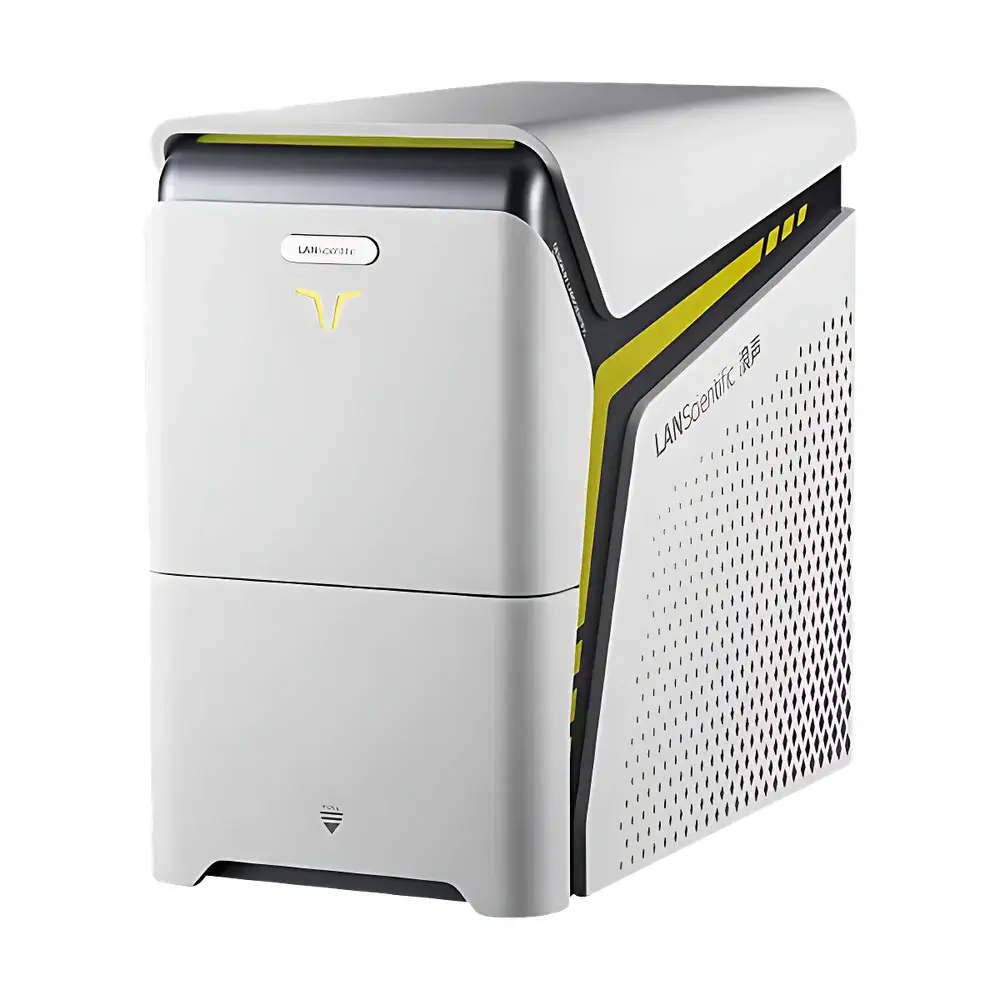
Brookfield LANScientific SuperSEM N10XL Desktop Scanning Electron Microscope with Integrated EDS
| Brand | LANScientific |
|---|---|
| Origin | Jiangsu, China |
| Manufacturer Type | Direct Manufacturer |
| Regional Category | Domestic (China) |
| Model | SuperSEM N10XL |
| Instrument Type | Desktop SEM |
| Electron Source | Tungsten Filament |
| SEM Class | Entry-Level Tungsten-Filament SEM |
| Sample Chamber Size | Up to 100 × 100 mm |
| Detector Configuration | Secondary Electron Detector (SED), Quadrant Backscattered Electron Detector (BSE), Integrated Silicon Drift Detector (SDD)-based EDS System |
| Real-Time Imaging Mode | Video-rate BSE + EDS spectral acquisition |
| Software Features | Auto-focus, Auto-stigmation, Auto-contrast/brightness, Large-area Stitching, Live EDS Mapping, Real-time Spectral Overlay |
| Power Requirement | Standard AC 220 V, 50 Hz |
| Footprint | < 0.8 m² |
Overview
The Brookfield LANScientific SuperSEM N10XL is a compact, high-integration desktop scanning electron microscope engineered for routine microstructural and elemental characterization in academic laboratories, quality control facilities, and industrial R&D environments. Utilizing a thermionic tungsten filament electron source, the system delivers stable beam current and sufficient resolution (≤ 3.5 nm at 30 kV) for morphological analysis of conductive and semi-conductive samples without requiring ultra-high vacuum or cryogenic infrastructure. Its core innovation lies in the hardware-synchronized integration of scanning electron imaging and energy-dispersive X-ray spectroscopy (EDS): the electron optical column, quadrant BSE detector, and silicon drift detector (SDD) are co-aligned and time-correlated at the firmware level, enabling concurrent acquisition of topographic, compositional, and atomic number contrast signals during a single scan pass. This architecture eliminates post-acquisition data registration errors and supports true real-time elemental mapping—critical for dynamic process monitoring, failure analysis, and iterative sample screening.
Key Features
- Integrated dual-signal acquisition: Simultaneous collection of secondary electron (SE), backscattered electron (BSE), and characteristic X-ray spectra at video frame rates (up to 30 fps at reduced resolution)
- Quadrant BSE detector with independent signal routing: Enables material contrast optimization via weighted signal synthesis (e.g., atomic number Z-contrast, topographic contrast, or phase differentiation)
- Real-time EDS mapping engine: On-the-fly spectral deconvolution and elemental quantification using standardless ZAF correction algorithms; supports live overlay of elemental distributions on SE/BSE images
- One-click operational workflow: Fully automated beam alignment, stigmation, focus, contrast/brightness adjustment, and large-area mosaic stitching—no manual aperture alignment or beam centering required
- Optical navigation system: Integrated infrared CCD camera provides real-time macro-view of the sample chamber (10×–50× magnification), accelerating region-of-interest localization and stage positioning
- Compact footprint and plug-and-play operation: Operates on standard 220 V/50 Hz mains power; no external vibration isolation table, liquid nitrogen, or dedicated HVAC required
Sample Compatibility & Compliance
The SuperSEM N10XL accommodates specimens up to 100 mm × 100 mm × 50 mm (W × L × H) in its fully accessible chamber, supporting bulk metals, ceramics, battery electrodes, polymer composites, geological thin sections, and coated substrates. Non-conductive samples may be analyzed under low-vacuum mode (10–100 Pa) with optional charge compensation or with standard carbon/tungsten sputter coating. The system complies with IEC 61000-6-3 (EMC emission standards) and IEC 61010-1 (safety requirements for electrical equipment). Data integrity and audit readiness are supported through software logging of all acquisition parameters, user actions, and calibration events—aligned with GLP documentation practices and compatible with FDA 21 CFR Part 11-compliant electronic signature modules when deployed in regulated QC/QA settings.
Software & Data Management
The proprietary SuperSEM Analysis Suite runs on Windows 10/11 and features a modular GUI designed for both novice and expert users. Core modules include: (1) Acquisition Manager for protocol-driven imaging and spectral collection; (2) EDS Quant Suite with library-based peak identification, matrix correction (ZAF/φρZ), and detection limit estimation per element; (3) MapStudio for pixel-by-pixel elemental ratio profiling, line scans, and false-color composite generation; and (4) Report Generator with customizable templates compliant with ISO 14709 and ASTM E1508 reporting conventions. All raw data—including spectrum files (.eds), image stacks (.tif/.ser), and metadata—are stored in vendor-neutral formats (HDF5-compatible containers) to ensure long-term archival accessibility and third-party interoperability.
Applications
- Materials science: Phase identification in multiphase alloys, interfacial analysis of thermal barrier coatings, porosity quantification in additive-manufactured parts
- Battery research: Cathode/anode particle cracking assessment, SEI layer thickness estimation, transition metal dissolution mapping
- Geosciences: Mineral assemblage characterization in polished rock sections, fluid inclusion morphology, clay mineral distribution
- Forensic analysis: Gunshot residue (GSR) particle morphology and Pb/Ba/Sb stoichiometry, fiber cross-section identification, paint layer stratigraphy
- Life sciences: Freeze-fractured cell membranes, biofilm architecture on implant surfaces, calcified tissue microstructure (with appropriate fixation and coating)
FAQ
What vacuum level does the SuperSEM N10XL operate at?
The system operates in high vacuum mode (≤ 5 × 10⁻³ Pa) for optimal EDS resolution and beam stability; low-vacuum mode (10–100 Pa) is available for non-conductive or hydrated specimens.
Is the EDS detector liquid-nitrogen-cooled?
No—the integrated SDD uses Peltier cooling only, eliminating the need for LN₂ refills while maintaining Mn Kα resolution ≤ 127 eV.
Can the software export data for third-party analysis (e.g., Python or MATLAB)?
Yes: Spectrum and image data are exportable in ASCII, CSV, and HDF5 formats with full metadata headers for reproducible computational workflows.
Does the system support automated particle analysis?
Yes—via the optional Particle Analysis Module, which performs size/shape classification, counting, and statistical reporting per ISO 13322-1 and ASTM E1245 guidelines.
What maintenance intervals are recommended for the tungsten filament?
Filament lifetime averages 150–200 operating hours under typical 20–30 kV conditions; replacement is user-serviceable in <15 minutes without breaking vacuum.





