
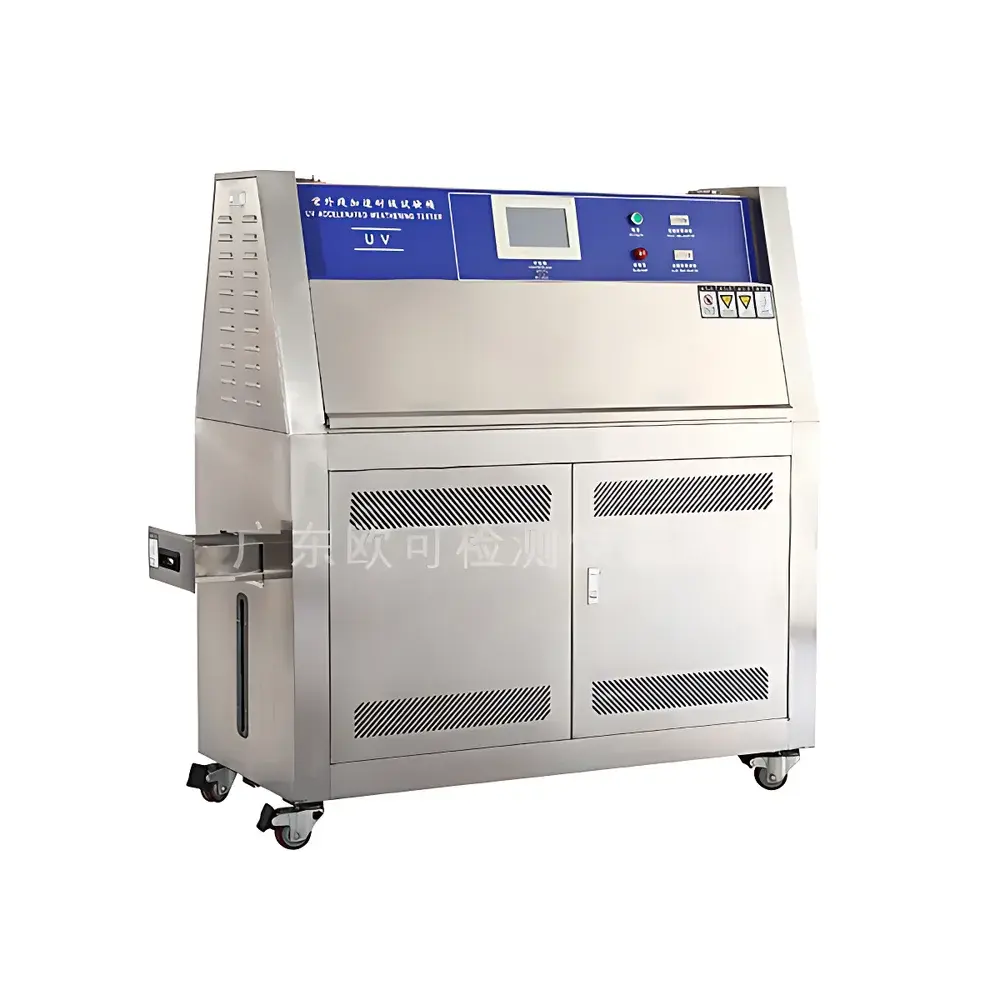
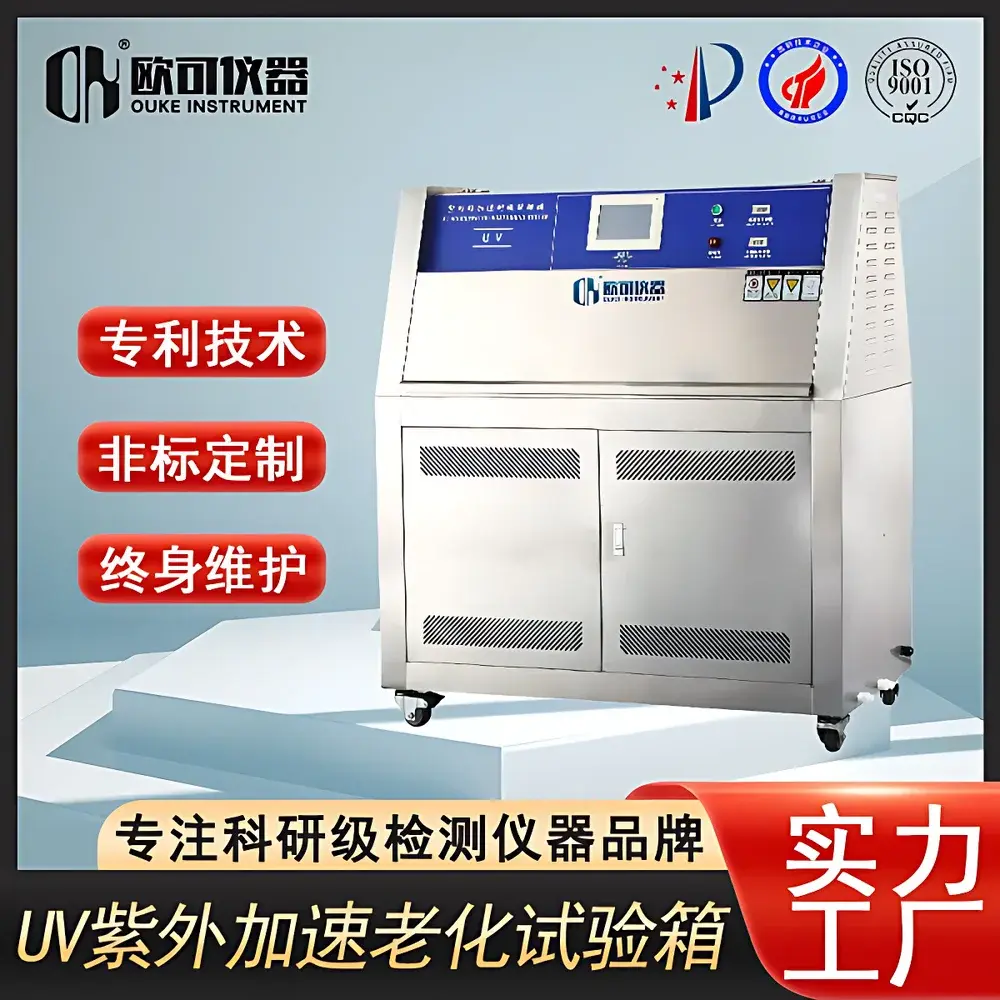
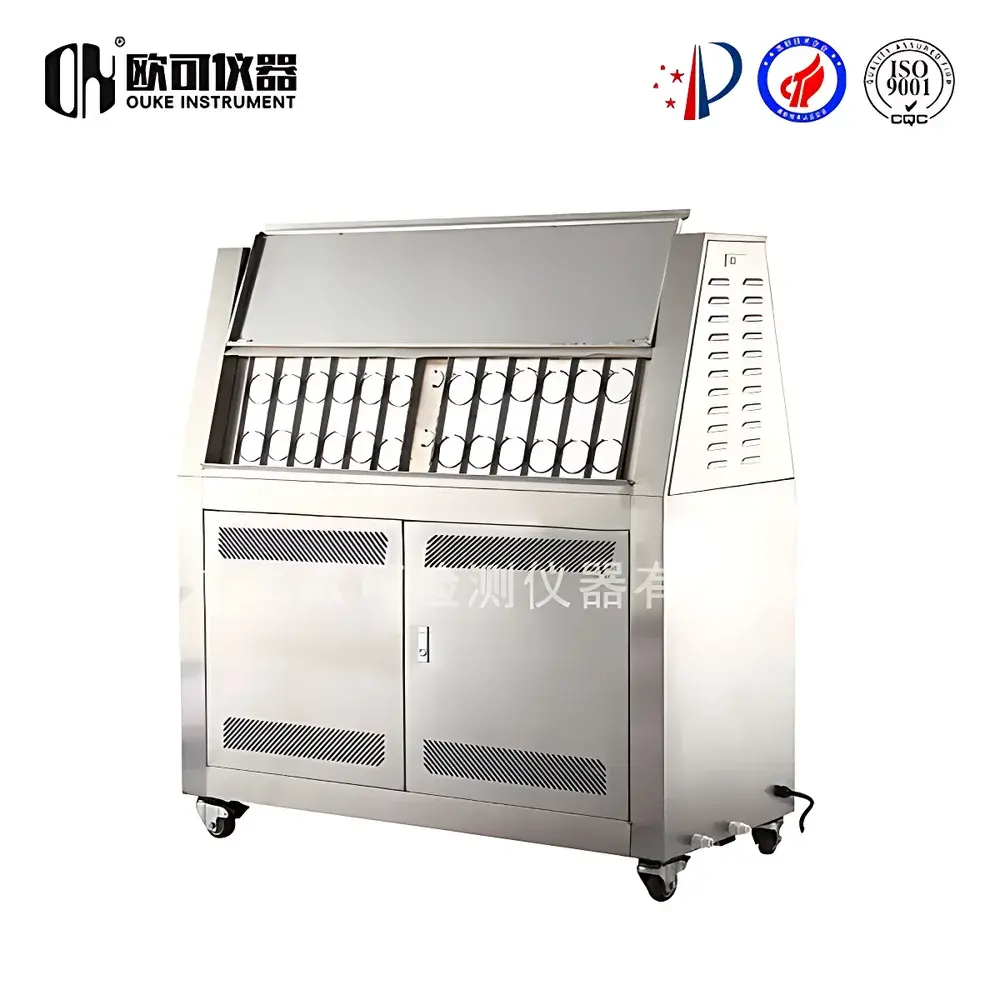
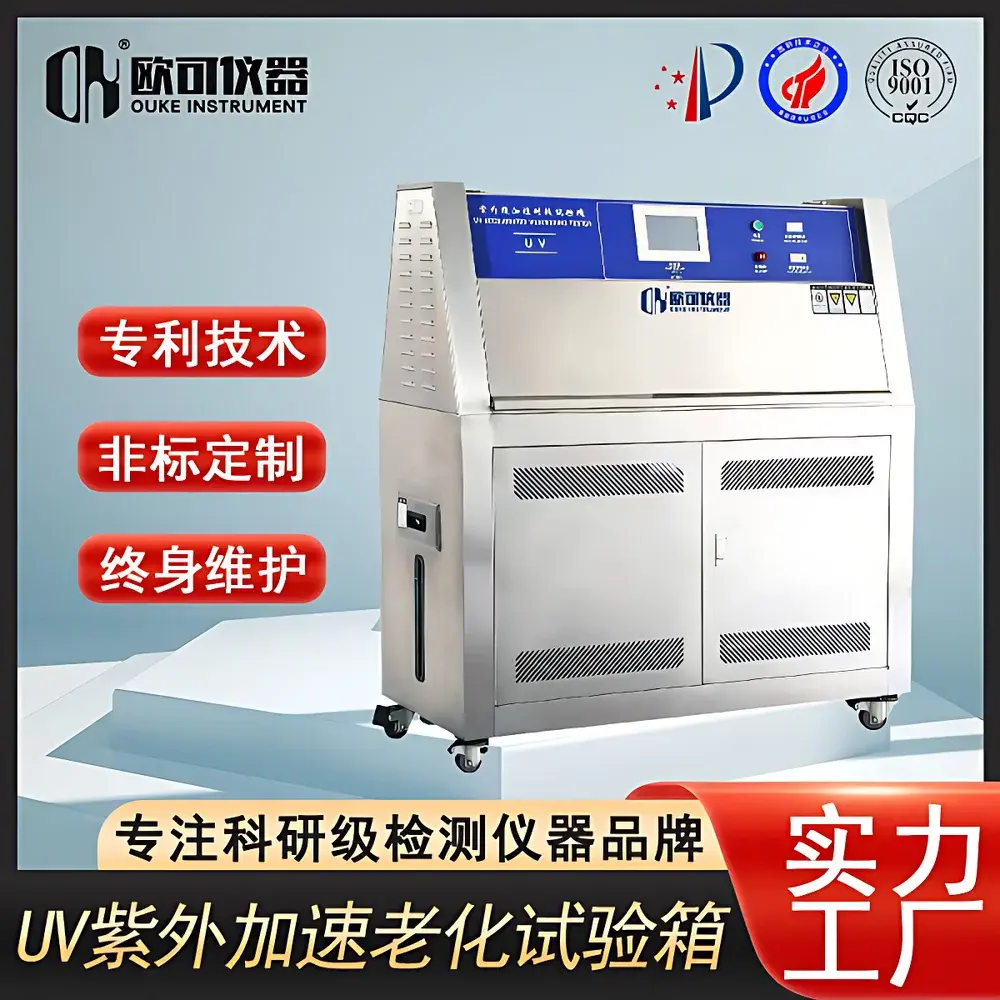
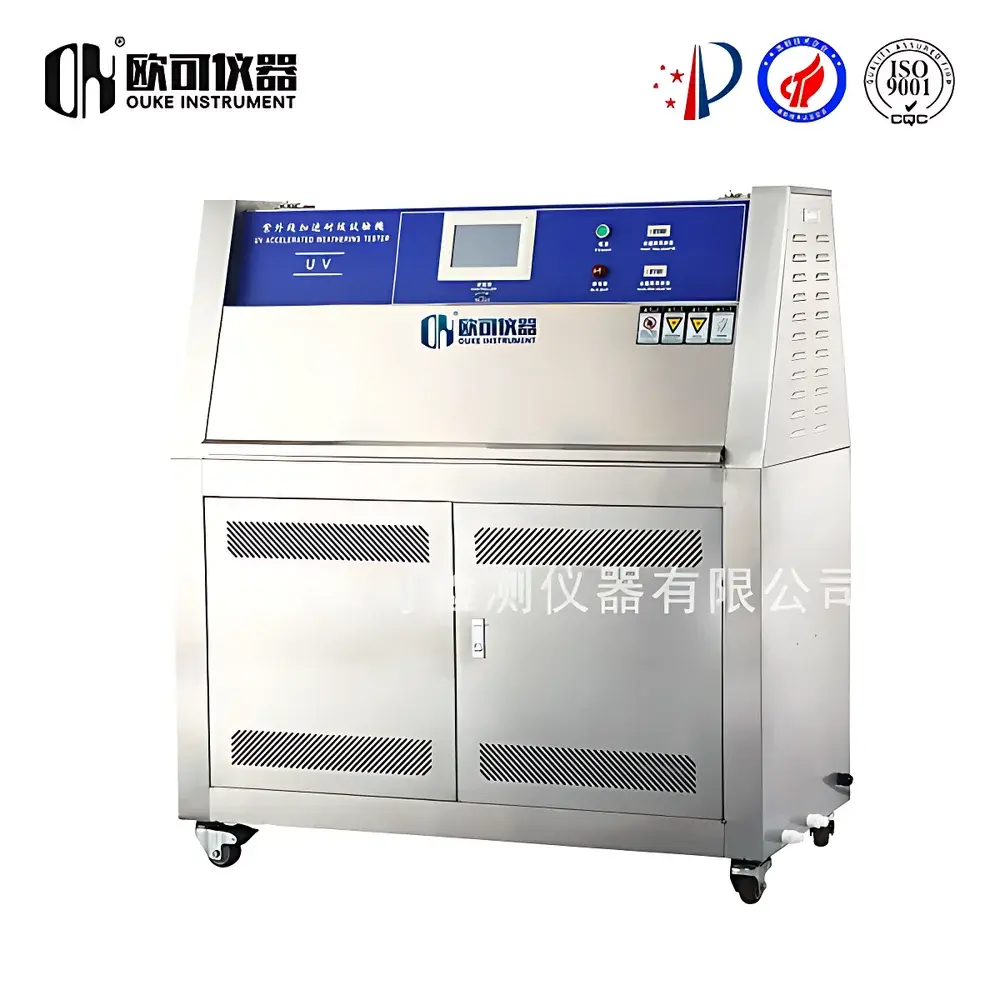
OK-UV-290.1 UV Aging Test Chamber
| Brand | OK Instruments |
|---|---|
| Origin | Guangdong, China |
| Manufacturer Type | Direct Manufacturer |
| Country of Origin | China |
| Model | OK-UV-290.1 |
| Humidity Range | ≥95% RH (actual chamber humidity) |
| UV Lamp Power | 40 W per lamp |
| Irradiance Range | 0.72 W/m² (at 340 nm reference wavelength) |
| Exposure Time | 1–9999 h (adjustable) |
| Black Panel Temperature Range | 75 °C (max) |
| UV Wavelength Range | 280–400 nm (UVA/UVB spectrum) |
| Internal Chamber Dimensions (L×W×H) | 1170 × 400 × 400 mm |
| Temperature Control Accuracy | ≤ ±0.5 °C |
| Temperature Uniformity | ≤ ±2 °C or ≤ ±3% |
| Lamp Lifetime | ~2000 h (typical) |
| Construction Material | SUS#304 stainless steel (inner & outer chamber) |
| Heating System | U-shaped titanium alloy heating elements |
| Safety Features | Interlocked door cut-off for UV lamps, over-temperature protection, low-water-level cutoff |
| Power Supply | AC 220 ±5 V, 50 ±0.5 Hz |
Overview
The OK-UV-290.1 UV Aging Test Chamber is an engineered environmental test system designed to accelerate material degradation under controlled ultraviolet (UV) radiation, thermal stress, and condensation cycles—mimicking key outdoor weathering factors. Based on the principle of photochemical degradation, it subjects specimens to calibrated UV irradiance (primarily in the 280–400 nm range, covering UVA and UVB bands), elevated black-panel temperatures (up to 75 °C), and high-humidity condensation phases (≥95% RH). Unlike xenon arc or carbon arc testers, this chamber employs fluorescent UV lamps optimized for spectral stability and reproducibility, enabling standardized simulation of solar UV exposure without significant infrared heat load. It is widely deployed in R&D laboratories, quality assurance departments, and certification bodies to evaluate polymer durability, coating adhesion, automotive trim resistance, and photostability of packaging materials prior to field deployment.
Key Features
- Stable UV irradiance output at 0.72 W/m² (measured at 340 nm), compliant with ASTM G154 spectral weighting requirements
- Black panel temperature control up to 75 °C with precision ≤ ±0.5 °C and uniformity ≤ ±2 °C across test area
- Condensation cycle generation via controlled water reservoir heating—no external humidifier required
- Dual-safety interlock: automatic UV lamp deactivation upon door opening, plus real-time monitoring of water level and chamber temperature
- Robust SUS#304 stainless steel construction for corrosion resistance and long-term chamber integrity
- Modular UV lamp array (40 W per lamp) with average service life of ~2000 hours; easy lamp replacement without tools
- Programmable exposure timer supporting durations from 1 hour to 9999 hours in 1-minute increments
Sample Compatibility & Compliance
The OK-UV-290.1 accommodates flat or low-profile specimens up to 1170 mm (L) × 400 mm (W) × 400 mm (H) internal volume. Standard sample holders support ISO 178, ASTM D638-compliant plaques, paint panels (e.g., Q-Panel Q-Lab standard size), and automotive interior trim samples. The system is configured to meet core international standards including ASTM G154 (Cycle 1 & 4), ASTM D4329, ASTM D4587, ISO 4892-3 (Method A), SAE J2020, and GB/T 14522. All operational parameters—including irradiance setpoint, temperature ramp profiles, and condensation duration—are traceable and configurable to align with GLP-compliant test protocols. While not inherently 21 CFR Part 11 validated, the chamber’s mechanical logging and manual parameter recording support audit-ready documentation when integrated into a validated lab management system.
Software & Data Management
The OK-UV-290.1 operates via a dedicated microprocessor-based controller with LCD interface, supporting local programming of multi-step UV/condensation/thermal cycles. Real-time display shows current black-panel temperature, elapsed exposure time, and lamp status. Data logging is performed internally (non-volatile memory) for up to 30 test records, each storing start/end timestamps, peak temperature, and cumulative irradiance-equivalent hours. Export is supported via USB port (CSV format) for post-processing in Excel or LIMS-compatible platforms. Optional RS485 communication enables integration with centralized facility monitoring systems using Modbus RTU protocol. No cloud connectivity or proprietary software installation is required—ensuring compatibility with air-gapped QA environments and minimizing validation overhead.
Applications
- Accelerated weathering evaluation of automotive exterior plastics (PP, ABS, PC blends) and interior upholstery fabrics
- Photostability screening of pharmaceutical packaging films (e.g., blister foil lamination, HDPE bottles)
- UV resistance validation of architectural coatings, wood finishes, and PVC window profiles
- Quality conformance testing for LED encapsulants, optical adhesives, and photovoltaic backsheet materials
- Comparative aging studies in academic polymer science labs investigating degradation kinetics and antioxidant efficacy
FAQ
What UV spectrum does the OK-UV-290.1 emit, and how is it measured?
The chamber uses UVA-340 fluorescent lamps emitting primarily between 280–400 nm, with peak intensity centered at 340 nm. Irradiance is calibrated using a NIST-traceable UV radiometer referenced to ASTM G154 spectral power distribution.
Can the chamber perform cyclic testing combining UV, condensation, and dark periods?
Yes—the controller supports programmable sequences including UV-only, UV + condensation, and dark condensation cycles, aligned with ASTM G154 Cycle 1 (UV only) and Cycle 4 (UV + condensation).
Is the humidity value of ≥95% RH actively controlled or passively generated?
Humidity is passively generated via heated water pan condensation; no steam generator or humidifier is used. Relative humidity is maintained ≥95% RH during condensation phase through precise thermal management of the chamber floor reservoir.
How often must UV lamps be replaced, and is calibration required after replacement?
Lamps are rated for ~2000 hours of operation. Post-replacement, users must reset the irradiance counter and verify output using an external radiometer; no factory recalibration is needed if lamps meet OEM spectral specifications.
Does the system comply with ISO/IEC 17025 or FDA 21 CFR Part 11 requirements?
The base unit provides auditable parameter logs but lacks electronic signature, audit trail, or user role management. Full Part 11 compliance requires integration with validated third-party LIMS or ELN systems.



