
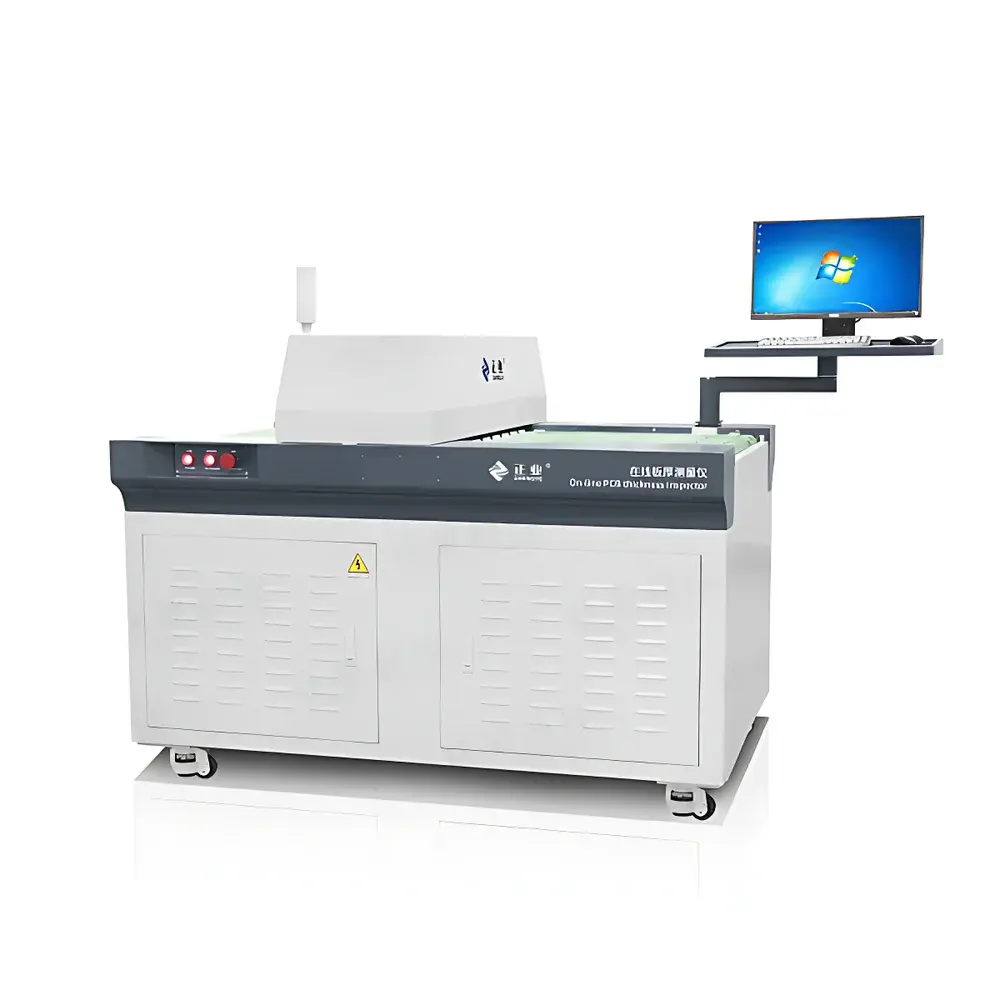
Zhengye BT11 Online PCB Thickness Measurement System
| Brand | Zhengye |
|---|---|
| Origin | Guangdong, China |
| Manufacturer Type | OEM/ODM Manufacturer |
| Country of Origin | China |
| Model | BT11 |
| Price Range | USD 70,000 – 140,000 |
| Measurement Principle | Non-contact laser triangulation |
| Measurement Range | 0–12 mm |
| Accuracy | ±5 µm (calibrated standard plate) |
| Sample Size Compatibility | 250 mm × 250 mm to 650 mm × 620 mm |
| Measurement Cycle Time | 6–8 s per board |
| Probe Positioning Accuracy | ±3 mm |
| Measurement Points | Configurable single point, or software-defined uniform grid (5-point or 9-point patterns) |
Overview
The Zhengye BT11 Online PCB Thickness Measurement System is an industrial-grade, non-contact thickness metrology solution engineered for real-time dimensional verification during printed circuit board (PCB) manufacturing and post-lamination processes. Based on high-stability laser triangulation technology, the system delivers traceable, repeatable thickness data without mechanical contact—eliminating surface deformation risks associated with tactile probes or micrometer-based offline methods. Designed for integration into automated production lines, the BT11 operates inline after hot-press lamination or before AOI and electrical testing stations, enabling immediate process feedback and statistical process control (SPC) at critical quality gates. Its optical architecture supports consistent measurement across dielectric substrates—including FR-4, polyimide, and high-frequency laminates—as well as rigid-flex hybrids and molded interconnect devices (MIDs), making it suitable for advanced packaging and automotive electronics applications where dimensional stability directly impacts solder joint reliability and impedance control.
Key Features
- Non-destructive laser triangulation measurement with zero sample contact—preserves surface integrity and eliminates wear-related calibration drift.
- Programmable multi-point acquisition: configurable single-point verification or standardized 5-point or 9-point grid mapping aligned with IPC-6012 and IPC-A-600 thickness sampling requirements.
- Integrated motion synchronization interface for seamless coordination with conveyor belt encoders or robotic handling systems (RS-422/Encoder input support).
- Robust environmental compensation: built-in temperature and ambient light monitoring algorithms mitigate thermal expansion effects and optical interference in factory-floor conditions.
- Real-time thickness deviation mapping: generates color-coded cross-sectional profiles and thickness variance heatmaps for rapid root-cause analysis of lamination non-uniformity or press alignment issues.
- IP65-rated enclosure with ESD-safe optics housing—certified for operation in Class 10,000 cleanrooms and ISO 9001-certified production environments.
Sample Compatibility & Compliance
The BT11 accommodates standard PCB panel sizes from 250 mm × 250 mm up to 650 mm × 620 mm, supporting both bare boards and assembled PCBA with component heights ≤15 mm (within laser standoff range). It maintains measurement fidelity on substrates with surface roughness (Ra) up to 3.2 µm and warpage ≤0.8 mm (per IPC-TM-650 2.2.14). Calibration traceability follows ISO/IEC 17025 procedures using NIST-traceable gauge blocks and certified step-height standards. The system complies with CE machinery directive (2006/42/EC), RoHS 2011/65/EU, and meets electromagnetic compatibility (EMC) requirements per EN 61326-1. Optional validation packages support IQ/OQ documentation for FDA-regulated medical device PCB suppliers operating under 21 CFR Part 820 and IATF 16949 automotive quality management systems.
Software & Data Management
The BT11 runs on a deterministic real-time OS with embedded VisionOS firmware and is managed via Zhengye’s proprietary ThicknessControl Suite v3.2—a Windows-based application supporting dual-mode operation: standalone workstation mode and OPC UA-enabled factory integration. Software features include SPC charting (X̄-R, Cpk/Ppk), automatic pass/fail classification against user-defined upper/lower specification limits (USL/LSL), and audit-trail logging compliant with FDA 21 CFR Part 11 (electronic signatures, immutable event logs, role-based access control). Raw point-cloud data and calibrated thickness values are exportable in CSV, XML, and industry-standard SEMI E142 formats for MES/ERP linkage. All calibration events, operator actions, and system diagnostics are timestamped and archived with SHA-256 hash integrity verification.
Applications
- Post-lamination thickness verification of multilayer PCB cores and prepreg stacks prior to drilling and plating.
- In-process monitoring of copper-clad laminate (CCL) thickness uniformity in substrate fabrication lines.
- Final QA inspection of HDI and rigid-flex boards where Z-axis tolerance stacking affects microvia reliability.
- Automotive Tier-1 supplier audits requiring IPC-6012 Class 3 thickness compliance reporting.
- Contract manufacturers performing turnkey PCB assembly for aerospace avionics, where thickness variation correlates with CTE mismatch-induced delamination risk.
FAQ
What is the maximum allowable PCB warpage for achieving ±5 µm accuracy?
The ±5 µm specification applies only to flat reference standards. For production PCBs, the system achieves ±25 µm accuracy when board bow/twist is maintained below 0.8 mm per IPC-TM-650 2.2.14.
Can the BT11 measure boards with tall surface-mount components?
Yes—provided component height does not exceed 15 mm and the laser field-of-view remains unobstructed; optional tilting stage integration is available for angled scanning of high-profile assemblies.
Is third-party calibration certification included with purchase?
A factory calibration certificate (traceable to NIST standards) is provided with each unit; ISO/IEC 17025-accredited external calibration services are available as an annual maintenance option.
How is measurement data synchronized with existing MES platforms?
Via OPC UA server implementation (conformance class: UA Embedded Device), supporting structured data push to Siemens Opcenter, Rockwell FactoryTalk, or custom RESTful API endpoints.
Does the system support Gage R&R studies?
Yes—the embedded statistical module includes ANOVA-based Gage R&R calculation per MSA 4th Edition, with automated report generation for GR&R %Study Variation and %Tolerance metrics.



