
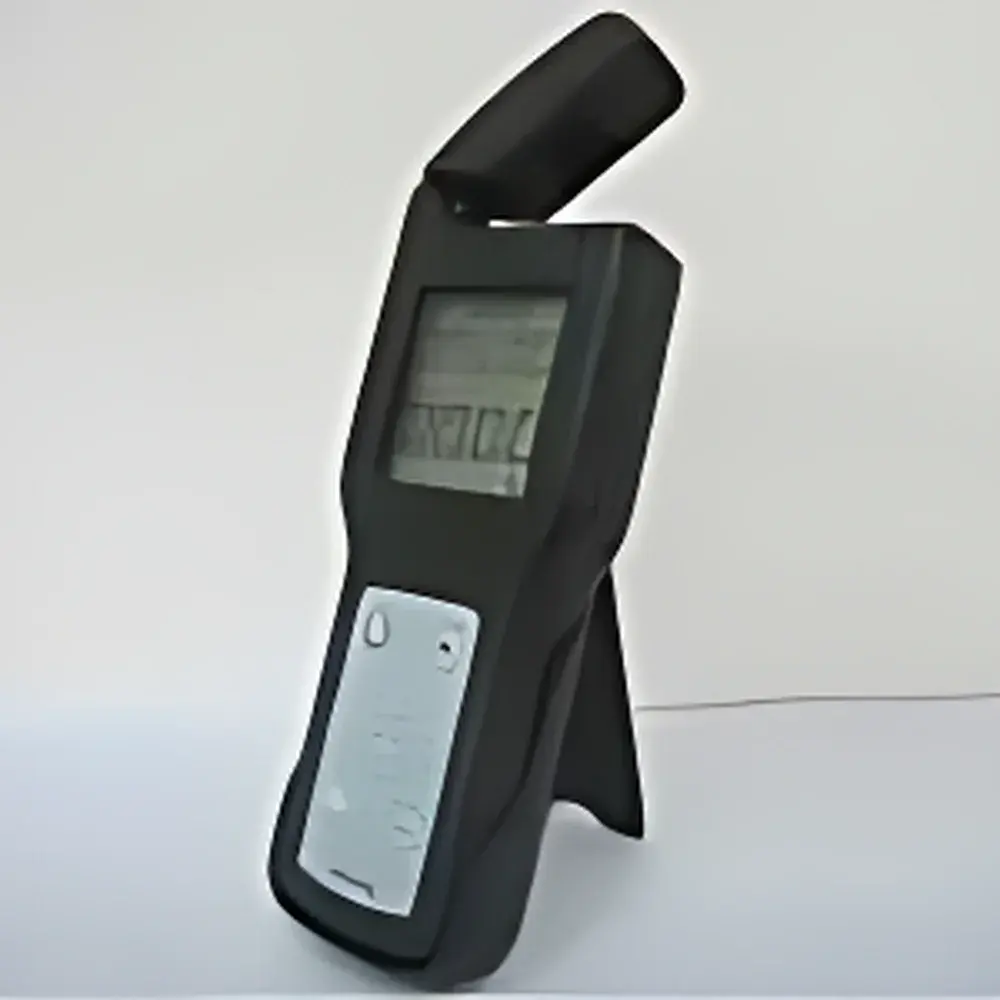
Hamamatsu BHP9510 Handheld ATP Bioluminescence Analyzer
| Brand | Hamamatsu Photonics (BHP) |
|---|---|
| Model | BHP9510 |
| Type | Portable ATP Analyzer |
| Detection Principle | Firefly Luciferase–Based Bioluminescence Assay |
| Biological Agent | *Photobacterium phosphoreum* or *Aliivibrio fischeri* (freeze-dried luminescent bacteria, optionally firefly luciferase reagent system) |
| Spectral Detection Range | 320–1000 nm |
| Background Count Rate | 0 cps |
| Measurement Range | 0–65535 RLU (Relative Light Units) |
| Detection Time | 5–300 s (user-adjustable) |
| Sensitivity | ≤1 × 10⁻¹⁵ mol ATP |
| Data Storage | ≥1000 test records + 100 configurable upper/lower alarm thresholds |
| Display & Output | RLU only (no concentration conversion built-in |
| Power Supply | Two AA alkaline or rechargeable batteries |
| Battery Life | ≥8 h continuous operation |
| Weight | 258 g (including batteries) |
| Dimensions | 202 × 78 × 30 mm |
| Interface | USB 2.0 (for data export and firmware update) |
| Operating Environment | 5–40 °C, 10–90% RH (non-condensing) |
| Sample Interface | Integrated sterile swab with pre-moistened buffer (single-use, CE-marked for hygiene applications) |
| Compliance | Designed to support ISO 22000, HACCP, and FDA Food Code Chapter 4 verification protocols |
Overview
The Hamamatsu BHP9510 Handheld ATP Bioluminescence Analyzer is an engineered field-deployable instrument designed for rapid, quantitative assessment of biological contamination via adenosine triphosphate (ATP) detection. It operates on the well-established firefly luciferase–luciferin bioluminescent reaction: in the presence of molecular oxygen and magnesium ions, luciferase catalyzes the oxidation of D-luciferin using ATP as a co-substrate, emitting photons at ~560 nm. The emitted light intensity—measured in Relative Light Units (RLU)—is directly proportional to ATP concentration under controlled reagent excess conditions. As ATP is present in all metabolically active cells (bacteria, yeasts, molds, and residual organic matter), the BHP9510 provides a surrogate metric for total viable microbial load or surface organic residue. Unlike culture-based methods requiring 24–72 h incubation, this analyzer delivers results in as little as 15 seconds post-swab extraction—enabling real-time hygienic process verification in critical control points.
Key Features
- Compact, ergonomic handheld form factor optimized for glove-compatible operation in food processing, clinical, and environmental settings.
- Dual-mode detection capability: compatible with both freeze-dried marine luminescent bacteria (*Photobacterium phosphoreum*) and purified firefly luciferase–luciferin reagents—supporting flexibility across regulatory and application requirements.
- High-sensitivity photomultiplier tube (PMT)-based optical detection system with spectral response spanning 320–1000 nm, ensuring robust signal capture across bioluminescent emission profiles.
- Zero-background-count optical architecture minimizes noise interference, enhancing low-level ATP quantification reproducibility (CV < 5% at 10⁻¹⁴ mol ATP).
- On-device RLU display with user-configurable pass/fail thresholds; no embedded algorithmic conversion to CFU/mL—maintains traceability to lab-validated calibration curves per ISO 21528-2 and AOAC Official Method 2012.05.
- USB 2.0 interface enables secure, non-networked data transfer to LIMS or QA documentation systems; firmware supports audit-log generation for GLP/GMP environments.
Sample Compatibility & Compliance
The BHP9510 is validated for use with standardized environmental swabs (e.g., 3M™ Clean-Trace™, Hygiena™ UltraSnap™) pre-moistened in ATP-free extraction buffer. It accommodates liquid samples (e.g., rinse water, filter eluates) when introduced via calibrated pipette into the integrated reaction chamber. Instrument design adheres to IEC 61326-1:2013 (EMC for laboratory equipment) and IP54 ingress protection rating. While not certified for medical device use under FDA 21 CFR Part 820, its operational parameters align with FDA Food Code §4-202.11 (ATP-based cleaning verification), ISO 14644-1 (cleanroom surface monitoring), and EU Regulation (EC) No 852/2004 Annex II (food premises hygiene validation). Routine performance verification is recommended using NIST-traceable ATP standards (e.g., Sigma-Aldrich A7699).
Software & Data Management
Data acquisition and reporting are managed through the embedded firmware—no proprietary desktop software required. Each measurement stores timestamp, operator ID (manually entered), RLU value, and pass/fail status based on user-defined thresholds. Exported CSV files contain raw RLU, measurement duration, battery level, and swab lot ID (if manually input). The USB interface supports read-only data extraction to prevent unauthorized firmware modification—a key requirement for regulated environments subject to 21 CFR Part 11 Annex 11 compliance assessments. Audit trails are retained onboard for ≥1000 entries and include event timestamps for power-on, threshold changes, and data export actions.
Applications
- Routine verification of sanitation efficacy on food contact surfaces (conveyor belts, cutting boards, stainless steel tanks) per HACCP prerequisite programs.
- Point-of-use assessment of drinking water distribution systems and filtration integrity via ATP-based biofilm indicator testing.
- Healthcare facility environmental monitoring: rapid evaluation of endoscope reprocessing efficacy, ICU bedrails, OR tables, and air handling unit condensate pans.
- Pharmaceutical cleanroom gowning room and laminar flow hood surface qualification prior to aseptic operations.
- Validation of CIP/SIP cycle endpoints in bioprocessing by detecting residual biomass on piping interiors using flush sampling.
FAQ
Does the BHP9510 provide direct CFU/mL or colony count output?
No. It reports only RLU values. Conversion to microbial load requires laboratory-derived calibration curves specific to sample matrix, swab type, and reagent batch.
Can the instrument be used with third-party ATP reagents?
Yes—provided the reagent system is compatible with the 320–1000 nm detection window and delivers stable bioluminescent kinetics within the 5–300 s integration window.
Is firmware upgrade supported in the field?
Yes, via USB-connected Windows PC using Hamamatsu-provided signed firmware binaries; upgrade history is logged in the audit trail.
What is the recommended frequency for instrument performance verification?
Daily before first use using a 1 × 10⁻¹³ mol ATP standard; full calibration verification every 30 days or after sensor cleaning.
Does the device meet GLP data integrity requirements?
It supports core GLP principles (traceable measurements, operator identification, immutable audit logs) but requires site-specific validation per OECD Principles of GLP Section 5.2.
Related Products







