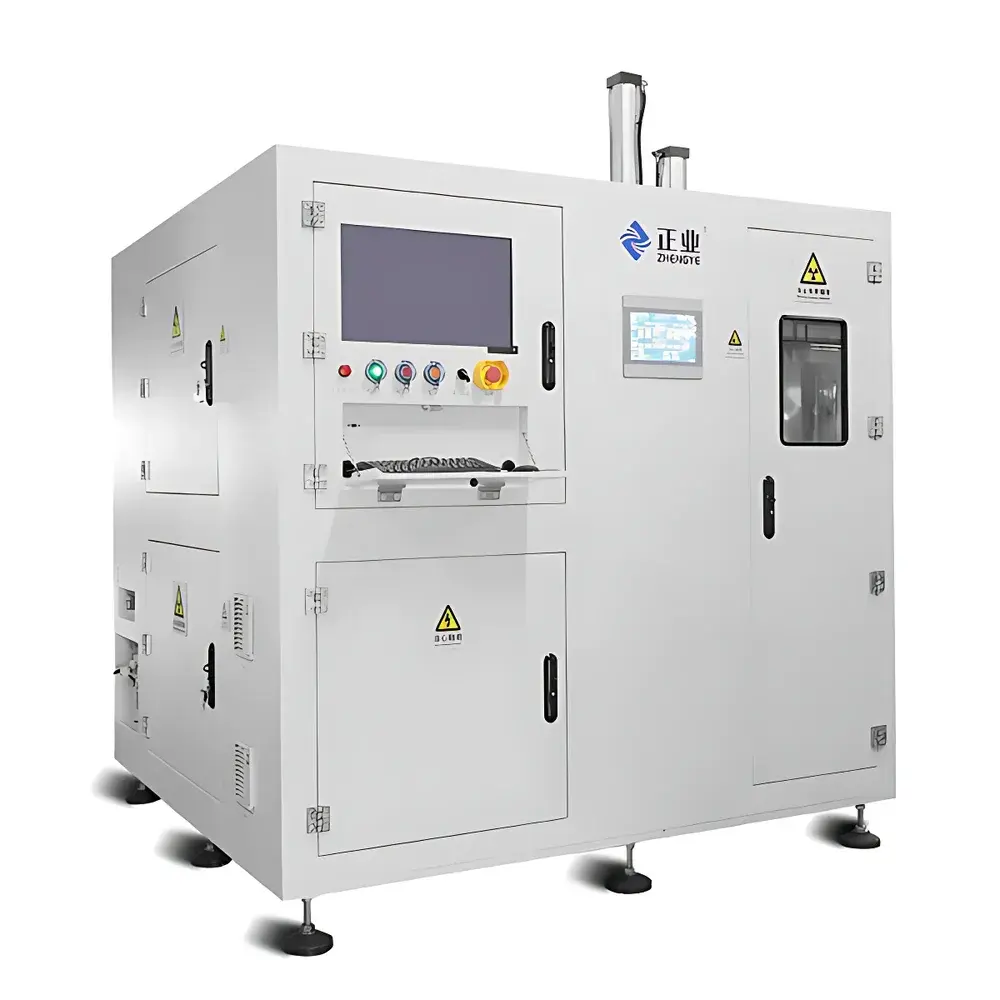
Zhengye Semiconductor Discrete Component Online X-Ray Inspection System DV-SCX1300
| Brand | Zhengye |
|---|---|
| Origin | Guangdong, China |
| Manufacturer Type | OEM Manufacturer |
| Country of Origin | China |
| Model | DV-SCX1300 |
| Price Range | USD 70,000 – 112,000 |
| Tray Compatibility | 7", 11", 13" standard JEDEC trays |
| Throughput | ≤3 min per 7" tray (up to 3,000 pcs) |
| Radiation Safety | Compliant with IEC 61000-6-4, GBZ 126-2011, and ISO 15801 Class I interlocked enclosure design |
| Integration | AGV interface, SECS/GEM optional, MES/ERP data upload via OPC UA or RESTful API |
| Imaging System | Microfocus X-ray source (≤5 µm focal spot), flat-panel digital detector (≥12-bit dynamic range, 100 µm pixel pitch) |
| Motion Control | 4-axis robotic handler with ±0.02 mm repeatability |
| Software | Proprietary real-time image reconstruction and defect classification engine with audit trail, user-level access control, and 21 CFR Part 11–compliant electronic signature support |
Overview
The Zhengye Semiconductor Discrete Component Online X-Ray Inspection System DV-SCX1300 is an industrial-grade, fully automated non-destructive testing (NDT) platform engineered for high-throughput inline inspection of discrete semiconductor devices—including diodes, transistors, MOSFETs, thyristors, and small-outline ICs—during final test and packaging stages. Utilizing microfocus X-ray transmission imaging, the system captures internal structural integrity data without physical contact or sample preparation. X-rays generated by a stabilized microfocus tube penetrate device packages (e.g., TO-220, SOT-23, DPAK, SOIC), revealing hidden defects such as bond wire misalignment, voiding in die attach, lead frame deformation, solder bridging, and foreign material contamination. The resulting radiographic images are acquired by a high-resolution flat-panel detector and processed in real time using deterministic image reconstruction algorithms optimized for low-contrast, high-noise semiconductor package geometries.
Key Features
- Fully integrated 4-axis robotic handling system with sub-50 µm positioning accuracy and programmable tray indexing for 7″, 11″, and 13″ JEDEC-standard trays—enabling true lights-out operation without manual intervention.
- Real-time image acquisition and analysis architecture: simultaneous image capture, geometric correction, contrast enhancement, and defect classification occur during tray scanning—eliminating post-acquisition batch processing delays.
- Proprietary traceability algorithm (“Replay Mapping”) dynamically correlates each detected NG location with its physical coordinate on the tray grid, enabling precise pick-and-place targeting for downstream automated sorting stations.
- Multi-modal human-machine interface: drag-and-zoom image viewer with dual-pane comparison mode; double-click navigation from replay map to original projection image; overlay-enabled annotation for root cause tagging (e.g., “wire lift”, “die tilt”, “void >15% area”).
- Comprehensive integration stack: supports barcode/2D code scanning at load station; bidirectional data exchange with MES via configurable JSON/OPC UA payloads; optional SECS/GEM protocol for fab automation environments.
- Triple-layer radiation safety architecture: interlocked access doors, real-time dose monitoring sensors, and shielded enclosure meeting Class I requirements per GBZ 126-2011 and ISO 15801—certified by third-party NDT safety auditors.
Sample Compatibility & Compliance
The DV-SCX1300 accommodates standard discrete semiconductor packages ranging from 1.2 mm × 0.8 mm (0402 SMD) up to 15.5 mm × 10.5 mm (TO-247), including plastic-molded, ceramic, and metal-can variants. Tray-based feeding supports both tape-and-reel converted trays and bare-die carrier formats. All mechanical and electrical subsystems conform to IEC 61000-6-2 (immunity) and IEC 61000-6-4 (emission) standards. Radiation shielding validation complies with national occupational exposure limits (GBZ 126-2011) and aligns with ISO 15801 Annex B for industrial X-ray equipment. Software functionality meets ALCOA+ principles for data integrity and includes full 21 CFR Part 11 compliance features: role-based authentication, immutable audit trails, electronic signatures with biometric or PKI options, and configurable retention policies.
Software & Data Management
The embedded inspection software—Zhengye X-Insight v4.2—is built on a deterministic real-time OS kernel with deterministic latency <8 ms per frame. It provides three operational modes: Auto-Run (fully unattended), Guided Review (operator-assisted NG verification), and Engineering Mode (algorithm tuning, threshold calibration, ROI definition). Image metadata—including acquisition parameters (kV, µA, exposure time), stage position, tray ID, timestamp, and operator ID—is embedded in DICOM-SR compliant headers and archived in encrypted SQLite databases. Raw projections and classified results are exportable in HDF5 format for offline metrology correlation or AI model retraining. Data export interfaces include RESTful API endpoints for ERP synchronization and MQTT brokers for factory-wide event streaming.
Applications
This system serves critical quality assurance functions across semiconductor back-end manufacturing: incoming material inspection of bare dies and lead frames; post-encapsulation verification of wire bonding integrity and mold compound fill uniformity; final test lot sampling for reliability screening; and failure analysis support for FA labs requiring rapid non-destructive cross-section surrogates. It is deployed in ISO 9001-certified assembly houses, AEC-Q200-qualified automotive component lines, and J-STD-020-compliant moisture sensitivity level (MSL) verification workflows. Typical use cases include detecting 50 µm-scale bond wire breaks in power MOSFETs, quantifying die attach voiding ≥3% area in IGBT modules, and identifying foreign metallic particles within QFN cavity packages.
FAQ
Does the system support custom defect rule sets for proprietary package designs?
Yes—users can define hierarchical inspection templates with configurable ROI masks, grayscale thresholds, edge detection kernels, and morphological filters via the Engineering Mode interface.
Is remote diagnostics and firmware update capability available?
Yes—the system includes TLS-secured remote maintenance tunnel with granular permission controls; over-the-air updates require dual-signature approval (local admin + cloud certificate authority).
What documentation is provided for regulatory audits?
Full IQ/OQ/PQ protocols, radiation safety certification reports, software validation summary (including unit/integration test logs), and 21 CFR Part 11 implementation evidence package are delivered with each installation.
Can the system integrate with existing AOI or ICT test data for correlation analysis?
Yes—via standardized CSV or JSON import, the software overlays X-ray findings with electrical test pass/fail flags, enabling statistical process control (SPC) on joint yield metrics.
What is the mean time between failures (MTBF) for the X-ray source under continuous operation?
The microfocus tube is rated for ≥8,000 hours at 90 kV / 0.2 mA nominal output; predictive maintenance alerts trigger at 7,200 hours based on cumulative dose logging and thermal drift trending.