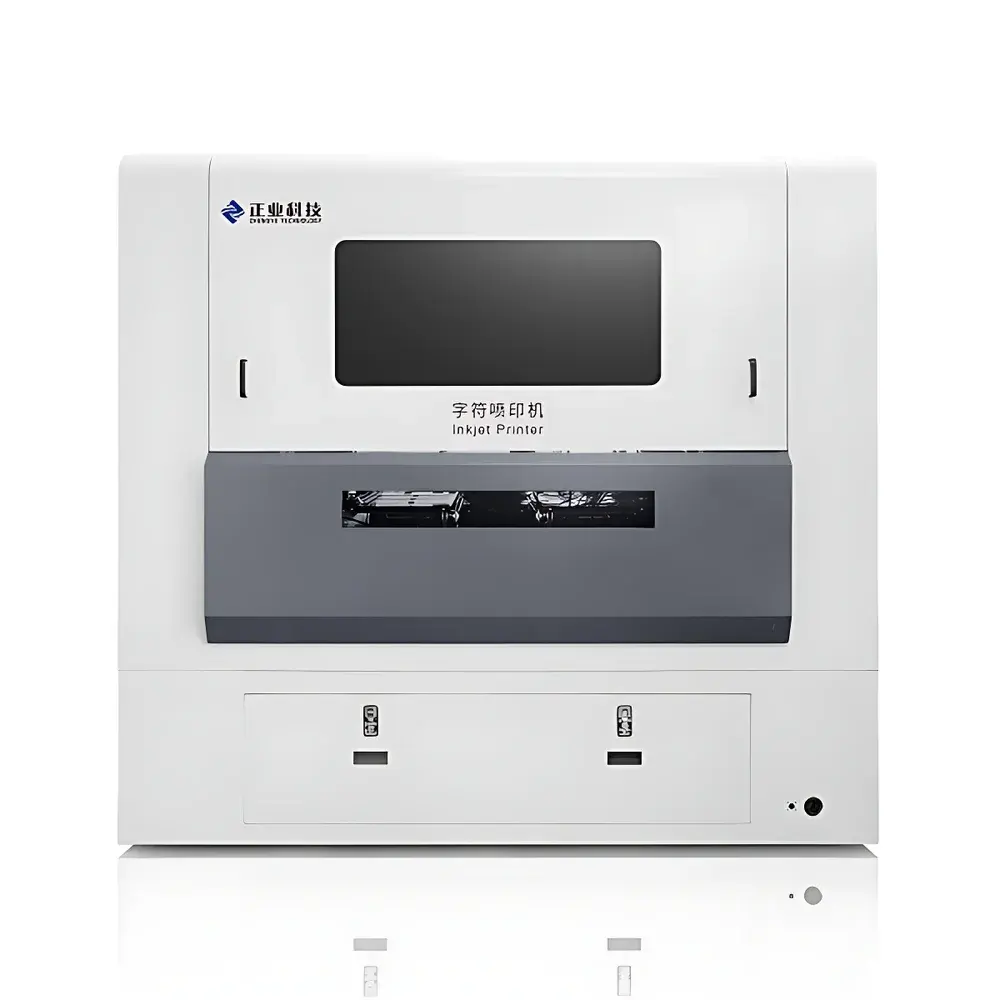
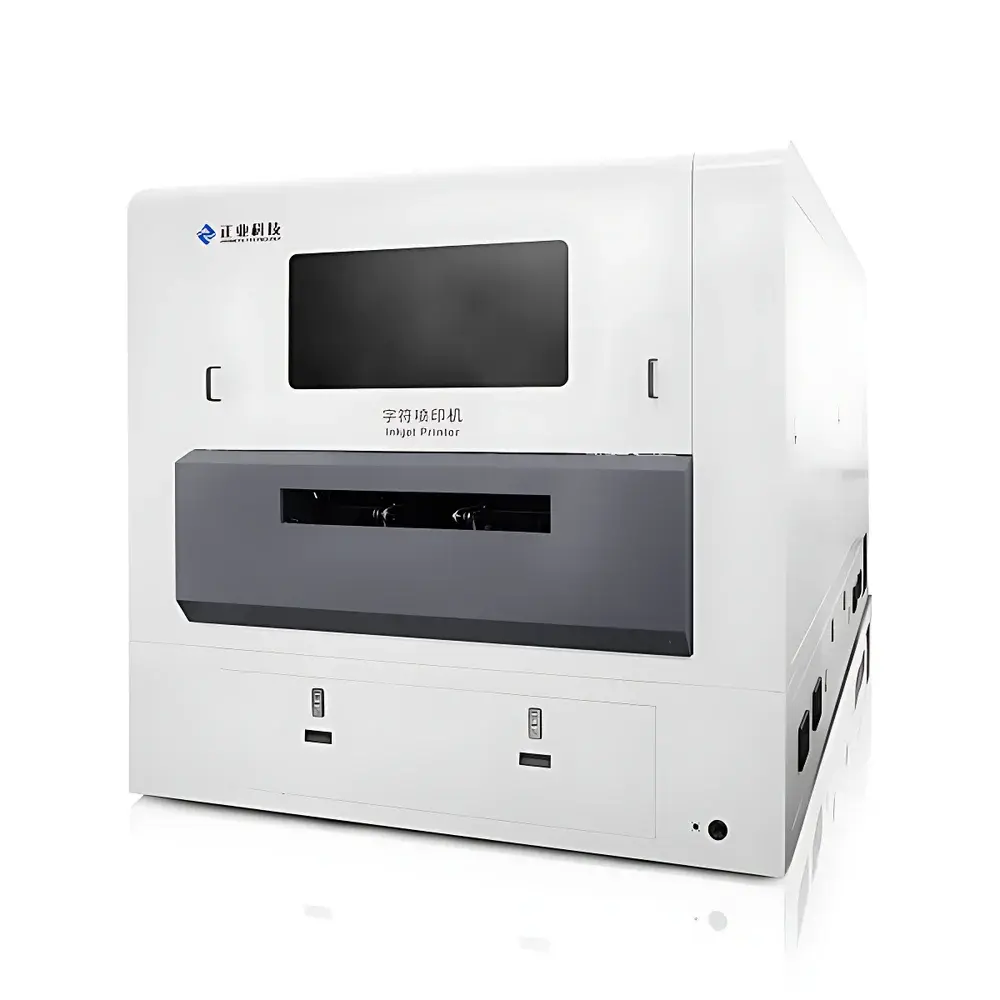
Zhengye PY800I Nine-Printhead Ultra-High-Speed PCB Legend Inkjet Printer
| Brand | Zhengye |
|---|---|
| Origin | Guangdong, China |
| Manufacturer Type | OEM/ODM Manufacturer |
| Country of Origin | China |
| Model | PY800I |
| Pricing | Available Upon Request |
| Printhead Configuration | 9 × 1024-nozzle industrial piezoelectric printheads |
| Maximum Board Size | 730 mm × 621 mm (28″ × 24″) |
| Board Thickness Range | 0.1–6.0 mm (4–236 mil) |
| Positioning Accuracy | ±38 µm |
| Repeatability | ±5 µm |
| Print Resolution Options | 720 / 1080 / 1440 dpi |
| Minimum Printed Line Width | 75–100 µm (3–4 mil) |
| Minimum Character Height | 0.5 mm |
| Cycle Time (Mass Production Mode, 2-pass) | 10 s/panel (including loading/unloading) |
| Cycle Time (High-Precision Mode, 3-pass) | 13 s/panel |
| UV Pre-Curing System | Integrated inline LED-UV lamp array |
| Machine Dimensions (L×W×H) | 2600 × 2100 × 2200 mm |
| Weight | 5000 kg |
| Optional Integration | Dual-station automated inline conveyor system for front/back-side simultaneous processing |
Overview
The Zhengye PY800I is an industrial-grade, nine-printhead ultra-high-speed inkjet printer engineered specifically for legend printing on rigid and flexible printed circuit boards (PCBs and FPCs). Unlike traditional screen printing—limited by stencil wear, alignment drift, and long setup cycles—the PY800I employs non-contact piezoelectric drop-on-demand (DOD) inkjet technology with real-time board registration, dynamic scaling, and substrate-specific gain compensation. It delivers deterministic placement accuracy and consistent ink laydown across heterogeneous surface topographies—including solder mask (green, black, white), OSP, ENIG, and immersion silver finishes. Designed for integration into Class 7 cleanroom environments and SMT production lines, the PY800I supports IPC-A-600 and IPC-6012-compliant legend definition while meeting ISO 9001 traceability requirements for electronic assembly manufacturing.
Key Features
- Precision Motion Control: Dual-axis linear motor gantry with optical encoder feedback ensures ±38 µm absolute positioning accuracy and ±5 µm repeatability over full 730 × 621 mm working area.
- Nine-Printhead Architecture: Configured with nine synchronized 1024-channel industrial piezoelectric printheads, enabling scalable throughput without resolution compromise—up to 1440 dpi native resolution at full board size.
- Dynamic Substrate Compensation: Integrated vision-guided registration detects fiducial marks and board deformation (stretch/shrink), applying per-panel geometric correction in real time.
- Inline UV Pre-Curing: High-intensity LED-UV lamp array activates UV-curable legend inks immediately post-deposition, minimizing smearing and enhancing adhesion on thermally sensitive substrates.
- Modular Platform Design: Adjustable Z-axis stage accommodates boards from 0.1 mm (flex) to 6.0 mm (heavy copper or metal-core), with vacuum-assisted clamping and edge-guided centering.
- OEM Software Stack: Proprietary print engine supports Gerber RS-274X, ODB++, and IPC-2581 input formats; includes automatic pad-to-character spacing validation and ink volume calibration per nozzle.
Sample Compatibility & Compliance
The PY800I processes standard FR-4, high-Tg laminates, polyimide-based FPCs, and ceramic substrates. It maintains consistent print quality on surfaces with varying roughness (Ra 0.2–1.8 µm), reflectivity, and chemical composition—including matte green solder mask, carbon-filled black mask, and bare copper with micro-etch conditioning. All firmware and motion control logic comply with IEC 61508 functional safety principles for industrial automation equipment. The system supports audit-ready logging per FDA 21 CFR Part 11 when deployed in regulated medical electronics manufacturing (e.g., implantable device PCBs), with optional electronic signature modules and role-based access control.
Software & Data Management
Zhengye’s proprietary LegendJet Suite provides a Windows-based interface for job setup, real-time monitoring, and predictive maintenance alerts. It features embedded IPC-2581 parser for direct netlist-driven character placement, automatic DFM checking (minimum clearance, legibility scoring), and version-controlled recipe management. All print logs—including nozzle health status, ink usage, board ID, timestamp, and operator ID—are stored in SQLite or optionally exported to SQL Server or MES via OPC UA. Full data export complies with ISO/IEC 17025 documentation standards for accredited test labs performing PCB qualification.
Applications
- High-mix, low-volume PCB prototyping requiring rapid legend revision without stencil rework
- Automotive ECUs where IPC Class 3 legibility and thermal cycling durability are mandated
- LED module substrates demanding fine-pitch alphanumeric coding under 0.5 mm height constraints
- FPC assemblies for wearables, where minimal ink bleed and precise registration on curved surfaces are critical
- Power electronics with thick copper layers (>6 oz), where screen-printed legends often delaminate during thermal stress testing
FAQ
Does the PY800I support multi-layer registration for double-sided boards?
Yes—using dual-camera fiducial detection and synchronized Z-axis height mapping, it achieves ±8 µm inter-layer alignment tolerance across front/back passes.
Can the system integrate with existing SMT line conveyors?
Standard configuration includes SMEMA-compliant I/O and Ethernet/IP protocol stack; custom mechanical interfaces available for third-party conveyor synchronization.
What ink chemistries are validated for use?
UV-curable acrylate-based inks certified to IPC-SM-782A for solder mask compatibility; halogen-free formulations available upon request.
Is remote diagnostics supported?
Yes—via TLS-secured VNC tunnel with granular permission tiers; includes real-time printhead waveform analysis and ink viscosity trending.
What is the mean time between failures (MTBF) for the printhead module?
Based on accelerated life testing under continuous operation: ≥12,000 hours per printhead assembly, with field-replaceable nozzle modules and auto-alignment calibration routines.