
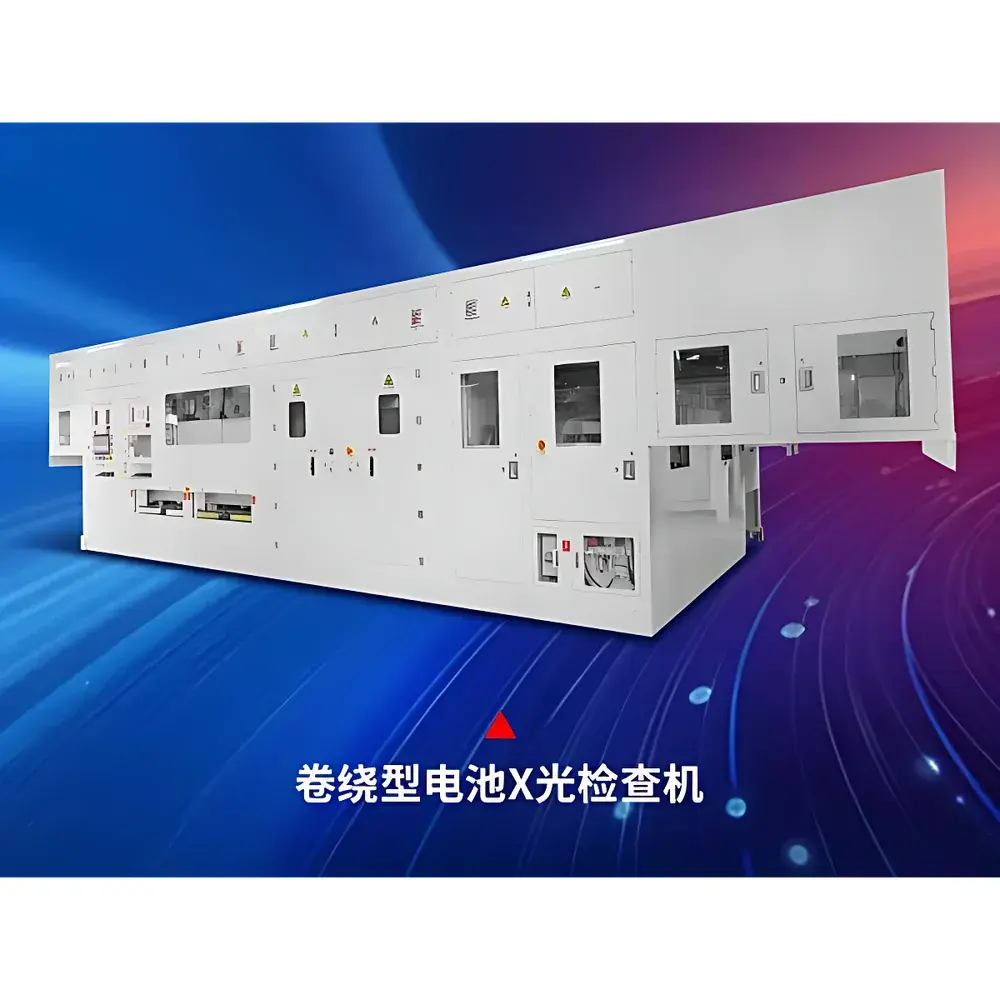
Zhengye Juanraodianchi XRAY High-Speed Lithium Battery X-Ray Inspection System
| Brand | Zhengye |
|---|---|
| Origin | Guangdong, China |
| Manufacturer Type | Manufacturer |
| Country of Origin | China |
| Model | JuanraodianchiXRAY |
| Pricing | Available Upon Request |
Overview
The Zhengye Juanraodianchi XRAY High-Speed Lithium Battery X-Ray Inspection System is an industrial-grade, inline non-destructive testing (NDT) platform engineered for real-time radiographic inspection of wound lithium-ion battery cells. Built upon dual-source X-ray imaging architecture and synchronized with high-precision conveyor motion control, the system operates on the principle of differential X-ray absorption—where variations in material density and thickness within the electrode stack, separator layers, and foil interfaces generate contrast-resolved grayscale images. This enables quantitative assessment of critical internal geometries—including winding alignment (stack-up tolerance), large-area wrinkling, foil misalignment, separator shrinkage, and foreign particle presence—without physical contact or sample preparation. Designed explicitly for integration into automated battery cell manufacturing lines, it bridges the gap between metrology-grade accuracy and production-line throughput requirements, supporting Industry 4.0-ready traceability and closed-loop process feedback.
Key Features
- High-throughput inline inspection at up to 60 parts per minute (ppm), achieved via a proprietary magnetic-drive intelligent conveyor system—eliminating mechanical bearings, reducing inertia, and enabling rapid acceleration/deceleration cycles.
- Zero-contact motion architecture ensures ultra-low operational noise ( 15,000 hours).
- Compact footprint (L×W×H ≤ 2,800 × 1,200 × 1,800 mm) facilitates retrofitting into existing cleanroom or dry-room production layouts with minimal civil engineering modifications.
- Integrated barcode/QR code reader synchronizes inspection data with MES/WMS identifiers, enabling full lot-level traceability from electrode winding to final cell assembly.
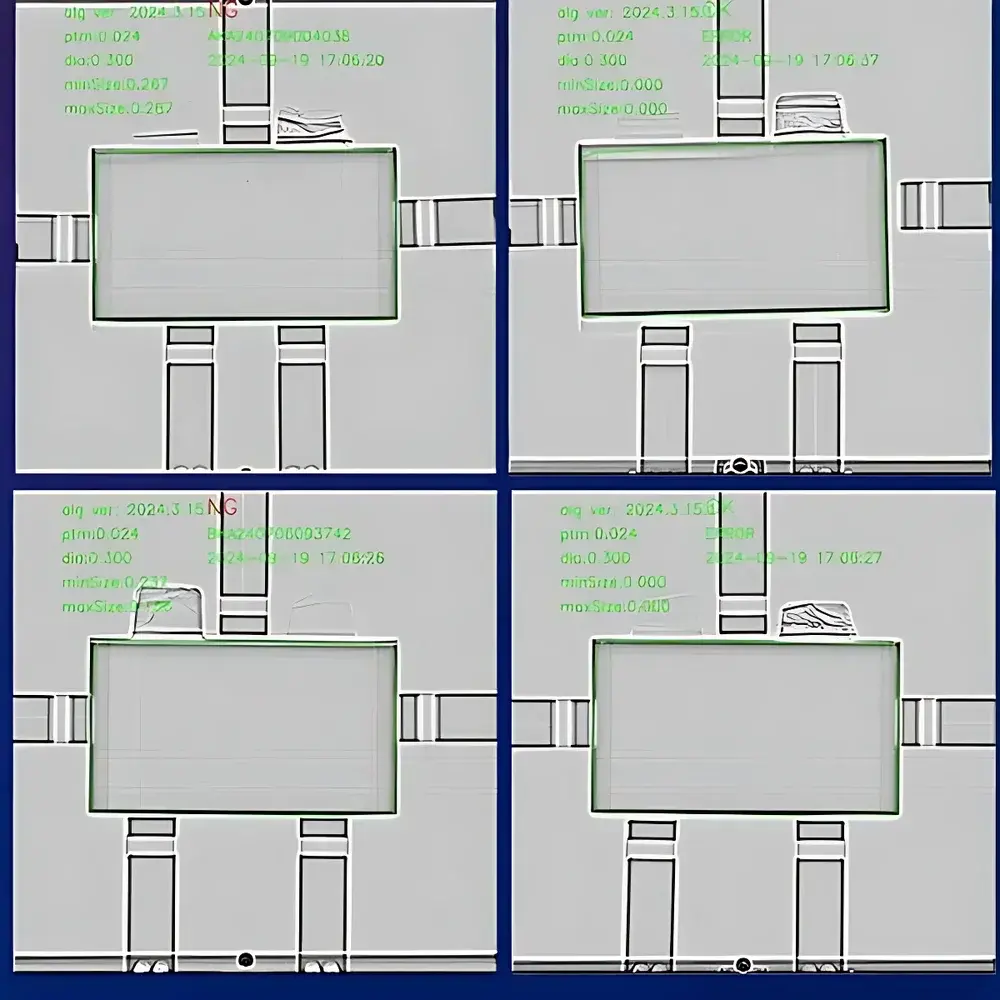
- Automated defect classification engine powered by embedded vision algorithms trained on statistically representative datasets of common lithium battery anomalies—including edge misalignment (>±0.15 mm), interlayer wrinkling (>30 µm amplitude), and foil burr detection.
- Dual-stage sorting logic: OK cells are routed back to upstream logistics conveyors; NG units undergo buffer-based re-inspection or direct ejection to designated reject chutes, all without manual intervention.
Sample Compatibility & Compliance
The system accommodates standard cylindrical, prismatic, and pouch-format wound lithium battery cells (diameter: 12–80 mm; length: 40–220 mm; max weight: 500 g). It supports both bare jellies (un-cased electrodes) and pre-assembled cells on carrier trays or pallets. Radiation safety conforms to IEC 61000-6-4 (EMC immunity), IEC 62471 (LED/X-ray optical radiation safety), and national GBZ 130–2020 standards for industrial X-ray equipment. All image acquisition, storage, and reporting workflows comply with ISO/IEC 17025 documentation integrity requirements and support audit-ready GLP/GMP-aligned metadata tagging—including operator ID, timestamp, exposure parameters (kV/mA), and detector gain calibration logs.
Software & Data Management
The proprietary Zhengye NDT Vision Suite v3.2 provides a Windows-based GUI with role-based access control (RBAC), configurable pass/fail thresholds, and real-time SPC dashboards. Raw DICOM-compliant X-ray images are archived with embedded EXIF metadata (source voltage, focal spot size, pixel pitch, geometric magnification factor). Export formats include CSV (defect metrics), PNG/JPEG (annotated thumbnails), and XML (structured QA reports). The software supports FDA 21 CFR Part 11 compliance through electronic signatures, audit trail logging (user actions, parameter changes, result overrides), and secure encrypted database storage (SQL Server Express or enterprise SQL Server).
Applications
- In-process quality gate verification post-winding and pre-tab welding
- Root cause analysis of yield loss related to electrode stacking defects
- Process validation during new product introduction (NPI) and line qualification
- Statistical process control (SPC) monitoring of winding tension consistency across shifts
- Supporting AI-driven predictive maintenance models using longitudinal defect trend analysis
- Compliance documentation for automotive OEM Tier-1 supplier audits (e.g., VDA 6.3, IATF 16949)
FAQ
What X-ray source configuration does this system use?
It employs a microfocus transmission X-ray tube (target: tungsten, focal spot ≤ 5 µm) operating at 60–130 kV adjustable range, coupled with a high-dynamic-range CMOS flat-panel detector (pixel pitch: 75 µm, 16-bit depth).
Is the system compatible with existing factory automation protocols?
Yes—it supports EtherNet/IP, PROFINET, and Modbus TCP for seamless PLC integration, and provides OPC UA server functionality for MES/SCADA interoperability.
How is radiation shielding implemented?
The inspection chamber features lead-lined steel housing (≥2 mm Pb equivalent), interlocked safety doors with dual-channel light curtains, and real-time dose monitoring sensors compliant with national occupational exposure limits (≤1 µSv/h at 5 cm from surface).
Can the system be validated for regulated environments?
Yes—IQ/OQ/PQ documentation packages are available, including installation qualification checklists, operational performance tests under worst-case load conditions, and precision repeatability studies (Gage R&R <10% for alignment measurements).
What maintenance intervals are recommended?
Preventive maintenance is scheduled every 1,000 operating hours or annually—whichever occurs first—with emphasis on X-ray tube warm-up calibration, detector flat-field correction, and conveyor positional encoder verification.



