
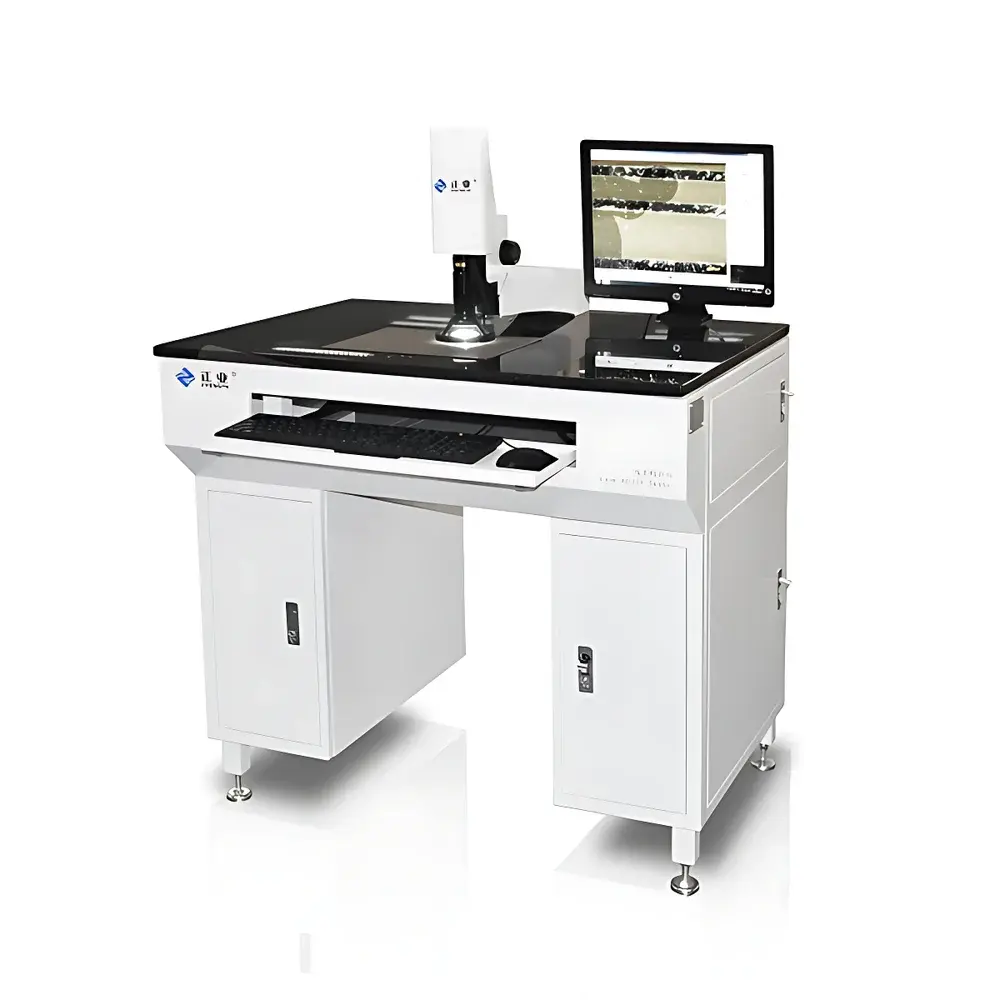
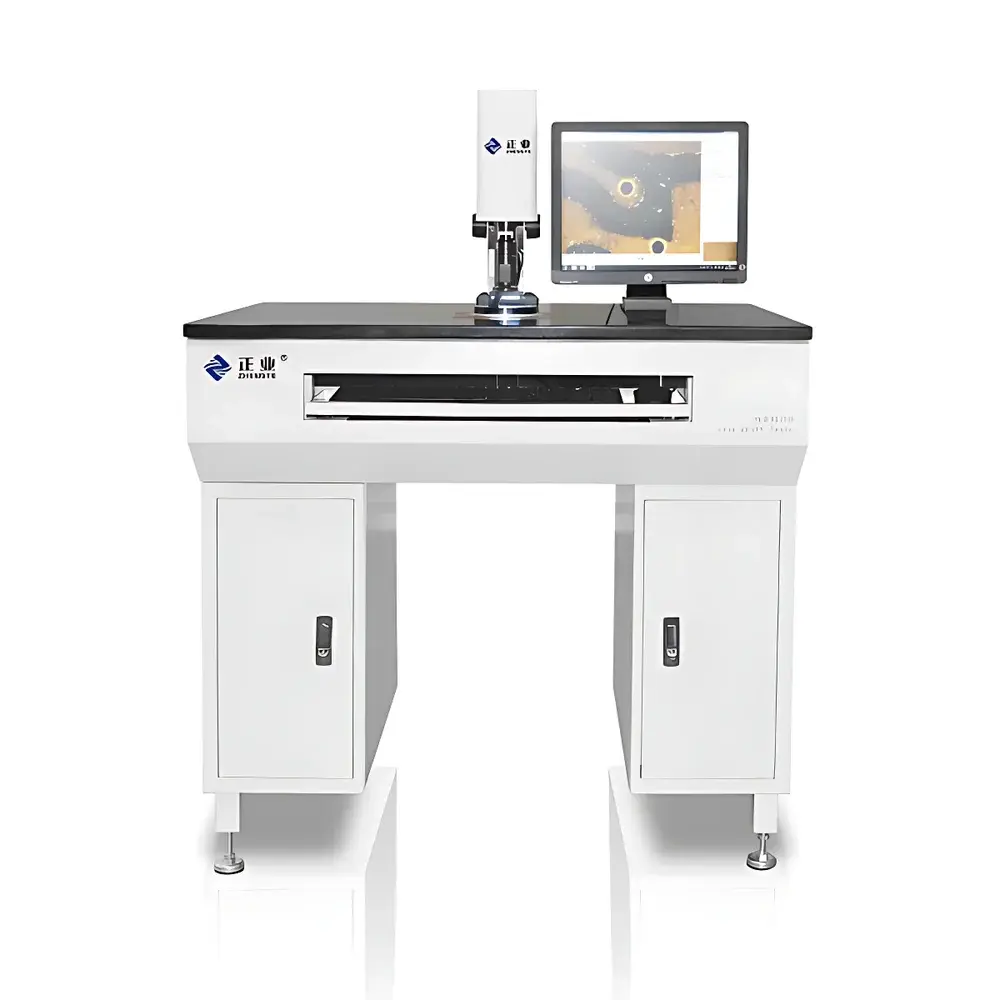
XK25 Series Online Optical Line Width & Pitch Measurement System (Zhengye Brand)
| Brand | Zhengye |
|---|---|
| Origin | Guangdong, China |
| Manufacturer Type | Direct Manufacturer |
| Region Classification | Domestic (China) |
| Model | XK25 |
| Price Range | USD 7,000 – 14,000 |
| Measurement Principle | High-Resolution Digital Microscopy with Sub-Pixel Edge Detection |
| Optical Magnification | 1.4×–9× Continuous |
| Total Magnification | 70×–450× |
| Measurement Accuracy | ±1 µm |
| Spatial Resolution | 0.4–2.7 µm/pixel |
| Maximum Board Width | ≤760 mm |
| Field of View Range | 0.53 mm × 0.4 mm to 3.3 mm × 2.5 mm |
| Measurable Line Width | 20–1200 µm |
| Dimensions (w/o PC) | 960 mm × 780 mm × 1280 mm |
| Weight (w/o PC) | 145 kg |
Overview
The XK25 Series Online Optical Line Width & Pitch Measurement System is an industrial-grade, non-contact metrology platform engineered for high-precision dimensional analysis of micro-structured conductive patterns in printed circuit board (PCB), semiconductor wafer, flat-panel display (LCD/OLED), and thin-film electronics manufacturing. Operating on the principle of high-magnification digital microscopy coupled with sub-pixel edge localization algorithms, the system captures calibrated optical images of etched features—such as trace lines, spacing between conductors, pad-to-edge distances, via diameters (including blind and microvias), and curved geometry—and computes dimensional metrics with traceable repeatability. Designed for integration into inline or offline quality assurance stations, the XK25 delivers quantitative data compliant with IPC-6012, IPC-A-600, and ISO 9001 process control requirements. Its robust mechanical architecture supports stable operation under factory floor conditions, including ambient temperature fluctuations and low-frequency vibration typical of PCB fabrication environments.
Key Features
- Sub-pixel edge detection algorithm enabling consistent line width and pitch measurement at ±1 µm accuracy across full operational range
- Motorized continuous zoom optics (1.4×–9× optical magnification) paired with high-resolution CMOS imaging sensor delivering effective total magnification from 70× to 450×
- Red LED coaxial illumination system for rapid visual alignment and real-time feature positioning without shadowing or glare interference
- Automated edge recognition engine trained on multi-layer metallization profiles—including copper, gold, and tin-lead alloys—minimizing operator dependency
- Integrated SPC module supporting real-time X-bar/R chart generation, Cp/Cpk calculation, and out-of-control condition flagging per ANSI/ASQ B1–B3 standards
- Modular mechanical design accommodating boards up to 760 mm wide; adjustable Z-axis focus mechanism with fine-tuning vernier scale for repeatable focal plane registration
Sample Compatibility & Compliance
The XK25 accommodates rigid and flexible PCB substrates (FR-4, polyimide), silicon wafers (up to 300 mm diameter), ITO-coated glass panels, and polymer-based thin-film sensors. It measures linear features ranging from 20 µm minimum line width to 1200 µm maximum, including asymmetric traces, tapered edges, and radius-defined contours (e.g., arc-shaped pads). All measurements adhere to ASTM E29–23 rounding conventions and are traceable to NIST-traceable calibration artifacts. The system meets electromagnetic compatibility (EMC) Class A requirements per EN 61326–1 and carries CE marking for industrial use within EU member states. Data integrity protocols align with GLP/GMP documentation practices, supporting audit-ready reporting for FDA 21 CFR Part 11–compliant environments when deployed with validated software configuration.
Software & Data Management
The proprietary Zhengye Vision Metrology Suite (v4.2+) provides a Windows-based interface with dual-mode operation: manual point-and-measure for R&D validation and fully automated batch inspection for production lot sampling. Raw image files are stored in lossless TIFF format with embedded metadata (timestamp, operator ID, calibration ID, lens position). Measurement reports export to CSV, PDF, and XML formats—with optional integration into MES platforms via OPC UA or RESTful API. Audit trail functionality logs all user actions, parameter modifications, and calibration events with time-stamped, immutable records. Software validation documentation (IQ/OQ/PQ templates) is provided upon request for regulated industries.
Applications
- Final inspection of inner/outer layer PCBs post-etch and pre-solder mask application
- Verification of photolithography fidelity in IC packaging substrates and fan-out wafer-level packaging (FOWLP)
- Process capability assessment during dry etch and electroplating development in advanced packaging lines
- Dimensional release testing for flex-rigid hybrid boards used in automotive ADAS modules
- Root cause analysis of line narrowing defects correlated with plating uniformity or developer concentration drift
- Qualification of mask alignment accuracy in TFT-LCD array fabrication
FAQ
What standards does the XK25 comply with for measurement traceability?
The system utilizes NIST-traceable step-height and linewidth calibration standards (e.g., VLSI Standards SRM 2050a), and its measurement uncertainty budget is documented per ISO/IEC 17025 Annex C guidelines.
Can the XK25 be integrated into an existing SMT line conveyor system?
Yes—the base frame includes mounting interfaces compatible with standard 30 mm aluminum profile automation rails; optional pneumatic lift and encoder-synced triggering are available for true inline deployment.
Is remote diagnostics and firmware update supported?
Firmware updates are delivered via secure HTTPS channel with SHA-256 signature verification; remote desktop-assisted troubleshooting is enabled through TLS-encrypted TeamViewer QuickSupport modules pre-installed and locked to authorized service accounts.
Does the system support multi-layer registration measurement (e.g., top/bottom layer overlay)?
No—XK25 performs single-surface topography analysis only; overlay registration requires complementary tools such as automated optical inspection (AOI) systems with fiducial-based alignment engines.
What maintenance schedule is recommended for sustained accuracy?
Biannual optical path verification using certified reticles and annual recalibration of the XY stage encoder and Z-focus actuator are advised per manufacturer’s maintenance protocol ZY-MNT-023 Rev. D.



