
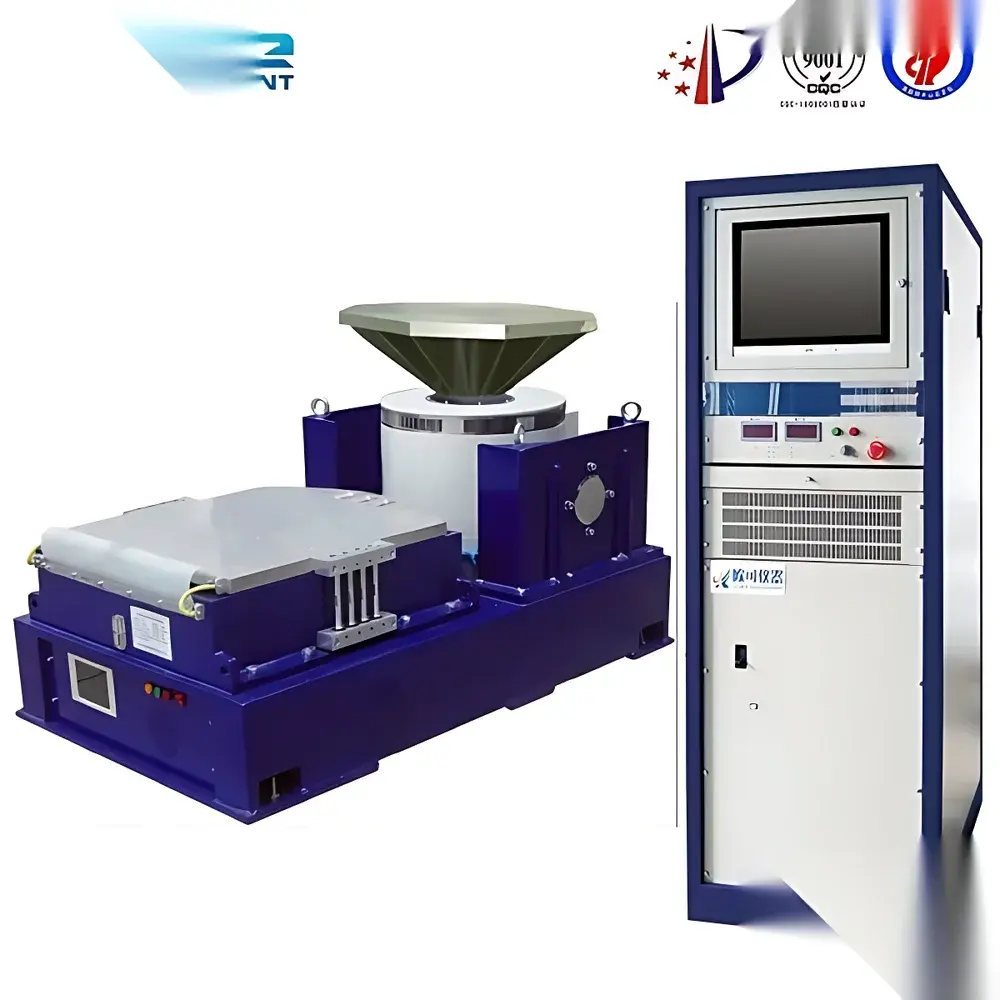
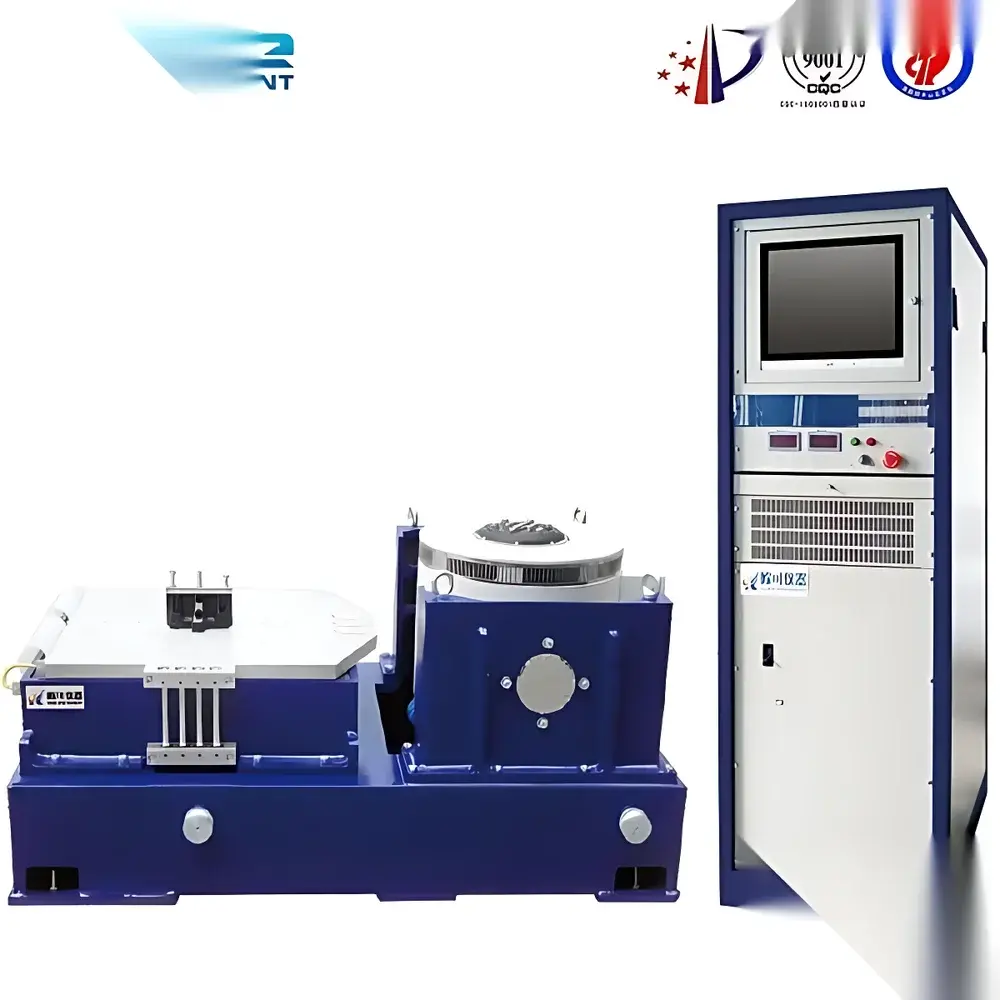
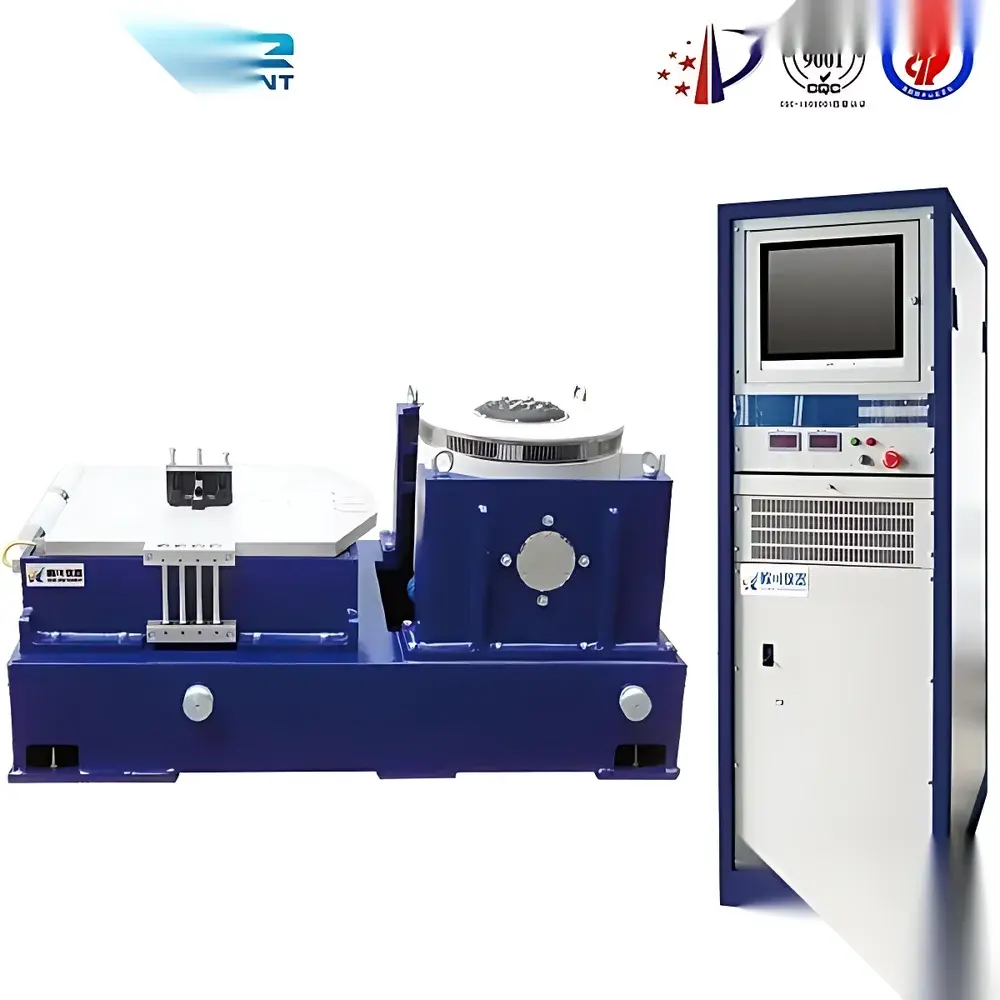
OK-ES Series Electrodynamically Driven Swept-Frequency Vibration Shaker System
| Brand | OK |
|---|---|
| Origin | Imported |
| Manufacturer Type | Authorized Distributor |
| Price | USD 14,000–20,000 (FOB) |
| Load Capacity | 25–1000 kg |
| Frequency Range | 5–80 Hz |
| Maximum Displacement | 5–10 mm peak-to-peak |
| Maximum Acceleration | 100 m/s² |
| Drive Power | 1.5–11 kW |
| Input Voltage | AC 220 V ±10% or AC 380 V ±10% |
| Table Dimensions | 40×40 to 140×140 cm |
| Weight | 500–3600 kg |
Overview
The OK-ES Series Electrodynamically Driven Swept-Frequency Vibration Shaker System is a precision-engineered electrodynamic vibration test platform designed for low-frequency mechanical stress evaluation of electronic components, electromechanical assemblies, instrumentation, and industrial equipment. Operating on the principle of Lorentz-force actuation—where controlled current through voice-coil windings interacts with a static magnetic field to generate linear inertial motion—the system delivers repeatable, traceable sinusoidal and swept-sine excitation across its specified frequency band. It is explicitly configured for compliance-driven testing protocols including MIL-STD-810H Method 514.8 (Vibration), IEC 60068-2-6, ISO 10816 (vibration severity assessment), and GB/T 2423.10 (Chinese national standard equivalent to IEC 60068-2-6). The shaker’s core function is to replicate real-world transport and operational vibration environments, enabling identification of structural resonances, fatigue thresholds, and mounting integrity under sustained or swept excitations.
Key Features
- Electrodynamic force generation with high linearity and minimal harmonic distortion below 0.5% THD at rated output
- Continuous swept-frequency operation from 5 Hz to 80 Hz with programmable sweep rate (oct/min or Hz/s) and dwell capability
- Optical tachometer feedback loop for closed-loop velocity and displacement control, enhancing amplitude stability across load variations
- Adjustable inertial mass counterbalance and optimized suspension geometry to minimize lateral motion (<2% transverse ratio per ISO 5347-12)
- Dual-axis configuration options (vertical-only or vertical + horizontal) with independent drive amplification and phase synchronization
- Integrated safety architecture: zero-signal lockout, over-acceleration cutoff, thermal overload protection, and “fly-away” suppression during signal interruption
- Modular amplifier design supporting scalable power delivery—from 1.5 kW for light-duty qualification to 11 kW for full-scale reliability validation
Sample Compatibility & Compliance
The OK-ES shaker series accommodates specimens ranging from PCB subassemblies (mounted on fixture plates) to full-size industrial enclosures (up to 1000 kg). Standard table sizes (40×40 cm to 140×140 cm) support ISO 13373-compliant accelerometer placement patterns and permit fixture design per ASTM E1492 guidelines. All models meet electromagnetic compatibility requirements per EN 61326-1 and are certified for use in Class 1, Division 2 hazardous locations when equipped with optional ATEX-rated enclosures. Test reports generated using this system satisfy audit requirements under ISO/IEC 17025, FDA 21 CFR Part 11 (when paired with compliant data acquisition software), and GLP/GMP documentation workflows.
Software & Data Management
The system integrates natively with industry-standard vibration control platforms—including Vibration Research’s VibrationVIEW, Crystal Instruments’ EnSoft, or m+p International’s Analyzer Suite—enabling real-time FFT analysis, resonance search algorithms, and automated test sequencing. All controllers support IEEE 1451.4 TEDS-compliant transducer recognition and provide timestamped, encrypted binary data export (.udf, .tdms) with embedded metadata (test ID, operator, calibration certificate ID, environmental conditions). Audit trails record parameter changes, abort events, and calibration verification cycles—fully traceable for regulatory submissions. Optional add-ons include remote monitoring via secure HTTPS API and integration with enterprise PLM systems (e.g., Siemens Teamcenter, PTC Windchill).
Applications
- Resonance detection and modal survey for printed circuit board (PCB) assemblies prior to HALT/HASS screening
- Transport simulation per ISTA 3A/3E and ASTM D999 for packaged electronics shipped via air, sea, or rail
- Structural durability validation of automotive ECUs, avionics racks, and medical imaging subsystems
- Qualification testing of military-grade connectors, sensors, and ruggedized displays under MIL-STD-810H Clause 514.8
- Reliability growth testing (RGT) programs where swept-sine profiles accelerate failure mode discovery in solder joints and flex circuits
- Verification of damping effectiveness in isolation mounts and shock-absorbing packaging designs
FAQ
What standards does the OK-ES series comply with for vibration testing?
It supports MIL-STD-810H Method 514.8, IEC 60068-2-6, ISO 10816-3, GB/T 2423.10, and ASTM D999—verified via third-party calibration certificates traceable to NIST.
Can the shaker perform random vibration testing?
No—the OK-ES series is optimized for swept-sine, fixed-frequency, and sine-on-random (SoR) profiles only; random spectrum generation requires pairing with an external controller and compatible power amplifier.
Is custom fixture design supported?
Yes—OK provides mechanical interface drawings (ANSI B5.54 compliant), modal analysis guidance, and static/dynamic load reaction force specifications to assist fixture engineering teams.
What maintenance intervals are recommended?
Annual preventive maintenance includes voice-coil centering verification, suspension elastomer inspection, cooling system flush, and amplifier capacitor ESR testing—documented per ISO 5347-11.
Does the system include calibration certification?
Each unit ships with a factory-as-built calibration report (acceleration, displacement, and velocity sensitivity) valid for 12 months; accredited recalibration services are available through OK-authorized labs worldwide.



