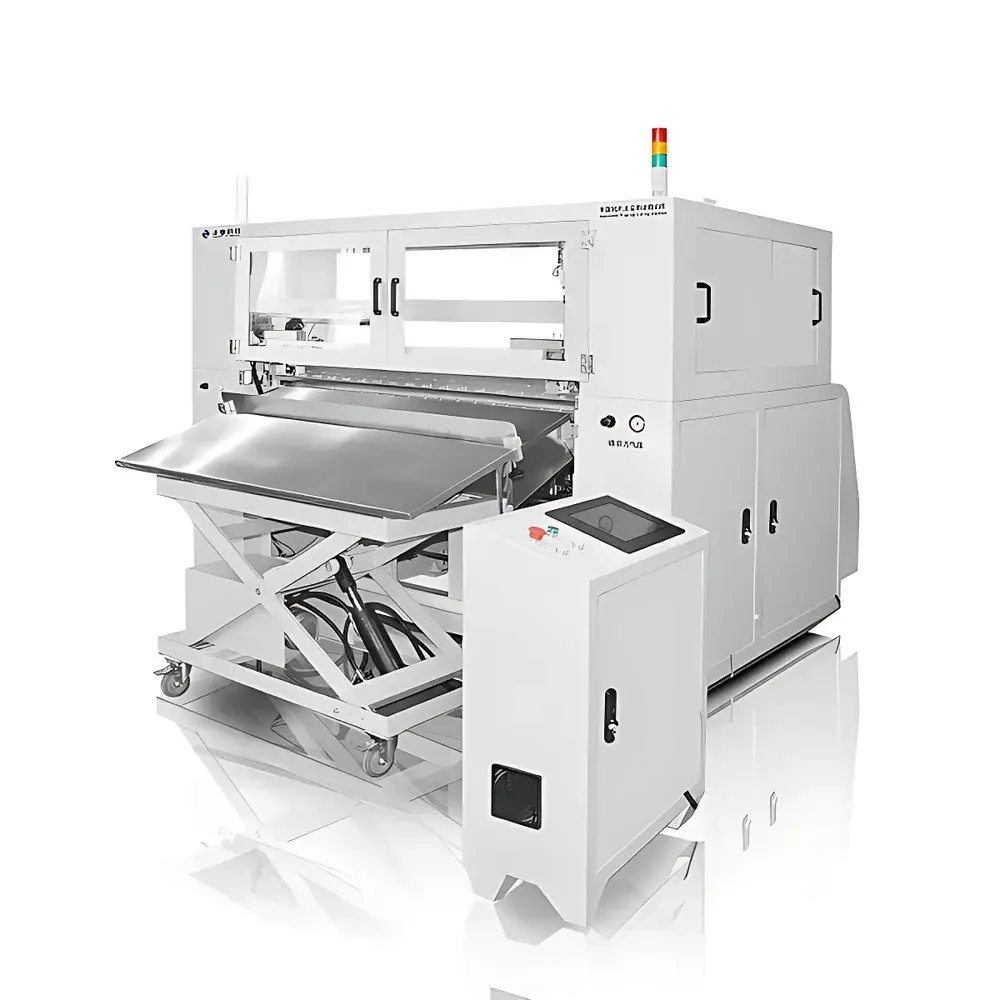
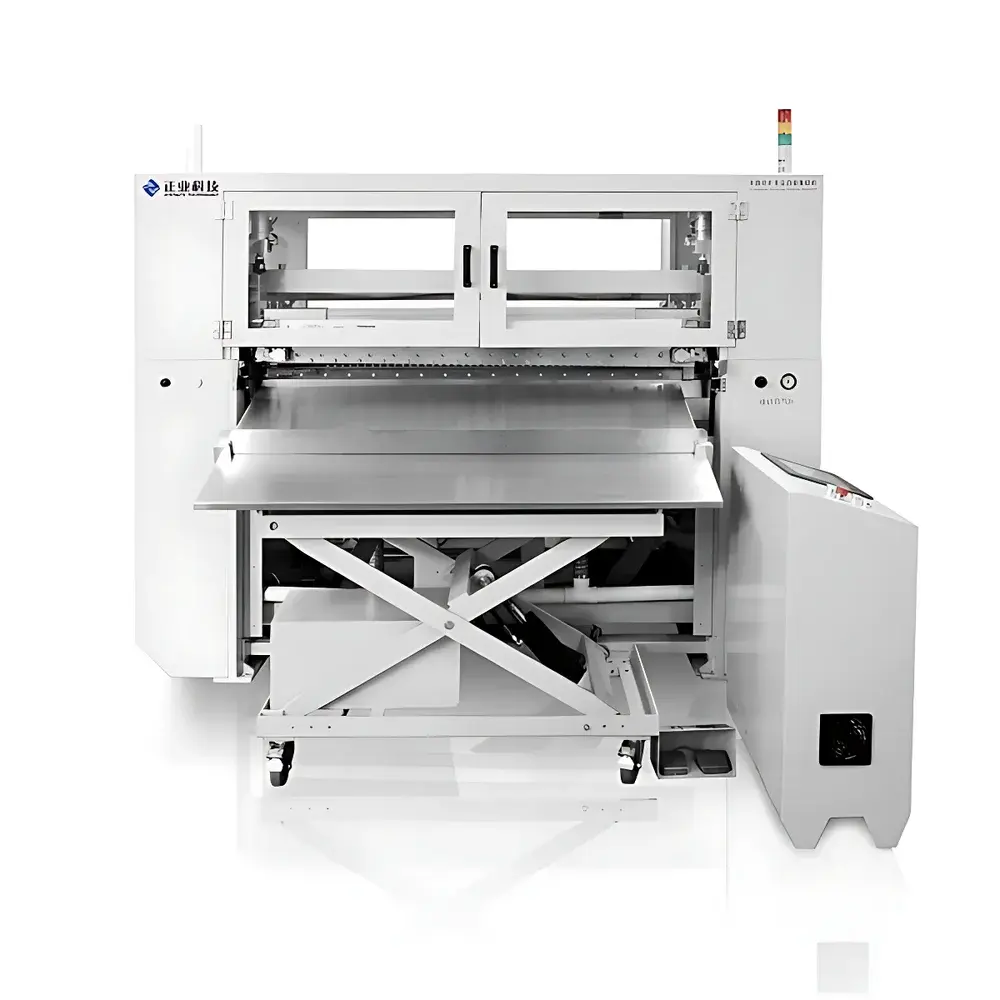
Zhengye CQ2000 Dust-Free Automated Prepreg Cutting System
| Brand | Zhengye |
|---|---|
| Origin | Guangdong, China |
| Manufacturer Type | OEM/ODM Producer |
| Country of Origin | China |
| Model | CQ2000 |
| Pricing | Upon Request |
| Cutting Accuracy | ±1 mm |
| Dust Reduction | >95% vs. conventional mechanical cutting |
| Max. Cutting Frequency (500 mm length) | ≤21 cuts/min |
| Cutting Length Range | 250–750 mm |
| Cutting Width Range | 200–1270 mm |
| Material Thickness Capacity | 0.02–0.3 mm |
| Transverse & Longitudinal Cutting Method | Dynamic IR-heated rotary blade (transverse), manual-adjustable slitting knives (longitudinal) |
| Edge Sealing | Integrated infrared thermal sealing pre-cut |
| Dust Extraction | Engineered vacuum system with CFD-optimized airflow path |
| Control System | Synchronized servo-driven motion control with parameter profile storage |
Overview
The Zhengye CQ2000 Dust-Free Automated Prepreg Cutting System is an industrial-grade, precision-engineered solution designed specifically for the high-volume processing of uncured epoxy-glass prepreg (B-stage) rolls used in PCB laminate manufacturing and advanced composite fabrication. Unlike conventional mechanical die-cutting or cold-blade slitting systems, the CQ2000 employs a thermally assisted cutting methodology grounded in controlled infrared (IR) heating—applied immediately prior to blade engagement—to soften the resin matrix at the cut interface. This eliminates micro-fracturing, fiber pull-out, edge delamination, and carbonization commonly observed in unheated shear processes. The system integrates synchronized servo motion control, real-time thermal regulation, and vacuum-assisted particulate capture to deliver repeatable, clean-edge cuts across variable prepreg formulations—including FR-4, polyimide, BT resin, and high-Tg halogen-free laminates—while maintaining full compliance with occupational health and safety requirements for airborne particulate exposure (OSHA PEL, ISO 8502-3).
Key Features
- Infrared Pre-Cut Thermal Activation: First-in-class IR emitter array calibrated to resin-specific glass transition temperatures (Tg), enabling localized softening without bulk heating or thermal degradation.
- Dust Suppression Architecture: CFD-modeled vacuum ducting with multi-stage filtration (HEPA + activated carbon) achieves >95% reduction in respirable particulates (PM2.5) versus legacy mechanical cutters—validated per ISO 16200-2 gravimetric sampling protocols.
- High-Fidelity Motion Control: Dual-axis servo synchronization ensures ±1 mm dimensional repeatability across 250–750 mm lengths and 200–1270 mm widths; position feedback resolution < 5 µm.
- Integrated Edge Sealing: IR-heated sealing bar activates concurrently with transverse cut, eliminating fraying, stringing, and resin bleed—critical for automated layup compatibility.
- Parameter-Driven Operation: Up to 99 user-defined cutting profiles stored in non-volatile memory; recall via alphanumeric ID or barcode scan—supports traceability under ISO 9001:2015 Clause 8.5.2.
- Automated Stack Handling: Servo-controlled stacker module indexes and aligns cut sheets with < ±0.3 mm lateral deviation; compatible with downstream robotic pick-and-place interfaces (SMEMA-compliant I/O).
Sample Compatibility & Compliance
The CQ2000 accommodates standard industry prepreg formats: woven E-glass, S-glass, and quartz-reinforced substrates impregnated with epoxy, cyanate ester, bismaleimide (BMI), or polyimide resins. It supports thicknesses from 0.02 mm (lightweight RF substrates) to 0.3 mm (high-strength structural laminates). All mechanical and thermal subsystems comply with CE Machinery Directive 2006/42/EC, EN 60204-1 (electrical safety), and ISO 13857 (safeguarding distances). Dust extraction performance meets ISO 16000-6 for indoor air quality verification. Optional validation packages support IQ/OQ documentation per GMP Annex 15 and FDA 21 CFR Part 11 electronic record integrity requirements.
Software & Data Management
The embedded HMI runs on a deterministic real-time OS with dual Ethernet ports (one for factory network integration, one for maintenance diagnostics). Cut logs—including timestamp, profile ID, material lot number (manual entry or RFID-scanned), temperature setpoint, actual IR surface reading (via integrated pyrometer), and positional error metrics—are exported in CSV/JSON format. Audit trails are immutable and time-stamped with NTP-synchronized clocks. Optional OPC UA server enables MES-level data exchange (e.g., Siemens Opcenter, Rockwell FactoryTalk). Firmware updates follow secure signed-package protocols compliant with IEC 62443-3-3 SL2.
Applications
- PCB Fabrication: High-yield segmentation of B-stage FR-4 and polyimide prepregs into panel-ready blanks for multilayer lamination.
- Aerospace Composites: Precision cutting of carbon-fiber/epoxy and glass-fiber/BMI prepreg tapes for automated tape laying (ATL) feedstock preparation.
- 5G Antenna Substrates: Low-dielectric-loss polyimide and liquid crystal polymer (LCP) sheet segmentation with zero edge charring—preserving RF performance.
- Medical Device Packaging: Clean-cutting of sterilizable composite laminates requiring ISO 13485-compliant process documentation.
- R&D Labs: Rapid iteration of prototype laminate geometries with programmable thermal profiles for resin cure-state optimization studies.
FAQ
What types of prepreg materials are validated for use with the CQ2000?
The system has been verified for standard epoxy, polyimide, BT, cyanate ester, and BMI-based prepregs reinforced with E-glass, S-glass, quartz, or carbon fiber. Material-specific IR calibration curves are provided in the Operator Manual.
Does the CQ2000 support integration into an Industry 4.0 production line?
Yes—dual Ethernet interfaces, OPC UA support, SMEMA-compatible I/O, and structured log export enable seamless integration with MES, SCADA, and digital twin platforms.
How is thermal uniformity maintained across varying web widths?
The IR emitter array features zoned power control and closed-loop pyrometric feedback; each zone adjusts output based on real-time surface temperature measurements taken at 10 Hz.
Is operator training required for profile management?
Basic operation requires <2 hours of supervised training; advanced profile development and validation require certified process engineering support—available through Zhengye’s Global Applications Lab.
What maintenance intervals are recommended for the IR emitters and cutting blades?
IR emitters: 12-month functional verification (radiometric calibration); rotary blades: replacement every 1.2 million linear meters of cut—tracked automatically in the HMI service log.
Related Products