
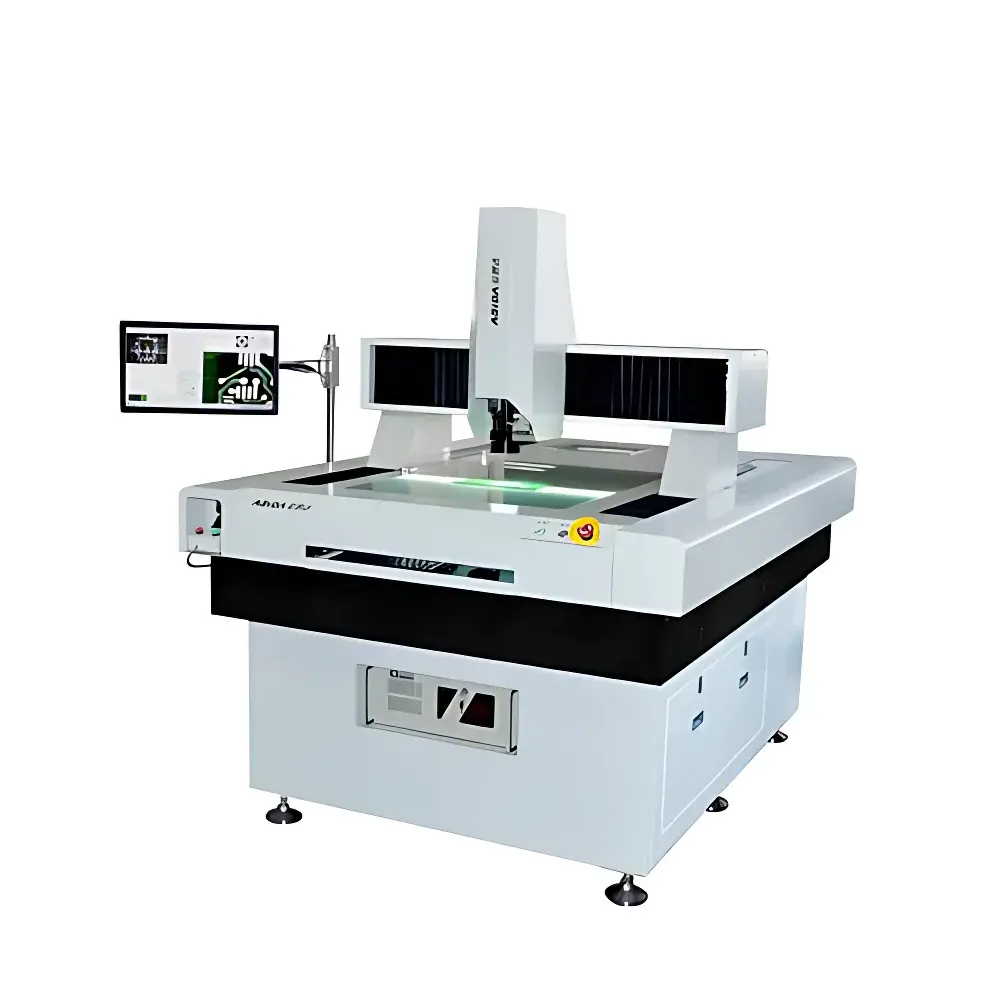
Zhengye ASIDA220180A Automatic 2D Vision Measuring Machine
| Brand | Zhengye |
|---|---|
| Origin | Guangdong, China |
| Manufacturer Type | Direct Manufacturer |
| Country of Origin | China |
| Model | ASIDA220180A |
| Price Range | USD $13,500 – $67,500 |
| Measurement Range (X×Y×Z) | 2200 × 1800 × 200 mm |
| Granite Base & Column Material | Grade-0 Granite |
| Bearing System | Air-bearing X/Y Stages |
| Drive System | Panasonic Servo Motors |
| Optical Axis | Telecentric Objectives with 0.7×–5× Zoom |
| Video Magnification | 25×–180× |
| Working Distance | 90 mm |
| Glass Stage Size | 2300 × 1900 mm |
| Stage Load Capacity | 30 kg |
| Scale Resolution | ≤0.001 mm |
| X/Y Linear Accuracy | E₂ ≤ ±(2.5 + L/200) µm |
| Repeatability | ≤ ±3 µm |
| Software | AISDA VMA 3.00.01 (Multilingual: Simplified Chinese, Traditional Chinese, English) |
| Data Export Formats | DXF, Excel (.xlsx), Word (.docx), Custom Report Templates |
| Light Source | Ring-type LED Cold Illumination |
| Machine Weight | 7500 kg |
Overview
The Zhengye ASIDA220180A Automatic 2D Vision Measuring Machine is a high-precision coordinate metrology system engineered for non-contact dimensional inspection of medium-to-large industrial components. Operating on the principle of optical triangulation and sub-pixel edge detection, it captures high-resolution monochrome images via a progressive-scan CCD sensor mounted on a motorized zoom lens assembly. The system reconstructs geometric features—including points, lines, circles, arcs, rectangles, polygons, and freeform contours—by analyzing intensity gradients at object boundaries with pixel-level registration accuracy. Designed for production-floor integration, the ASIDA220180A delivers traceable, repeatable measurements in accordance with ISO 10360-7 (coordinate measuring machines) and supports optional tactile probing for hybrid 2.5D profile verification. Its structural architecture—featuring grade-0 granite base and column, air-bearing guideways, and thermally stable LED illumination—minimizes mechanical drift and thermal deformation over extended operational cycles.
Key Features
- Grade-0 natural granite frame providing exceptional rigidity, vibration damping, and long-term geometric stability (hardness ≥ 650 HV, thermal expansion coefficient ≈ 6.5 × 10⁻⁶ /°C)
- Air-bearing X/Y motion stages with frictionless guidance and sub-micron positioning repeatability, eliminating backlash and wear-related error accumulation
- Panasonic AC servo drive system with closed-loop feedback control, enabling programmable acceleration/deceleration profiles and synchronized axis coordination
- Motorized telecentric zoom objective (0.7×–5×) paired with high-resolution CCD imaging, yielding video magnification from 25× to 180× without parallax shift
- Ring-type cold LED illumination with uniform intensity distribution and zero infrared emission, preventing thermal distortion during prolonged measurement sessions
- Integrated Z-axis linear encoder with ≤0.001 mm resolution, supporting height mapping and step-height analysis within the 200 mm vertical range
Sample Compatibility & Compliance
The ASIDA220180A accommodates parts up to 2200 mm × 1800 mm footprint and 30 kg mass on its reinforced glass stage (2300 × 1900 mm). It supports reflective, translucent, and matte-surface components typical of sheet metal stampings, PCB assemblies, automotive body panels, aerospace composite layups, and precision machined castings. All measurement algorithms comply with ISO 1101 (geometrical tolerancing), ISO 5459 (datum systems), and ASME Y14.5M-2018 standards. The machine’s calibration protocol aligns with VDI/VDE 2617 Part 6 (optical CMMs) and includes documented uncertainty budgets per ISO/IEC 17025 requirements. Optional probe modules enable compliance with ISO 10360-5 for tactile probing performance validation.
Software & Data Management
AISDA VMA 3.00.01 is a Windows-based metrology platform supporting multilingual UI (English, Simplified/Traditional Chinese) and role-based user permissions. It provides automated feature recognition, GD&T evaluation (position, concentricity, parallelism, flatness), statistical process control (SPC) charting, and batch report generation. Audit trails record all operator actions, parameter changes, and calibration events—fully compliant with FDA 21 CFR Part 11 for electronic records and signatures when deployed in regulated manufacturing environments. Data export includes native DXF for CAD comparison, Excel-compatible CSV/XLSX for statistical analysis, and Word-formatted inspection certificates with embedded measurement images and tolerance annotations. Custom report templates can be defined using XML-based layout definitions.
Applications
- Dimensional verification of large-format printed circuit boards (PCBs) and flex-rigid hybrids
- Geometric inspection of automotive door panels, fenders, and chassis subassemblies
- Profile matching of injection-molded plastic housings against nominal CAD models
- Surface contour analysis of machined aluminum extrusions used in structural framing
- First-article inspection (FAI) documentation per AS9102 requirements in aerospace supply chains
- Tooling validation and wear monitoring of progressive die sets in stamping operations
FAQ
What is the maximum part size the ASIDA220180A can accommodate?
The instrument accepts parts up to 2200 mm in X-direction, 1800 mm in Y-direction, and 200 mm in Z-height, with a stage load capacity of 30 kg.
Does the system support GD&T evaluation according to ISO 1101?
Yes—AISDA VMA 3.00.01 implements full GD&T functionality including datum reference frames, composite tolerances, and profile of a surface calculations.
Is calibration traceability provided with the instrument?
Each unit ships with a factory calibration certificate traceable to NIM (National Institute of Metrology, China) or equivalent national metrology institute standards.
Can the software generate SPC-compliant control charts?
Yes—the software includes real-time X-bar/R, Cp/Cpk, and Pp/Ppk calculation engines with automatic outlier detection and capability trending.
What environmental conditions are recommended for optimal performance?
Operating temperature: 20 ± 1°C; humidity: 40–60% RH non-condensing; floor vibration: <2.5 µm peak-to-peak below 10 Hz; ambient lighting: controlled diffuse illumination only.



