
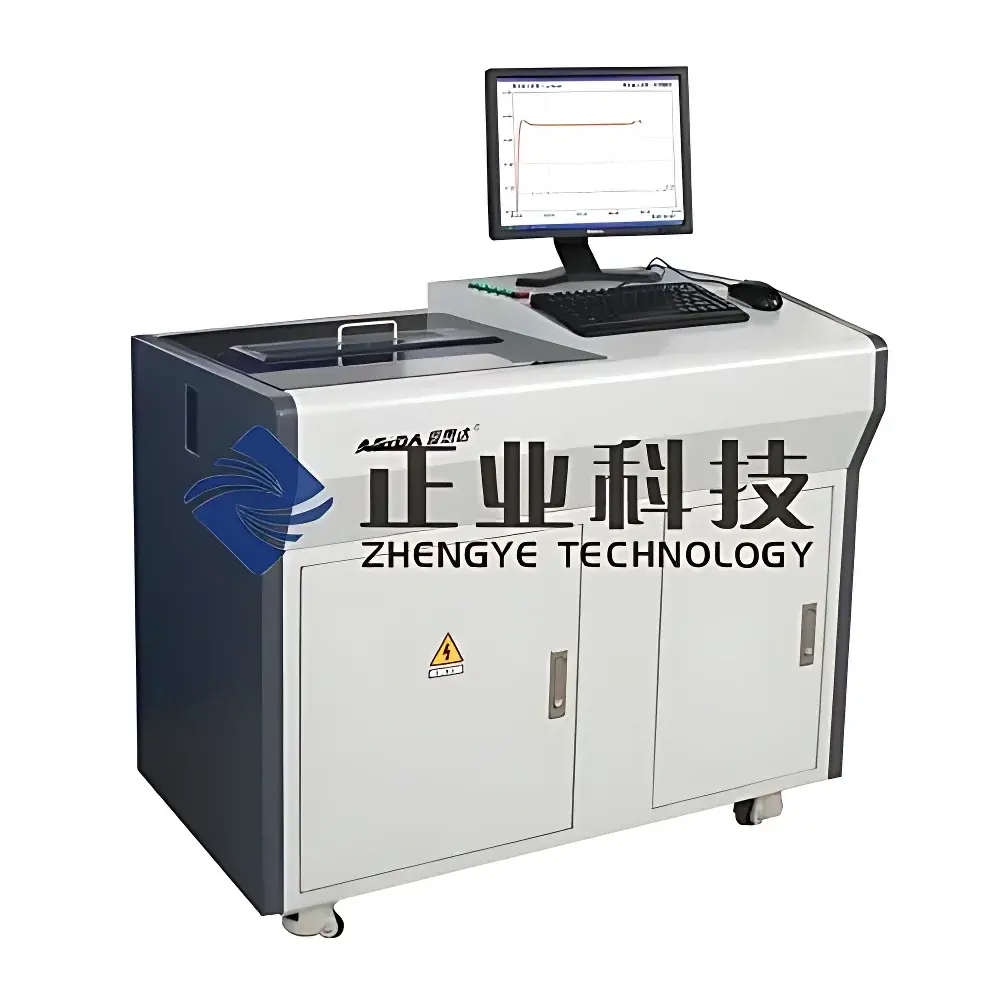
ASIDA LZ21 PCB Ionic Contamination Tester
| Brand | ASIDA |
|---|---|
| Model | LZ21 |
| Origin | Guangdong, China |
| Measurement Range | 0.1–20 µS/cm² |
| Accuracy (F.S.) | ±5% |
| Sensor Sensitivity | 0.0001 µS/cm |
| Test Duration (Dynamic) | 14 min |
| Test Duration (Static) | 6 min + 13 min resin regeneration = 19 min |
| PCB Test Area (Type B) | 1200–8712 cm² |
| Dimensions (Standard) | 1050 × 600 × 920 mm |
| Weight (Standard) | ~115 kg |
| Conductivity Benchmark | 66/100 MΩ |
| Equivalent NaCl Mass Resolution | ≤12,530 µg Eq NaCl |
Overview
The ASIDA LZ21 PCB Ionic Contamination Tester is a dedicated analytical instrument engineered for quantitative assessment of ionic residue on printed circuit boards (PCBs) and assembled PCBAs. It operates on the principle of solvent extraction followed by high-precision conductivity measurement—compliant with IPC-TM-650 2.3.25 (Ionic Contamination by Resistivity of Solvent Extract, ROSE) and aligned with J-STD-001 and IPC-A-610 acceptance criteria. The system employs deionized water (or IPA/water mixtures per method specification) to extract soluble ionic contaminants—including halides (Cl⁻, Br⁻), sulfates (SO₄²⁻), sodium (Na⁺), and ammonium (NH₄⁺)—from board surfaces. Extracted solution conductivity is measured in real time using a temperature-compensated, high-stability conductivity sensor calibrated to traceable standards. The LZ21 integrates a closed-loop circulation system with mixed-bed ion exchange resin regeneration, enabling repeatable, low-drift measurements across extended operational cycles without manual electrolyte replacement.
Key Features
- Dynamic & Static Dual-Mode Operation: Supports both continuous-flow dynamic extraction (14 min typical cycle for 20 mL NaCl standard) and static immersion protocols (6 min extraction + 13 min resin regeneration), allowing method flexibility for R&D validation or production-line throughput optimization.
- High-Fidelity Conductivity Sensing: Equipped with a sub-microsiemens-resolution sensor (0.0001 µS/cm) and automatic temperature compensation (0–45°C), ensuring metrological consistency across ambient lab conditions.
- Automated Resin Regeneration: Onboard mixed-cation/anion exchange column enables full resin reactivation between tests—eliminating consumable cartridge swaps and reducing operator intervention.
- Scalable Test Chamber Design: Accommodates PCBs up to 8712 cm² (Type B configuration); chamber footprint optimized for standard SMT line integration with minimal floor space (66 × 66 cm active test zone).
- Robust Mechanical Architecture: Stainless-steel fluid path, corrosion-resistant pump manifold, and sealed extraction vessel ensure long-term reliability under repeated thermal cycling and solvent exposure.
Sample Compatibility & Compliance
The LZ21 accepts bare PCBs (unpopulated) and populated PCBA substrates within defined dimensional limits (max 1200–8712 cm² surface area). Boards are secured on a non-conductive, inert support tray to prevent edge shorting during immersion. The system complies with IPC-TM-650 2.3.25 revision G for ROSE testing methodology and supports traceable calibration via NIST-traceable KCl standards. Data output meets GLP/GMP documentation requirements when paired with optional audit-trail-enabled software (see Software section). All wetted materials conform to USP Class VI biocompatibility and RoHS Directive 2011/65/EU restrictions.
Software & Data Management
The embedded control interface provides real-time conductivity trending, automatic NaCl-equivalent mass calculation (µg Eq NaCl), and pass/fail threshold flagging per user-defined limits (e.g., 10.06 µg/cm² per IPC-J-STD-001E). Optional PC-based software (ASIDA DataLink v3.x) adds FDA 21 CFR Part 11-compliant electronic signatures, multi-user role permissions, raw data export (CSV/Excel), and automated report generation with embedded test parameters, operator ID, timestamp, and instrument serial number. Audit logs record all parameter changes, test starts/stops, and calibration events with immutable timestamps.
Applications
- Final cleaning validation post-wave soldering, reflow, or aqueous defluxing processes
- Process qualification of new flux chemistries or cleaning agents
- In-process monitoring of ultrasonic or batch washer performance
- Failure analysis of electrochemical migration (ECM) or dendritic growth incidents
- Supplier qualification audits requiring documented ionic cleanliness evidence
- Compliance verification for aerospace (AS9100), automotive (IATF 16949), and medical device (ISO 13485) manufacturing environments
FAQ
What extraction solvent is required for IPC-TM-650 2.3.25 compliance?
Deionized water (resistivity ≥10 MΩ·cm at 25°C) is mandatory for standard ROSE testing; IPA/water blends may be used only if validated per internal method equivalence protocols.
Can the LZ21 measure chloride-specific contamination?
No—the LZ21 quantifies total ionic activity via conductivity. For anion-speciation (e.g., Cl⁻ quantification), ion chromatography (IC) or potentiometric titration is required.
Is temperature calibration required before each test?
The integrated Pt100 sensor auto-compensates conductivity readings to 25°C reference; no manual calibration is needed unless verifying sensor drift annually per ISO/IEC 17025 procedures.
How often must the mixed-bed resin be replaced?
Under normal use (≤20 tests/day), the resin achieves ≥6 months service life. System alerts trigger at 90% exhaustion based on cumulative conductivity integral.
Does the LZ21 support networked data transfer to MES or LIMS?
Yes—via Ethernet TCP/IP with Modbus TCP or OPC UA protocol support (optional firmware module), enabling direct integration with factory-wide data infrastructure.




