
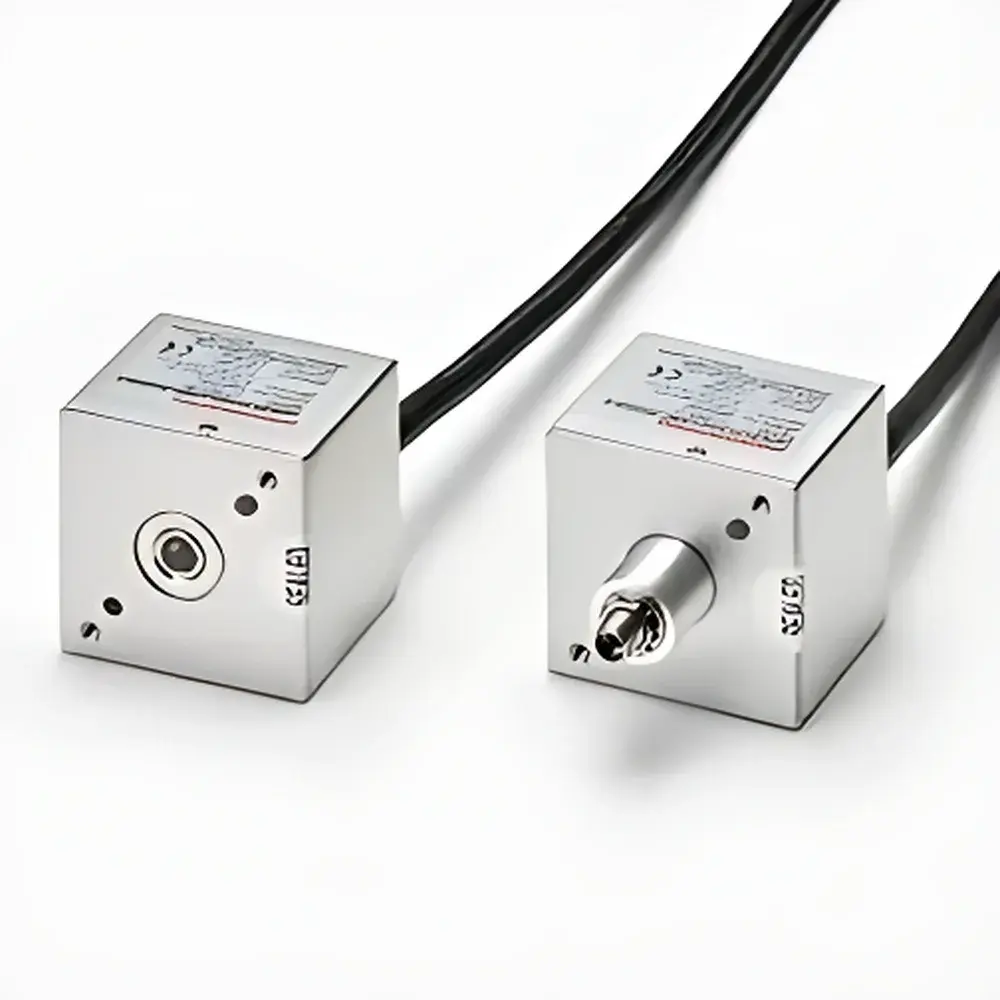
Hamamatsu L13651-01 Series 2 W Pulsed Xenon Flash Lamp Module
| Brand | Hamamatsu |
|---|---|
| Origin | Japan |
| Manufacturer Type | Original Equipment Manufacturer (OEM) |
| Product Category | Imported |
| Model | L13651-01 / L13651-02 / L13651-03 / L13651-04 (Standard & SMA-Fiber-Adapted Variants) |
| Light Source Type | Pulsed Xenon Arc Lamp |
| Illumination Configuration | Internal Illumination |
| Spectral Range | 185–2500 nm (UV-Vis-NIR) |
| Arc Gap | 1.0 mm |
| Window Material | UV-Grade Fused Silica / MgF₂ (Model-Dependent) |
| Max. Repetition Rate | Up to 79 Hz (at 600 V, 0.141 µF) |
| Max. Average Power | 2.0 W |
| Pulse Energy Range | 1.6–25.4 mJ per flash |
| Output Stability | ≤2.0% CV (typ. 0.4% CV at ≥10 Hz) |
| Lifetime | ≥1 × 10⁹ flashes (to 50% radiant output @ 190–1100 nm) |
| Input Voltage | 4.75–5.5 V or 10.8–13.2 V DC |
| Trigger Signal | TTL-compatible rectangular pulse (≥10 µs width, 2.5–5 V) |
| EMC Compliance | IEC/EN 61326-1 (CISPR 11 Group 1 Class B) |
| Safety | IEC/EN 62471 Risk Group 3 |
| RoHS | IEC/EN 63000 |
Overview
The Hamamatsu L13651-01 Series is a compact, self-contained pulsed xenon flash lamp module engineered for high-stability, low-noise optical excitation in demanding laboratory and industrial instrumentation. Operating on a simple 5 V DC supply, the module integrates a precision-machined 1.0 mm arc gap xenon discharge cell within a cylindrical hermetic package—enabling reliable, repeatable microsecond-scale light pulses across an exceptionally broad spectral range (185–2500 nm). Its design eliminates reliance on external high-voltage generators or complex cooling systems, making it ideal for integration into space-constrained platforms such as portable spectrophotometers, flow cytometers, HPLC detectors, and UV-Vis-NIR analytical sensors. The core principle relies on controlled capacitive discharge through a stabilized xenon plasma arc, generating intense, broadband, near-continuous-spectrum pulses with minimal electromagnetic interference (EMI)—a critical advantage in sensitive electronic environments where signal integrity must be preserved.
Key Features
- Ultra-low EMI architecture compliant with IEC/EN 61326-1 (CISPR 11 Group 1 Class B), minimizing coupling into adjacent analog or digital circuits.
- Precision electrode alignment (±0.05 mm tolerance) ensures consistent arc positioning and long-term spatial stability of the emission centroid—essential for fiber-coupled or collimated optical paths.
- Two mechanical configurations: standard PCB-mount variant (L13651-xx) and SMA-fiber-integrated version (L13651-1x), eliminating need for external lensing or alignment optics.
- Flexible triggering interface: TTL-compatible input (2.5–5 V, ≥10 µs pulse width) synchronized to rising edge; isolated RTN reference prevents ground-loop noise injection.
- Wide operational voltage range (4.75–5.5 V or 10.8–13.2 V DC) supports both low-power embedded systems and higher-energy configurations without redesign.
- No active cooling required under nominal operation (0–40 °C ambient); thermal management relies on passive conduction via aluminum housing—reducing system complexity and power overhead.
Sample Compatibility & Compliance
The L13651 series is compatible with a wide array of sample geometries and measurement modalities, including cuvette-based absorbance, flow-cell transmission, reflective surface analysis, and free-space fluorescence excitation. Its UV-transmitting window options (UV-grade fused silica or MgF₂) ensure effective output down to 185 nm—supporting applications in ozone-sensitive UV spectroscopy and photochemical reaction monitoring. The module meets IEC/EN 62471 Photobiological Safety Standard (Risk Group 3), confirming safe integration into Class 1 laser product enclosures and medical diagnostic devices. RoHS-compliant construction (IEC/EN 63000) and vibration/shock resistance (5–200 Hz, 15 m/s²; 500 m/s² shock) validate suitability for field-deployable instrumentation and GLP/GMP-regulated environments where mechanical robustness and material traceability are mandatory.
Software & Data Management
While the L13651 operates as a hardware-level light source with no onboard firmware or digital interface, its deterministic electrical behavior enables seamless synchronization with third-party data acquisition systems—including National Instruments DAQs, Keysight digitizers, and custom FPGA-based controllers. Trigger latency is stable and sub-microsecond, supporting time-resolved measurements such as lifetime decay profiling or gated detection. When deployed in regulated environments (e.g., clinical diagnostics or pharmaceutical QC), the module’s fixed pulse energy calibration and documented lifetime degradation curve (per IEC TR 62778) support audit-ready traceability. Integration with LabVIEW, Python (PyVISA), or MATLAB allows automated parameter sweeps (voltage, capacitance, repetition rate) while logging flash-to-flash intensity variance—facilitating compliance with FDA 21 CFR Part 11 requirements for electronic records when paired with validated host software.
Applications
- UV-Vis-NIR Absorption & Reflectance Spectroscopy: Broadband excitation for benchtop and portable spectrometers requiring stable, drift-free baseline performance over extended measurement sessions.
- HPLC & Flow Cytometry Detection: High-repetition-rate pulsing (up to 79 Hz) enables real-time peak integration in fast chromatographic runs and high-throughput cell analysis.
- In Vitro Diagnostics (IVD): Used in blood/urine analyzers where UV-excited fluorescence (e.g., NADH, tryptophan) or direct absorption (e.g., hemoglobin, bilirubin) must meet CLIA and ISO 15197 repeatability thresholds.
- Colorimetric & Turbidimetric Sensing: Stable pulse-to-pulse output (<2.0% CV) ensures reproducible quantification in water quality monitors (e.g., COD, nitrate, turbidity).
- Material Inspection & Semiconductor Metrology: Integrated into wafer inspection tools for defect contrast enhancement under pulsed UV illumination, avoiding thermal damage to photosensitive substrates.
- Multiplexed Microplate Readers (MTP): Modular form factor allows parallel deployment across multi-well plates, supporting wavelength-switched assays without lamp warm-up delays.
FAQ
What is the typical spectral irradiance distribution of the L13651 series?
The L13651 emits a continuous spectrum from 185 nm to 2500 nm (standard UV-glass window) or 160–7500 nm (MgF₂ window variant), closely approximating a blackbody radiator at ~6000 K, with strong UV line structure superimposed.
Can the L13651 be operated continuously at maximum repetition rate?
Yes—within thermal limits. At 600 V and 0.141 µF, the maximum average power is 2.0 W; sustained operation above this requires thermal derating or forced-air cooling if housing temperature exceeds 45 °C.
Is external high-voltage generation required?
No—the module contains an integrated DC-DC converter and storage capacitor bank; only low-voltage DC input (4.75–5.5 V or 10.8–13.2 V) and a TTL trigger signal are needed.
How is lifetime defined and validated?
Lifetime is defined as the number of flashes until radiant output (190–1100 nm) degrades to 50% of initial value, measured using Hamamatsu S1336-8BQ photodiode under standardized 2 W operating conditions per IEC TR 62778.
Does the module support analog modulation of pulse energy?
Yes—via external analog control voltage (3.2–4.8 V) applied to the dedicated Vctrl pin, enabling real-time adjustment of main discharge voltage and thus pulse energy without changing hardware configuration.




