
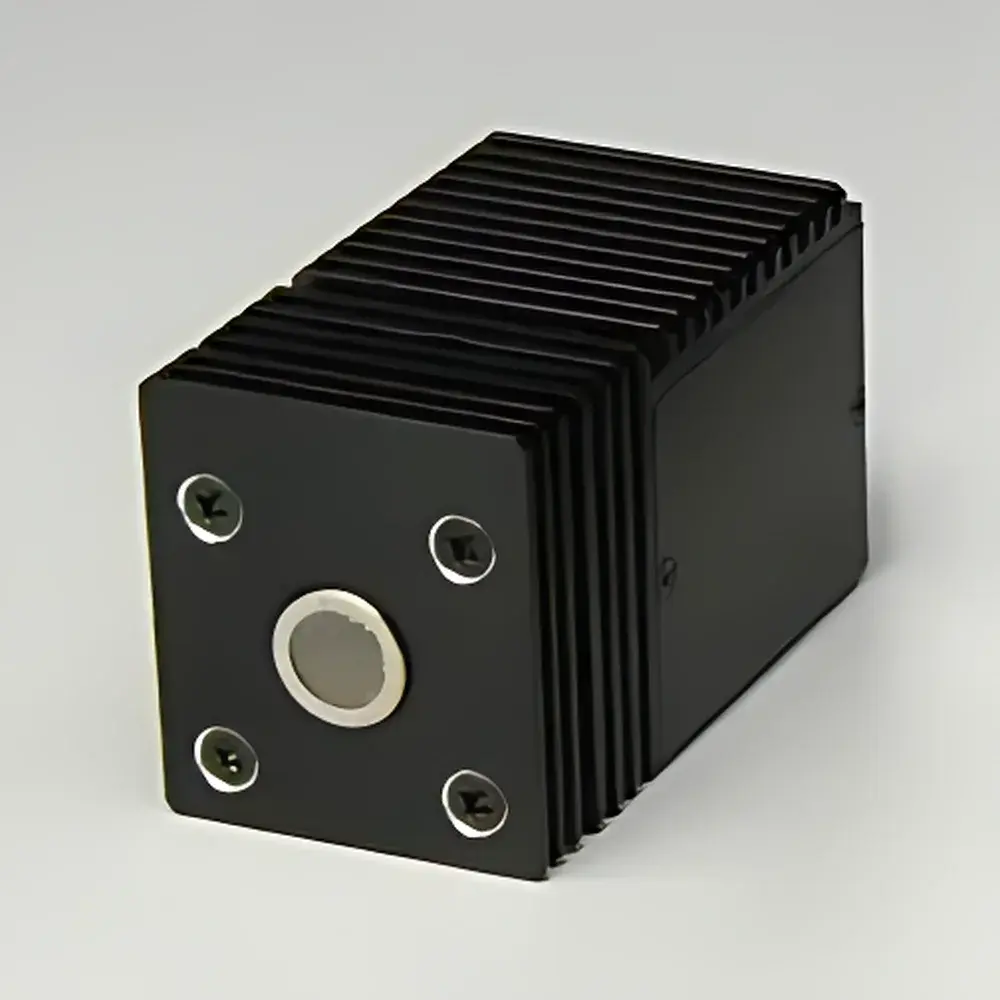
Hamamatsu Infrared-Enhanced CCD Area Image Sensor S11510-1106
| Brand | Hamamatsu |
|---|---|
| Origin | Japan |
| Manufacturer Type | Original Equipment Manufacturer (OEM) |
| Product Origin | Imported |
| Model | S11510-1106 |
| Price Range | USD 0–9,999 |
Overview
The Hamamatsu S11510-1106 is a high-performance, back-illuminated, infrared-enhanced charge-coupled device (CCD) area image sensor engineered for demanding spectroscopic detection applications. Designed with a 1024 × 128 pixel array and optimized quantum efficiency in the near-infrared (NIR) spectral range (700–1100 nm), this sensor delivers superior signal-to-noise ratio (SNR) and low readout noise—critical attributes for low-light, high-resolution spectral acquisition. Its thermoelectrically cooled architecture (typically operating at −10 °C to −20 °C) minimizes dark current, enabling extended integration times without significant thermal noise accumulation. The device employs a full-frame CCD architecture with interline transfer capability, supporting both global shutter operation and flexible binning modes to balance spatial resolution, frame rate, and sensitivity. As a core optoelectronic component, the S11510-1106 is not a standalone instrument but an OEM-grade imaging engine intended for integration into custom spectrometers, monochromators, Raman systems, and NIR process analyzers requiring robust, stable, and spectrally tailored detection.
Key Features
- Infrared-enhanced, back-thinned silicon CCD architecture with peak QE >75% at 850 nm and >40% at 1000 nm
- 1024 (horizontal) × 128 (vertical) active pixel array; 24 µm × 24 µm pixel pitch
- Integrated thermoelectric (Peltier) cooler enabling stable operation at −10 °C to −20 °C (typical)
- Low read noise: <15 e⁻ RMS (at 100 kpixels/s readout speed); dark current <0.001 e⁻/pixel/s at −15 °C
- Full-frame operation with mechanical shutter compatibility; supports 2×2 and 4×4 on-chip binning
- 16-bit analog-to-digital conversion via external clocking and correlated double sampling (CDS) circuitry
- Hermetically sealed ceramic package with quartz window; RoHS-compliant and suitable for cleanroom assembly
Sample Compatibility & Compliance
The S11510-1106 is compatible with optical configurations utilizing fiber-coupled inputs (e.g., SMA905), free-space collimated beams, or direct mounting onto spectrograph slit planes. It supports spectral dispersion across standard grating-based systems with focal lengths from 150 mm to 500 mm. While not a finished analytical instrument, its design adheres to industrial reliability standards expected in regulated environments: the sensor’s temperature stabilization protocol aligns with GLP-compliant data acquisition workflows; its stable gain and linearity (±0.5% over 90% of full scale) support traceable calibration per ISO/IEC 17025 requirements for metrological traceability in laboratory-developed methods. The device meets JEDEC JESD22-A108 stress-test protocols for temperature cycling and humidity exposure, ensuring long-term performance consistency in continuous-duty spectroscopy platforms.
Software & Data Management
As an OEM imaging component, the S11510-1106 does not include embedded firmware or proprietary software. Instead, it interfaces via industry-standard LVDS or CMOS-compatible timing signals (e.g., SHUTTER, CLOCK, SERIAL OUT) and requires integration with host FPGA or microcontroller-based driver electronics. Reference timing diagrams and register maps are provided in Hamamatsu’s official datasheet (S11510-1106-D, Rev. D). Compatible third-party SDKs—including those from National Instruments (NI-IMAQ), Thorlabs (Kinesis), and open-source libraries such as libuvc and PyHamamatsu—support frame capture, dark frame subtraction, flat-field correction, and spectral centroid calculation. All raw image data output is linear and unprocessed, preserving photometric integrity for downstream chemometric modeling (e.g., PLS regression, PCA) in compliance with FDA 21 CFR Part 11 when deployed within validated system architectures.
Applications
- Near-infrared (NIR) reflectance and transmittance spectroscopy for pharmaceutical tablet assay and blend uniformity analysis
- Portable and benchtop Raman spectrometers requiring high NIR quantum efficiency for 785 nm and 1064 nm excitation lines
- FT-NIR and dispersive NIR process analyzers used in food moisture/fat content monitoring and polymer composition verification
- Custom hyperspectral imaging systems for agricultural phenotyping and material sorting
- Time-resolved luminescence detection where gated integration and low dark current are essential
- Calibration reference detectors in NIST-traceable spectral radiometry setups
FAQ
Is the S11510-1106 supplied with a controller board or driver electronics?
No. It is a bare image sensor module requiring external timing generation, analog signal processing, and ADC interfacing—typically implemented via custom PCB or commercial camera-link/FPGA development kits.
What cooling method is recommended for optimal dark current suppression?
A two-stage thermoelectric cooler (TEC) controlled to −15 °C ± 0.5 °C is recommended; Hamamatsu specifies maximum junction temperature limits and thermal interface material (TIM) requirements in the mechanical drawing documentation.
Can this sensor be used in vacuum or high-humidity environments?
The hermetic ceramic package permits operation in ambient air and inert gas atmospheres; however, prolonged exposure to >85% RH without conformal coating is not advised. Vacuum operation requires evaluation of outgassing per ASTM E595.
Does Hamamatsu provide spectral responsivity calibration data for individual units?
Yes—NIST-traceable relative spectral response (RSR) curves and pixel uniformity maps are available as optional factory calibration services (order code: CAL-S11510-RSR).
Is the S11510-1106 compliant with export control regulations (e.g., EAR99 or ECCN)?
The device falls under EAR99 classification; no license is required for most destinations, though end-use restrictions apply for military or nuclear applications per U.S. Export Administration Regulations.




