
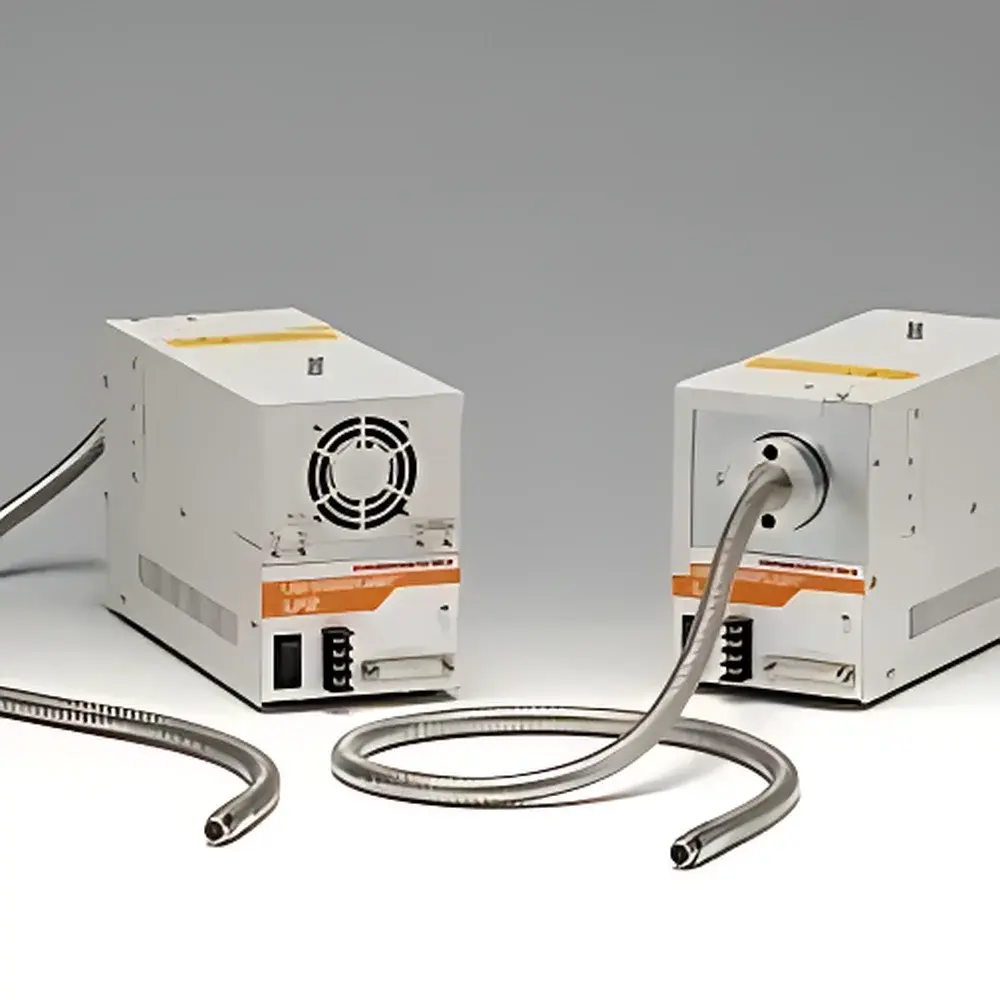
Hamamatsu Multi-Source Optical Module Platform
| Brand | Hamamatsu |
|---|---|
| Origin | Japan |
| Manufacturer Type | Original Equipment Manufacturer (OEM) |
| Product Category | Imported Optical Instrument |
| Model Series | Modular Light Source Family (S2D2, H2D2, L10671, L10290, OSG, VUV, RF Excimer, etc.) |
| Light Source Types | Deuterium, Tungsten-Halogen, Xenon Flash, UV-LED (365 nm / 385 nm), Electrodeless RF Excimer, Vacuum UV (VUV), Tunable Optical Spectrum Generator (OSG), THz Photoconductive Antenna Module |
| Illumination Mode | External (Free-Space or Fiber-Coupled) |
| Spectral Range | 115 nm – 1600 nm (depending on module) |
| Typical Lifetime | 10,000 – 20,000 h (UV-LED) |
Overview
The Hamamatsu Multi-Source Optical Module Platform is a modular family of precision light sources engineered for scientific instrumentation, industrial process control, and analytical system integration. Each module implements a distinct physical emission mechanism—such as continuum radiation from deuterium/tungsten-halogen lamps, narrowband electroluminescence from UV-LEDs, pulsed plasma discharge in xenon flash lamps, or tunable spectral synthesis via optical parametric filtering in the OSG series—to meet application-specific requirements in photometry, spectroscopy, photochemistry, semiconductor inspection, and vacuum ultraviolet (VUV) metrology. The platform emphasizes optical stability (<0.2% RMS intensity drift over 8 h), mechanical reproducibility (sub-millimeter mounting repeatability), and electrical interoperability (TTL/CMOS trigger compatibility, analog modulation inputs). All modules comply with IEC 61000-4 electromagnetic immunity standards and are designed to operate within ISO/IEC 17025-accredited laboratory environments where traceable irradiance calibration and long-term photometric consistency are mandatory.
Key Features
- Modular architecture enabling plug-and-play replacement and hybrid configuration (e.g., simultaneous UV-VIS-NIR illumination via L10671 + OSG)
- High-stability deuterium modules (S2D2, H2D2) featuring proprietary electrode geometry and air-cooled thermal management for <0.15% short-term intensity fluctuation
- UV-LED modules (365 nm / 385 nm) with thermally stabilized drive electronics, delivering <±0.5 nm wavelength tolerance and negligible IR thermal load on sensitive samples
- Optical Spectrum Generator (OSG): electronically tunable output across 390–700 nm (standard) or 430–790 nm (extended), with 1 nm step resolution and ±0.3 nm wavelength accuracy traceable to NIST SRM 2035
- Vacuum UV (VUV) modules incorporating MgF₂ windows and sealed D₂ discharge tubes, rated for operation down to 115 nm under controlled low-pressure conditions
- RF-driven excimer lamps operating at 2 MHz for uniform, low-flicker (≤0.1% RMS) 172 nm (Xe₂*) or 222 nm (KrCl*) emission—compatible with ISO 15714-compliant UV curing validation protocols
- Fiber-coupled variants (L10290, L10671) supporting SMA905 or FC/PC interfaces, with calibrated spectral irradiance data provided per unit
Sample Compatibility & Compliance
These modules support non-contact illumination of diverse sample types—including photomasks, biological tissues, thin-film coatings, and gas-phase analytes—without thermal degradation or photochemical side reactions. UV-LED and OSG modules are certified for use in Class 100 cleanrooms (ISO 14644-1) and conform to RoHS Directive 2011/65/EU and REACH Annex XVII restrictions. VUV sources meet ASTM E2533-17 specifications for vacuum ultraviolet radiometry, while flash xenon modules satisfy IEC 61000-4-5 surge immunity requirements for field-deployable environmental analyzers. All power supplies include safety interlocks compliant with IEC 61010-1 for laboratory equipment, and firmware-controlled modules support FDA 21 CFR Part 11 audit trails when integrated with validated software platforms.
Software & Data Management
Hamamatsu provides the “LightMaster” SDK (Windows/Linux/macOS) for full remote control of intensity, pulse width, repetition rate, and wavelength selection (OSG). The SDK supports LabVIEW, Python (PyHamamatsu), MATLAB, and C/C++ APIs, with built-in functions for spectral calibration interpolation, dark-current subtraction, and real-time intensity logging. Exported datasets follow HDF5 format with embedded metadata (wavelength axis, integration time, ambient temperature, serial number), ensuring compatibility with chemometric tools such as Unscrambler X and MATLAB Statistics Toolbox. Firmware updates are delivered via signed binary packages with SHA-256 verification, maintaining integrity during GLP/GMP audits.
Applications
- UV curing process monitoring and dose mapping in microelectronics packaging
- High-resolution absorbance spectroscopy (UV-VIS-NIR) for pharmaceutical QC per USP
- VUV reflectometry of EUV lithography masks at 13.5 nm (via harmonic generation seeding)
- Time-resolved fluorescence lifetime imaging (FLIM) using synchronized xenon flash modules
- Photoelectron spectroscopy source alignment and energy calibration
- THz time-domain spectroscopy (THz-TDS) using integrated photoconductive antenna modules with <100 fs laser synchronization
- Static charge neutralization in vacuum chambers using L12542 VUV ionizer (115–200 nm band)
FAQ
Can these modules be integrated into custom OEM instruments?
Yes. All modules feature standardized mechanical footprints (e.g., 30 mm × 30 mm baseplate), 24 V DC input, and digital control via RS-232 or USB-C, facilitating seamless integration into third-party spectrometers, ellipsometers, or wafer inspection tools.
Are spectral calibration certificates included?
Each unit ships with a factory-measured spectral irradiance curve (NIST-traceable reference detector), recorded at three operating temperatures (15°C, 25°C, 35°C) and archived in the device’s onboard EEPROM.
What is the recommended maintenance interval for deuterium modules?
No routine lamp replacement is required; however, intensity recalibration is advised every 500 operational hours or after 1,000 on/off cycles to maintain photometric compliance per ISO/IEC 17025 Clause 6.5.2.
Do RF excimer modules require external cooling?
No. These modules utilize passive aluminum heatsinking and are rated for continuous operation at ambient temperatures up to 40°C without forced airflow.
Is fiber coupling available for VUV modules?
Not directly—due to MgF₂ window transmission limits and VUV photon absorption in silica fibers. Free-space beam delivery with reflective optics (Al+MgF₂ coated mirrors) is the standard configuration.



