
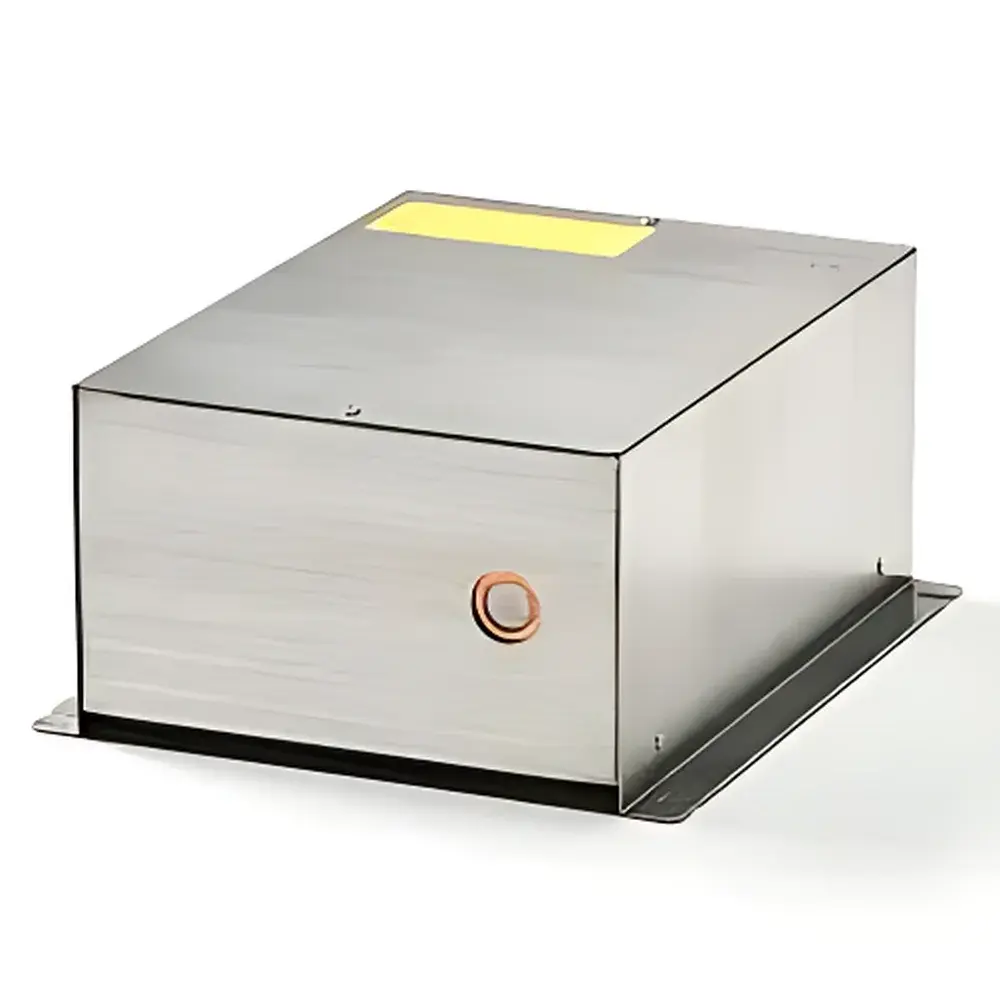
Hamamatsu L13050 Compact Soft X-Ray Source
| Brand | Hamamatsu |
|---|---|
| Origin | Japan |
| Manufacturer Type | Original Equipment Manufacturer (OEM) |
| Import Status | Imported |
| Model | L13050 |
| Cooling Method | Forced Air Cooling |
| Output Window Material | Beryllium (Be) |
| Tube Voltage Range | 10–15 kV |
| Tube Current Range | 100–150 µA |
| Maximum Output Power | 1.5 W |
| Maximum Rated Voltage | 26.4 V DC |
| X-Ray Emission Angle | 71° |
| Output Stability (*1) | ±0.5% (after 5 h operation) |
| Supply Voltage | 24 V DC |
| Supply Current | 1 A |
| Remote Control Functions | X-Ray ON/OFF, Lifetime Monitoring, Tube Voltage Control & Monitoring, Tube Current Control & Monitoring, I-PRO Monitoring |
| Weight | 1400 g |
| Operating Temperature | +10 to +40 °C |
| Storage Temperature | 0 to +60 °C |
| Operating Humidity | ≤60% RH |
| Storage Humidity | ≤85% RH |
Overview
The Hamamatsu L13050 is a compact, OEM-integrated soft X-ray source engineered for laboratory-scale and synchrotron-complementary applications requiring stable, controllable, and spatially defined soft X-ray emission in the 0.1–2.5 keV range. Unlike conventional sealed-tube or rotating-anode sources, the L13050 employs a miniature thermionic cathode and grounded anode architecture with a thin beryllium exit window (≤12.5 µm), enabling efficient transmission of low-energy photons while maintaining vacuum integrity. Its operation relies on electron acceleration across a precisely regulated 10–15 kV potential difference, generating characteristic line emissions (e.g., Al Kα at 1.486 keV, Mg Kα at 1.254 keV) and broadband bremsstrahlung suitable for surface-sensitive techniques including X-ray photoelectron spectroscopy (XPS) pre-characterization, soft X-ray reflectometry (SXR), and laboratory-based X-ray absorption near-edge structure (XANES) studies.
Key Features
- Integrated power supply and control electronics housed within a single 1400 g module—designed for space-constrained vacuum chambers and custom beamline endstations.
- Beryllium output window optimized for high transmission below 2 keV; compatible with UHV environments when coupled to differential pumping stages.
- Forced-air cooling system ensures thermal stability during continuous operation up to 1.5 W output, supporting ≥5-hour stability of ±0.5% (typical) under constant voltage/current conditions.
- Digital remote interface (RS-232 or TTL-compatible) enables full parameter control: X-ray enable/disable, real-time monitoring of tube voltage (kV), tube current (µA), and integrated I-PRO signal for predictive lifetime estimation.
- Fixed 71° take-off angle geometry facilitates consistent beam alignment and simplifies optical coupling with zone plates, multilayer mirrors, or grating monochromators.
- Compliant with IEC 61010-1 safety standards for electrical equipment for measurement, control, and laboratory use; includes interlock-ready signals for integration into larger safety-rated systems.
Sample Compatibility & Compliance
The L13050 is not a standalone analytical instrument but a critical subsystem for soft X-ray instrumentation platforms. It supports analysis of conductive and insulating thin films, 2D materials (e.g., graphene, TMDs), oxide interfaces, and organic semiconductor layers—provided samples are mounted in vacuum-compatible holders and positioned within the 71° emission cone. While the source itself does not perform spectral analysis, its stability and repeatability meet requirements for GLP-aligned calibration workflows in metrology labs. The unit complies with RoHS Directive 2011/65/EU and carries CE marking for electromagnetic compatibility (EN 61326-1) and low-voltage safety (EN 61010-1). No radioactive isotopes or hazardous gases are employed—operation is fully electrically driven and vacuum-sealed.
Software & Data Management
Hamamatsu provides the L13050 Control Software (v3.x, Windows 10/11 compatible) with native DLL support for LabVIEW™, Python (PySerial), and MATLAB® integration. All remote commands generate timestamped ASCII logs containing voltage, current, cumulative operating hours, and I-PRO degradation metrics—enabling traceable audit trails required under FDA 21 CFR Part 11 for regulated R&D environments. The software implements configurable ramping profiles (e.g., soft-start voltage sequencing) to minimize cathode sputtering and extend operational lifetime beyond 5,000 hours (typical). No cloud connectivity or proprietary firmware updates are required; all configuration resides locally and remains fully deterministic for ISO/IEC 17025-accredited laboratories.
Applications
- Pre-characterization of catalyst surfaces prior to in situ XPS measurements.
- Calibration reference source for soft X-ray detectors (e.g., back-illuminated CCDs, microchannel plate assemblies).
- Source for tabletop X-ray microscopy setups utilizing Fresnel zone plates.
- Teaching platform for undergraduate solid-state physics and radiation instrumentation labs.
- Component in custom-designed X-ray fluorescence (XRF) analyzers targeting light elements (Z = 5–13).
- Beamline component for university-scale undulator or bending magnet beamlines requiring auxiliary or backup excitation.
FAQ
Is the L13050 suitable for ultra-high vacuum (UHV) environments?
Yes—when installed with appropriate CF or KF flange adapters and operated with standard vacuum feedthroughs, it maintains integrity down to 1×10⁻⁷ Pa. The Be window must remain uncoated and free of hydrocarbon contamination.
Can tube voltage and current be modulated dynamically during acquisition?
Yes—via RS-232 command set with ≤10 ms response time; however, rapid cycling (>10 Hz) is not recommended due to thermal stress on the cathode filament.
What is the expected lifetime under nominal operating conditions?
Rated for ≥5,000 hours at 12 kV / 120 µA; lifetime scales inversely with operating voltage and is tracked via the embedded I-PRO monitor.
Does the unit include radiation shielding?
No—shielding must be implemented externally per local regulatory requirements (e.g., NCRP Report No. 148); typical configurations use 1–2 mm lead-equivalent acrylic or aluminum enclosures.
Is OEM customization available for mechanical or electrical interfaces?
Yes—Hamamatsu offers mechanical redesign (flange type, cable routing), firmware modifications, and extended temperature-range variants upon formal engineering inquiry.





