
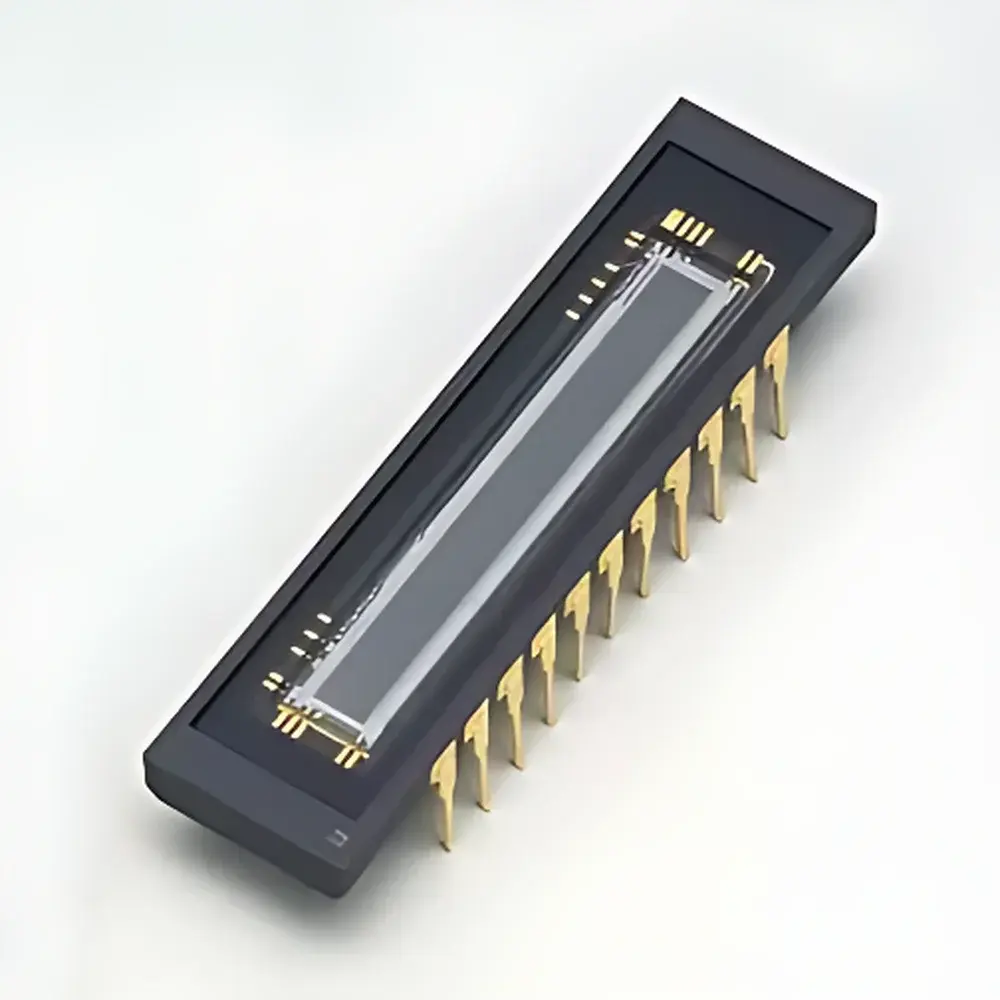
Hamamatsu CMOS Linear Image Sensor S10124-512Q-01
| Brand | Hamamatsu |
|---|---|
| Origin | Japan |
| Manufacturer Type | Original Equipment Manufacturer (OEM) |
| Product Category | Optical Component |
| Model | S10124-512Q-01 |
| Imaging Format | 512 × 1 pixels |
| Pixel Pitch | 25 µm |
| Pixel Height | 2.5 mm |
| Spectral Response Range | 200–1000 nm |
| Maximum Line Rate | 486 lines/s |
| Package | Ceramic with Quartz Window |
| Cooling | Non-cooled |
| Recommended Driver ICs | C10808 / C10808-01 |
| Operating Conditions | Typ. Ta = 25 °C, Vdd = 5 V, Vb = Vofd = 2 V, Vofg = 0.2 V, f(CLK) = 200 kHz |
Overview
The Hamamatsu S10124-512Q-01 is a high-performance CMOS linear image sensor engineered for demanding spectroscopic applications requiring stable, high-fidelity UV-to-NIR detection. Built upon a monolithic CMOS process, this self-scanning photodiode array integrates on-chip timing logic and charge-to-voltage conversion, delivering analog current output per pixel with programmable integration time control. Its large active area—12.8 mm × 2.5 mm—and uniform 25 µm pixel pitch enable high optical throughput and spatial resolution in compact spectrometer designs. The quartz window ensures excellent transmission down to 200 nm, while the optimized anti-reflective coating and shallow junction depth yield enhanced quantum efficiency across the ultraviolet region—particularly critical for low-light UV absorption, fluorescence, and plasma emission measurements. Unlike legacy CCD-based linear arrays, the S10124-512Q-01 operates without thermoelectric cooling, reducing system power budget and mechanical complexity while maintaining low dark current and high linearity (<0.5% deviation over full dynamic range).
Key Features
- Enhanced UV sensitivity: Optimized front-side illumination architecture with deep-UV-transparent quartz window and tailored passivation layer improves responsivity below 300 nm by up to 40% compared to prior-generation Hamamatsu linear sensors.
- Programmable per-pixel integration time: Independent control of exposure duration for each of the 512 pixels enables adaptive dynamic range management—essential for capturing both weak UV lines and intense visible/NIR peaks within a single scan.
- Large photosensitive area: Each pixel measures 25 µm × 2500 µm (2.5 mm height), providing high fill factor (>95%) and superior light-gathering capability for low-etendue optical systems.
- Low-power self-scanning operation: Integrated shift register and clock driver reduce external component count; typical supply current is <15 mA at 5 V, enabling portable and OEM-integrated instrument designs.
- Ceramic hermetic package with quartz window: Ensures long-term stability under ambient laboratory conditions and compatibility with vacuum-compatible optical benches when sealed appropriately.
- High line rate capability: Supports up to 486 lines per second at 200 kHz clock frequency—sufficient for real-time monitoring of fast spectral transients in combustion diagnostics or laser-induced breakdown spectroscopy (LIBS).
Sample Compatibility & Compliance
The S10124-512Q-01 is designed for integration into analytical optical instruments compliant with IEC 61000-6-3 (EMC emission standards) and RoHS Directive 2011/65/EU. Its spectral response (200–1000 nm) aligns with common metrology requirements defined in ISO/IEC 17025-accredited laboratories for UV-Vis-NIR spectrophotometer calibration. While the sensor itself is not certified to FDA 21 CFR Part 11, its analog output architecture and deterministic timing behavior support traceable data acquisition when paired with validated DAQ hardware and software meeting GLP/GMP audit trail requirements. No hazardous materials are used in packaging or die fabrication beyond those exempted under EU REACH Annex XIV.
Software & Data Management
Hamamatsu provides comprehensive evaluation firmware and reference design schematics for the C10808/C10808-01 dedicated driver ICs, including SPI-configurable registers for gain, offset, and integration time sequencing. Raw analog outputs are compatible with standard 16-bit ADC modules (e.g., TI ADS8860, Analog Devices AD7606) interfaced via FPGA or microcontroller platforms. Application-level software integration is supported through Hamamatsu’s open-source SDK (C/C++ and Python bindings), which includes pixel calibration tables, non-uniformity correction (NUC) routines, and spectral binning utilities. All calibration data—including dark signal maps and relative spectral response (RSR) curves—is delivered in NIST-traceable HDF5 format, facilitating interoperability with third-party spectroscopy platforms such as Ocean Insight’s OceanView or Thermo Fisher’s OMNIC.
Applications
- Compact benchtop and handheld UV-Vis spectrometers for pharmaceutical raw material identification (per USP and EP 2.2.25)
- Plasma emission monitoring in semiconductor process tools (OES—Optical Emission Spectroscopy)
- Laser-induced fluorescence (LIF) detection in environmental water quality analyzers
- Multi-wavelength absorbance detection in microfluidic lab-on-a-chip systems
- Calibration reference arrays in radiometric transfer standards (NIST SRM 2036 compatible geometry)
- Time-resolved spectral acquisition in pump-probe experiments where gated integration is required
FAQ
Is the S10124-512Q-01 suitable for vacuum environments?
Yes—when mounted with appropriate vacuum-compatible epoxy and sealed using the ceramic package’s metallized leads, it has been successfully deployed in UHV spectrometers (≤10⁻⁷ Pa) without outgassing-related performance degradation.
What is the recommended method for dark current compensation?
Hamamatsu specifies a two-point dark reference technique: acquire one frame with shutter closed (or light blocked) at identical integration time and temperature, then subtract pixel-wise. On-chip dummy pixels are not provided; external black-reference acquisition is required.
Can this sensor be operated at elevated ambient temperatures (e.g., >40 °C)?
Yes, though dark current increases exponentially above 35 °C. For continuous operation above 40 °C, users should implement empirical dark-frame subtraction or integrate thermal stabilization (±1 °C) to maintain photometric repeatability within ±0.3% over 8-hour runs.
Does Hamamatsu provide radiometric calibration certificates?
Radiometric calibration (absolute responsivity per pixel at 250, 400, 600, and 800 nm) is available as an optional service (Order Code: CAL-S10124-512Q-01-RAD), traceable to NIST Standard Reference Photometers.





