
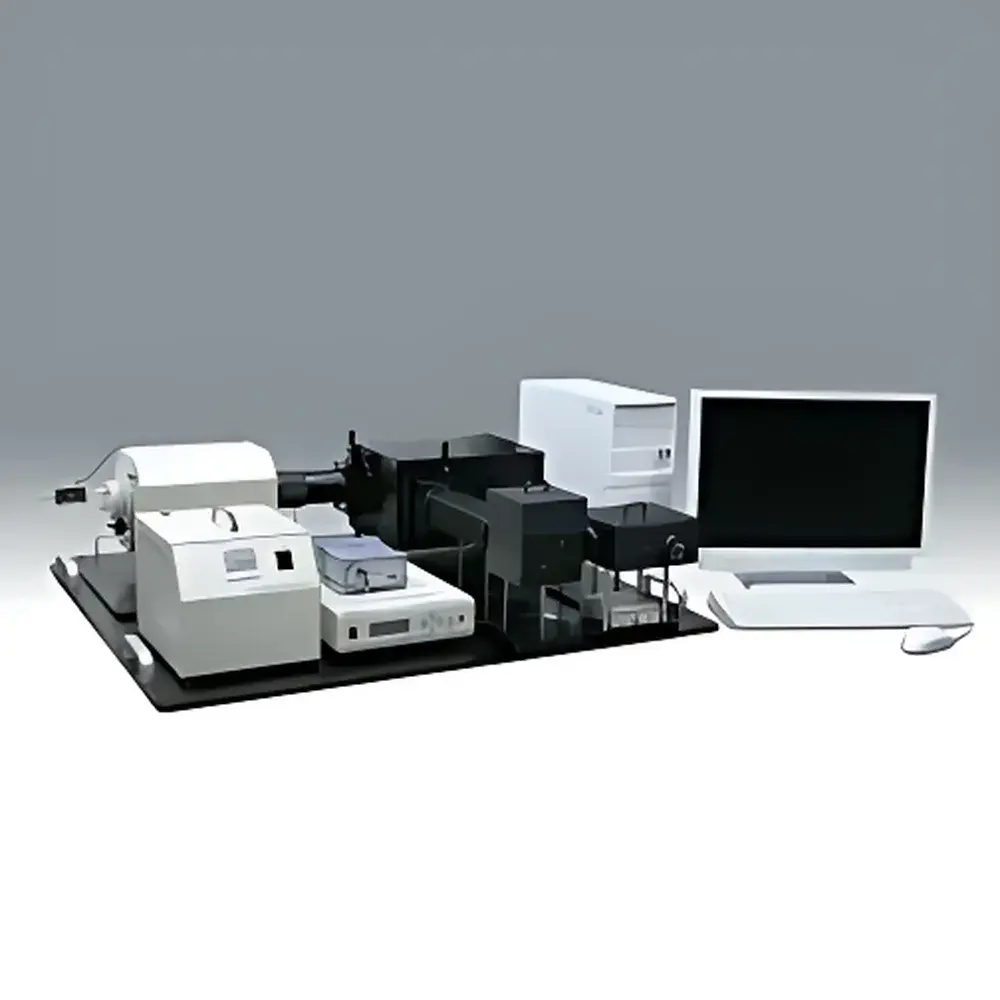
Hamamatsu C7990 Near-Infrared Fluorescence Lifetime Measurement System
| Brand | Hamamatsu |
|---|---|
| Origin | Japan |
| Manufacturer Type | Original Equipment Manufacturer (OEM) |
| Product Origin | Imported |
| Model | C7990 |
| Price | Upon Request |
| Wavelength Range Options | 650–1400 nm, 650–1700 nm, 950–1400 nm, 950–1700 nm |
| Cooling Methods | Liquid Nitrogen (≈2 h cooldown), Thermoelectric (≈30 min cooldown) |
| Time Resolution | 100 ps – 600 ps (model-dependent) |
Overview
The Hamamatsu C7990 Near-Infrared Fluorescence Lifetime Measurement System is a high-performance, modular time-domain fluorescence lifetime analyzer engineered for quantitative decay kinetics characterization in the biologically and industrially critical near-infrared (NIR) spectral window. Operating on the principle of time-correlated single-photon counting (TCSPC), the system delivers precise temporal resolution from sub-nanosecond down to 100 ps across multiple NIR spectral bands—enabling rigorous investigation of fluorophore dynamics where water absorption, tissue penetration, and low autofluorescence are decisive factors. Designed for laboratory-based fundamental research and applied R&D in photonics, life sciences, and materials science, the C7990 integrates synchronized pulsed laser excitation (typically picosecond diode or solid-state lasers), ultra-low-noise NIR-sensitive detectors, and high-precision timing electronics to resolve complex multi-exponential decays with high signal-to-noise ratio and excellent reproducibility.
Key Features
- Configurable spectral coverage: Four standard configurations support wavelength ranges from 650–1400 nm, 650–1700 nm, 950–1400 nm, and 950–1700 nm—optimized for InGaAs/InP photodiodes and extended-range PMTs.
- Sub-100 ps time resolution capability: The C7990-21 and C7990-22 variants achieve ≈100 ps instrument response function (IRF) full width at half maximum (FWHM) under liquid nitrogen cooling, enabling resolution of fast non-radiative relaxation pathways in quantum dots, conjugated polymers, and NIR-II probes.
- Dual cooling architecture: Selectable liquid nitrogen (LN₂) cooling (≈2 h thermal stabilization) for ultimate dark current suppression and thermoelectric (TE) cooling (≈30 min stabilization) for rapid setup and routine operation—both maintaining detector operating temperatures below −80 °C for optimal signal fidelity.
- Modular TCSPC core: Integrates Hamamatsu’s proprietary high-speed time-to-digital converter (TDC) with <10 ps binning resolution, synchronized to user-supplied laser repetition rates (10 kHz–80 MHz), and supports gated acquisition modes for background rejection.
- Rugged optical bench design: Pre-aligned excitation/detection paths with SMA905 or FC/PC fiber coupling options; optional motorized filter wheels and automated wavelength calibration routines ensure long-term measurement stability.
Sample Compatibility & Compliance
The C7990 accommodates solid, liquid, and thin-film samples via standard cuvette holders, microscope-integrated stages, or custom sample chambers. Its NIR sensitivity enables direct interrogation of biological tissues, semiconductor wafers, carbon nanotube dispersions, and upconversion nanoparticles without spectral interference from visible-region autofluorescence. All configurations comply with IEC 61000-6-3 (EMC emission standards) and IEC 61010-1 (safety requirements for electrical equipment). Data acquisition workflows support audit-trail-enabled operation per FDA 21 CFR Part 11 when paired with validated Hamamatsu Photonics software environments, and measurement traceability aligns with ISO/IEC 17025 guidelines for calibration laboratories.
Software & Data Management
Controlled via Hamamatsu’s proprietary FLIM Studio software (Windows 10/11, 64-bit), the system provides real-time decay curve visualization, iterative reconvolution-based multi-exponential fitting (Levenberg–Marquardt algorithm), χ² diagnostics, and global analysis across wavelength or temperature series. Raw TCSPC histograms are stored in industry-standard SPC binary format; export options include CSV, HDF5, and FCS (Fluorescence Correlation Spectroscopy) v2.0 compliant files. Software modules support batch processing, ROI-based lifetime mapping (when coupled with scanning stages), and integration with MATLAB and Python via documented DLL and REST API interfaces. Audit logs record operator ID, acquisition parameters, calibration timestamps, and file integrity hashes—ensuring GLP/GMP-compliant data governance.
Applications
- Quantitative lifetime imaging of NIR-II fluorophores (e.g., Ag₂S QDs, rare-earth-doped nanoparticles) in preclinical in vivo models.
- Charge carrier lifetime mapping in perovskite solar cells and organic photovoltaic films under ambient and controlled-atmosphere conditions.
- Protein conformational dynamics via time-resolved Förster resonance energy transfer (TR-FRET) using NIR donor–acceptor pairs.
- Quality control of phosphor materials for LED lighting and laser gain media through microsecond-to-picosecond decay component deconvolution.
- Time-resolved spectroscopy of photosynthetic complexes and light-harvesting antennas in native membrane environments.
FAQ
What laser sources are compatible with the C7990 system?
The system accepts external picosecond-pulsed lasers with repetition rates between 10 kHz and 80 MHz and trigger outputs compatible with TTL or NIM logic levels. Commonly used sources include Hamamatsu PLP-10, PicoQuant LDH-D-C, and Toptica FemtoFErb series.
Can the C7990 be integrated with a confocal or widefield microscope?
Yes—via fiber-coupled input/output ports and optional XYZ piezo scanning stages, the C7990 supports both point-scanning FLIM and widefield time-gated acquisition when interfaced with commercial microscope platforms (e.g., Nikon A1R-MP+, Zeiss LSM 980).
Is calibration data traceable to national metrology institutes?
Hamamatsu provides factory calibration certificates referencing NIST-traceable reference fluorophores (e.g., IR-1061 in DCM, lifetime ≈ 2.3 ns at 25 °C) and certified timing standards; on-site recalibration services are available globally.
Does the system support lifetime-based pH or ion sensing?
Yes—by selecting environment-sensitive NIR fluorophores (e.g., cyanine derivatives with protonation-dependent non-radiative decay), the C7990 enables quantitative ratiometric or lifetime-based sensing with sub-0.1-unit pH resolution in turbid media.
What maintenance is required for LN₂-cooled configurations?
Liquid nitrogen consumption averages 0.8–1.2 L/h during continuous operation; automated level monitoring and vacuum-jacketed dewars minimize boil-off. Detector quantum efficiency degradation is negligible over 5+ years under specified thermal cycling protocols.



