
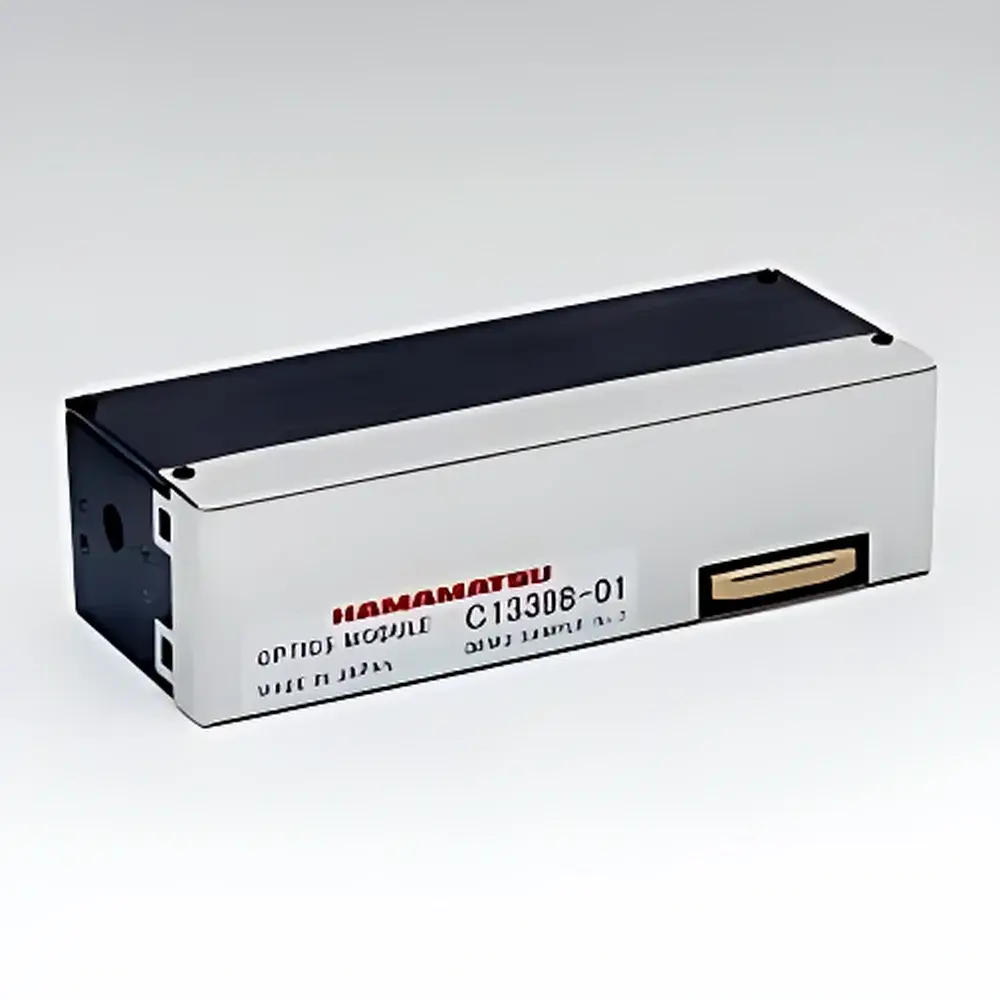
Hamamatsu Optical Absorption Module C13398-01
| Brand | Hamamatsu |
|---|---|
| Origin | Japan |
| Manufacturer Type | Original Equipment Manufacturer (OEM) |
| Product Category | Imported |
| Model | C13398-01 |
| Price Range | USD 0–1,499 |
Overview
The Hamamatsu Optical Absorption Module C13398-01 is a compact, OEM-grade photometric detection module engineered for precise absorbance measurement in benchtop and embedded spectroscopic systems. Based on a fixed-wavelength, multi-channel optical architecture, it employs a silicon photodiode array coupled with precision optical components—including a beam splitter, interference filters, and low-noise transimpedance amplification—to deliver stable analog voltage outputs proportional to incident light intensity. Its design targets applications requiring high optical density (OD > 4) rejection—critical for quantifying low-transmittance samples—and ultra-low electronic noise performance across ambient laboratory conditions. Unlike scanning spectrometers, the C13398-01 operates as a discrete-wavelength absorption sensor: each channel corresponds to a pre-aligned spectral band defined by its integrated interference filter, enabling rapid, drift-resistant measurements without moving parts or wavelength calibration routines.
Key Features
- Multi-wavelength capability: Simultaneous detection of nine user-defined analytical wavelengths plus one dedicated reference channel for real-time baseline correction and photometric stability compensation.
- High optical density rejection: Optimized optical path and detector shielding achieve OD > 4 attenuation, minimizing stray-light-induced errors in high-absorbance regimes (e.g., concentrated dye solutions or turbid biological suspensions).
- Low-noise analog output: Integrated transimpedance amplifier delivers stable voltage signals (0–5 V or 0–10 V scalable) with <10 µV RMS noise (typical, 10 Hz–10 kHz bandwidth), suitable for direct interfacing with data acquisition systems or PLCs.
- Compact OEM form factor: Dimensions of 89 mm (W) × 26 mm (H) × 38 mm (D) enable integration into space-constrained instruments; mounting via M4 threaded holes on the baseplate facilitates rigid coupling to fiber-optic light guides or collimated beam paths.
- Filter-defined spectral response: Each channel incorporates a hard-coated interference filter with ±2 nm center wavelength tolerance and <10 nm FWHM bandwidth, ensuring reproducible photometric selectivity across production batches.
Sample Compatibility & Compliance
The C13398-01 is compatible with standard cuvette-based, flow-cell, and microfluidic absorbance configurations when paired with appropriate illumination sources (e.g., LED arrays, halogen lamps, or laser diodes). It supports liquid, suspension, and thin-film samples within optical path lengths ranging from 0.1 mm to 10 mm. As an optical subassembly—not a standalone analytical instrument—it complies with IEC 61326-1 (EMC for laboratory equipment) and RoHS 2011/65/EU directives. While not certified as a medical device or GLP-compliant instrument per se, its traceable optical design and stable analog output make it suitable for use in ISO/IEC 17025-accredited laboratories when integrated into validated host systems meeting ASTM E275, USP , or ISO 10993-12 requirements for photometric validation.
Software & Data Management
The C13398-01 operates as an analog front-end and requires external signal conditioning and digitization. When used with the optional Hamamatsu Evaluation Circuit C13390 (sold separately), the module’s nine analytical + one reference channels are simultaneously digitized at 16-bit resolution with programmable sampling rates up to 10 kS/s. The C13390 provides USB 2.0 interface, onboard EEPROM for filter calibration coefficients, and Windows/Linux-compatible SDK supporting LabVIEW, MATLAB, Python (PyUSB), and C/C++ APIs. All acquired absorbance data include timestamping, channel metadata, and optional audit-trail logging—enabling compliance with FDA 21 CFR Part 11 when deployed in validated environments using appropriate software configuration controls.
Applications
- Continuous monitoring of enzymatic reaction kinetics in microplate readers and bioreactor analyzers.
- Multi-analyte detection in point-of-care diagnostic platforms (e.g., immunoassay strip readers, lateral flow quantification).
- Process analytical technology (PAT) for real-time concentration tracking in pharmaceutical synthesis and fermentation control loops.
- Embedded absorbance sensing in environmental water quality sensors (e.g., nitrate, phosphate, COD estimation).
- Calibration transfer and method development in UV-Vis spectrophotometer OEM modules.
FAQ
Is the C13398-01 supplied with calibrated wavelength filters?
Yes—each unit ships with factory-aligned interference filters; spectral center wavelengths and transmission curves are documented in the individual calibration report (NIST-traceable reference standards used during characterization).
Can the module operate without the C13390 evaluation circuit?
Yes—the C13398-01 provides analog voltage outputs directly; however, digitization, synchronization, and channel multiplexing require external DAQ hardware and custom firmware or driver development.
What is the maximum recommended irradiance level per channel?
The Si photodiode array is rated for continuous operation up to 10 mW/cm² at peak filter transmission; exceeding this may induce nonlinearity or thermal drift—consult Hamamatsu Application Note AN-002 for derating curves.
Does Hamamatsu provide mechanical drawings and footprint files?
Yes—STEP, IGES, and PDF dimensional drawings, including PCB layout and mounting hole specifications, are available under NDA upon request through authorized distributors.
Is temperature compensation built into the module?
No—temperature-dependent responsivity drift (~0.05 %/°C typical) must be addressed either via external thermistor feedback in the host system or post-acquisition correction using calibration tables provided in the technical manual.




