
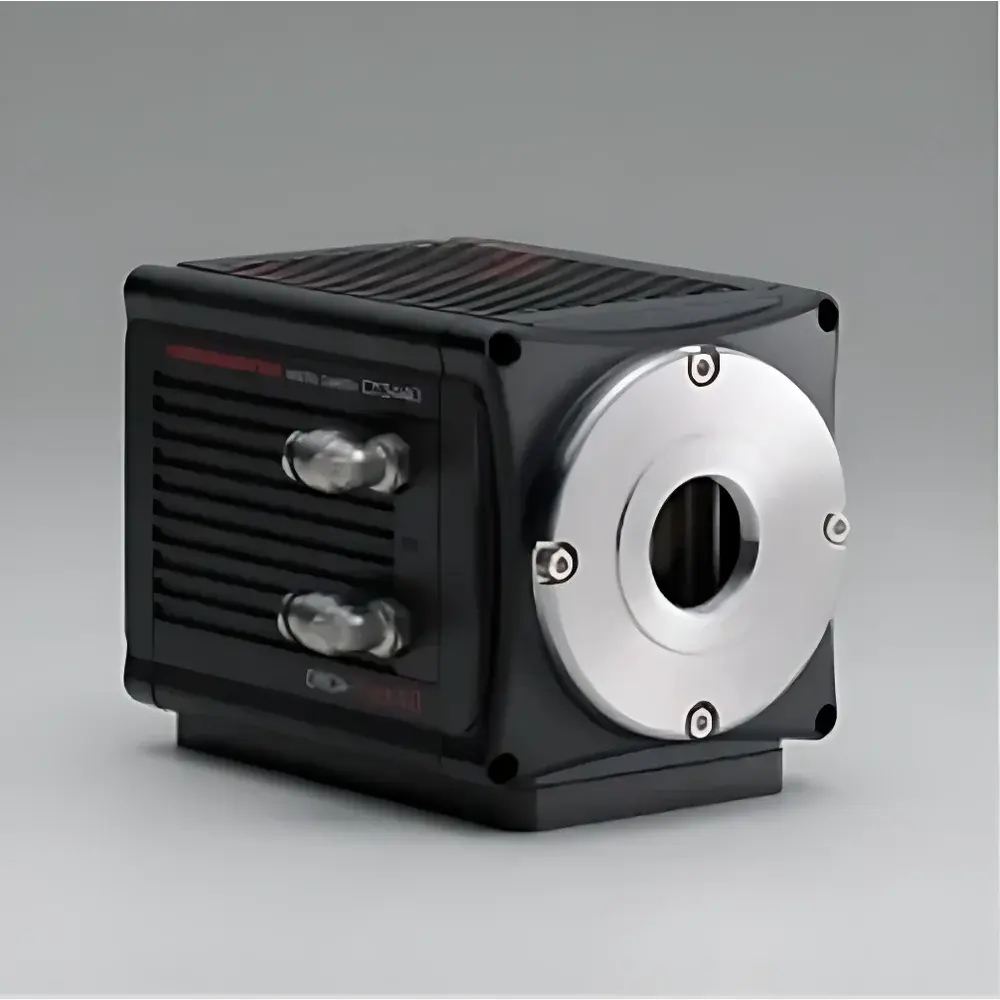
Hamamatsu ORCA-Flash4.0 V3 sCMOS Camera
| Brand | Hamamatsu |
|---|---|
| Origin | Japan |
| Manufacturer | Hamamatsu Photonics K.K. |
| Product Type | Scientific sCMOS Imaging Camera |
| Model | C13440-20CU |
| Detector Type | Back-illuminated sCMOS |
| Quantum Efficiency | 82% (peak @ 560 nm) |
| Resolution | 2048 × 2048 pixels |
| Pixel Size | 6.5 µm × 6.5 µm |
| Active Area | 13.312 mm × 13.312 mm |
| Full Well Capacity | 30,000 e⁻ (typ.) |
| Read Noise | 1.6 e⁻ RMS (100 fps, standard scan) |
| Dark Current | 0.06 e⁻/pix/s (@ −10 °C, typ.), 0.006 e⁻/pix/s (@ −30 °C, typ.) |
| Dynamic Range | 37,000:1 (typ.) |
| Cooling | Thermoelectric (TEC) with forced-air or water cooling options (−10 °C or −30 °C below ambient) |
| Interface | Camera Link / USB 3.0 |
| A/D Depth | 16-bit / 12-bit / 8-bit selectable |
| Shutter Modes | Global Reset, Rolling Shutter, Lightsheet Mode, W-View Mode, Dual Lightsheet Mode |
| Triggering | Hardware-triggered start, burst, internal sync, master pulse generator (1 µs resolution) |
| Hot Pixel Correction | 4-level programmable (off to aggressive) |
| PRNU & DSNU | Calibrated per unit (EMVA 1288 compliant) |
| Lens Mount | C-mount |
| Power Consumption | <15 W |
| Operating Temperature | 10–30 °C ambient |
Overview
The Hamamatsu ORCA-Flash4.0 V3 (Model C13440-20CU) is a high-performance scientific sCMOS camera engineered for quantitative, low-light imaging applications in life sciences, biophotonics, and physical research laboratories. Built upon Hamamatsu’s proprietary back-illuminated sCMOS sensor architecture, it delivers exceptional quantum efficiency (82% peak at 560 nm), ultra-low read noise (as low as 1.4 e⁻ RMS in slow-scan mode), and deep thermoelectric cooling (down to −30 °C with water cooling). Its optical design and on-board FPGA-based image processing enable precise photon counting fidelity across wide dynamic ranges — critical for applications demanding pixel-level linearity, reproducible photometry, and minimal fixed-pattern noise. Unlike conventional CCD or EM-CCD systems, the ORCA-Flash4.0 V3 achieves sub-electron read noise without gain multiplication, eliminating excess noise factor penalties while maintaining true 16-bit digitization integrity.
Key Features
- Quantitative Calibration Framework: Each unit undergoes full EMVA 1288-compliant characterization, including per-pixel PRNU (Photo Response Non-Uniformity) and DSNU (Dark Signal Non-Uniformity) mapping, ensuring traceable linearity down to <500 e⁻ signal levels and absolute photometric accuracy across the full well range (≤0.5% nonlinearity).
- Multi-Mode Readout Architecture: Supports Normal Area, Multiple ROI, Lightsheet Readout Mode (patented row-wise exposure timing control), W-View Mode (dual-exposure acquisition on left/right sensor halves), and Dual Lightsheet Mode — enabling synchronized dual-color light-sheet microscopy when paired with W-View GEMINI-2C beam splitters.
- Programmable Hot Pixel Correction: Four-tier correction algorithm (Off / Low / Medium / High) allows users to balance raw data fidelity against artifact suppression — essential for motion-critical tracking or post-acquisition analysis requiring unaltered pixel values.
- Enhanced Visualization Mode: Applies real-time contrast enhancement for live viewing while preserving original 16-bit linear data to disk — bridging the perceptual gap between sCMOS fidelity and legacy EM-CCD visual expectations without compromising quantitative integrity.
- Hardware-Level Synchronization: Integrated master pulse generator provides sub-microsecond trigger precision (1 µs increments), enabling deterministic multi-camera coordination in complex setups such as multi-angle light-sheet, lattice light-sheet, or simultaneous fluorescence/FRET acquisitions.
- Flexible Data Throughput Management: Selectable bit-depth output (16/12/8-bit) combined with region-of-interest cropping and USB 3.0 or Camera Link interfaces supports optimization of bandwidth, storage footprint, and frame rate — up to 80 fps at 8-bit full resolution over USB 3.0.
Sample Compatibility & Compliance
The ORCA-Flash4.0 V3 is designed for integration into regulated and research-grade optical platforms, including inverted and upright microscopes, light-sheet systems, TIRF rigs, and single-molecule localization setups. Its C-mount interface ensures mechanical compatibility with standard microscope ports and relay optics. All calibration data — including measured read noise, electron-to-DN conversion factor (gain), PRNU/DSNU maps, and linearity curves — are provided with each unit and archived for auditability. The camera complies with ISO 15739:2013 (electronic still-picture imaging — noise measurements) and adheres to EMVA 1288:2020 standards for performance reporting. While not FDA-cleared as a medical device, its architecture supports GLP/GMP-aligned workflows through deterministic triggering, timestamped metadata embedding, and optional software logging features compatible with 21 CFR Part 11-compliant acquisition suites (e.g., HCImage Live, Micro-Manager with Hamamatsu SDK).
Software & Data Management
Hamamatsu provides native SDKs for Windows (C/C++, .NET, Python) and Linux (C/C++), supporting integration into custom acquisition pipelines and third-party platforms including Micro-Manager, MetaMorph, and NIS-Elements. All acquired frames embed EXIF-style metadata: exposure time, temperature, gain setting, bit depth, ROI coordinates, and firmware version. The camera’s on-FPGA preprocessing engine performs real-time offset subtraction, flat-field correction, and hot pixel masking — reducing host CPU load and minimizing latency-induced jitter. Raw TIFF and HDF5 export formats preserve full bit-depth fidelity; time-stamped multi-channel datasets are structured to support FAIR (Findable, Accessible, Interoperable, Reusable) data principles. Optional Hamamatsu HCImage Live software includes batch calibration import, drift-corrected time-lapse stitching, and export-ready quantification reports aligned with MIAME/MINSEQE reporting guidelines.
Applications
- Single-Molecule Tracking & PALM/STORM: Sub-electron read noise and high QE enable robust detection of sparse fluorophore emissions with minimal false positives and accurate centroid fitting.
- Light-Sheet Microscopy: Lightsheet and Dual Lightsheet modes eliminate stripe artifacts by synchronizing illumination pulses with rolling shutter line exposure — critical for volumetric imaging of cleared tissues or developing embryos.
- Dual-Color Quantitative Co-Localization: W-View Mode permits independent exposure control per spectral channel, correcting for large intensity disparities between fluorophores (e.g., GFP/mCherry) without saturation or underexposure.
- High-Speed Calcium Imaging: 80 fps at 8-bit resolution over USB 3.0 supports whole-field neuronal activity mapping in cultured networks or acute brain slices.
- Low-Light Particle Imaging: Used in colloidal dynamics, microfluidic flow cytometry, and quantum dot tracking where photon budget constraints demand maximum SNR per frame.
- Time-Resolved Spectroscopy Coupling: Precise hardware triggering enables gated acquisition synchronized to pulsed lasers or synchrotron X-ray sources.
FAQ
What cooling configurations are supported, and how do they affect dark current?
The ORCA-Flash4.0 V3 supports forced-air and water-cooling options. At −10 °C (air-cooled), typical dark current is 0.06 e⁻/pix/s; at −30 °C (water-cooled), it drops to 0.006 e⁻/pix/s — a tenfold reduction critical for long-exposure applications such as deep-tissue imaging or low-flux spectroscopy.
Is the camera compatible with existing Hamamatsu software and third-party acquisition packages?
Yes. It maintains backward compatibility with HCImage Live v4.5+ and supports V2 legacy API mode for integration with older custom codebases. Native drivers are available for Micro-Manager 2.0+, NIS-Elements AR 5.2+, and MATLAB Image Acquisition Toolbox.
How does Lightsheet Mode differ from standard rolling shutter operation?
Lightsheet Mode reconfigures the sensor’s row-by-row exposure timing to match the propagation velocity of a scanned light sheet — eliminating motion blur and ensuring uniform integration time across the illuminated plane, unlike conventional rolling shutter which introduces temporal skew.
Can I disable all on-camera corrections to obtain truly raw sensor output?
Yes. Hot pixel correction, offset subtraction, and flat-field correction are fully programmable and can be disabled individually or collectively via SDK commands — delivering unprocessed 16-bit pixel values directly from the ADC.
What is the warranty and calibration validity period?
Hamamatsu provides a 24-month limited warranty covering materials and workmanship. Factory calibration data remains valid for the instrument’s operational lifetime; however, users may request recalibration every 12–24 months depending on usage intensity and environmental stability — particularly in GLP-regulated environments where traceability documentation is required.





