
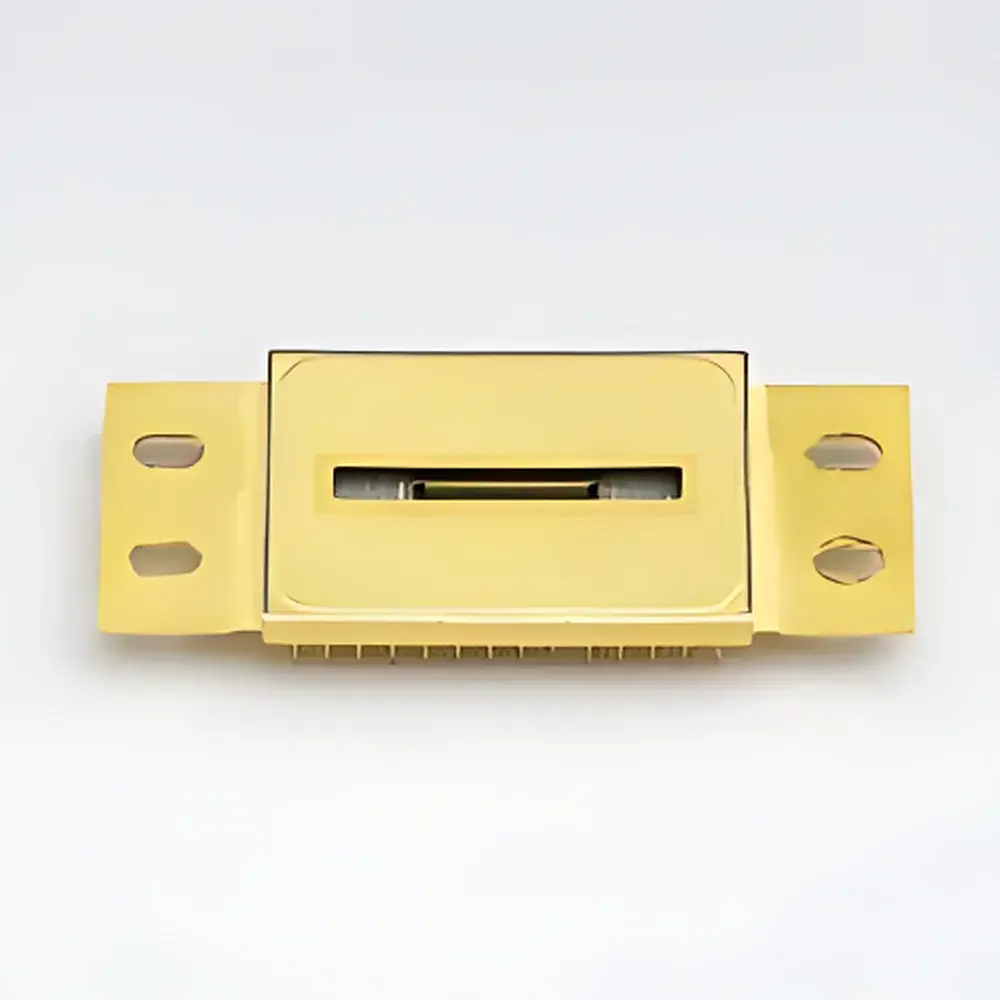
Hamamatsu G14237-512WA InGaAs Linear Image Sensor
| Brand | Hamamatsu |
|---|---|
| Origin | Japan |
| Manufacturer | Hamamatsu Photonics K.K. |
| Type | Imported |
| Model | G14237-512WA |
| Spectral Range | 850–1450 nm |
| Pixel Count | 512 |
| Pixel Pitch | 25 µm |
| Pixel Size | 25 × 250 µm |
| Active Area | 12.8 × 0.5 mm |
| Max Line Rate | 9150 lines/s |
| Cooling | Two-stage TE-cooled |
| Package | Hermetically sealed metal |
| On-chip CDS | Yes |
| On-chip saturation countermeasure circuit | Yes |
| Integrated thermistor | Yes |
| Built-in timing generator | Yes |
| Configurable charge conversion efficiency (CE) | 4 settings (e.g., 16 nV/e⁻, 32 nV/e⁻, etc.) |
| Dark Current | ≤1/10 of predecessor (G11508-512SA) at cutoff λ = 1.7 µm |
| Linearity (max) | >99.5% |
| Operating Temp. Range | –20 °C to +60 °C (case) |
Overview
The Hamamatsu G14237-512WA is a high-performance, two-stage thermoelectrically cooled InGaAs linear image sensor engineered specifically for demanding near-infrared (NIR) spectroscopic applications—particularly 1064 nm laser-excited Raman spectroscopy. Unlike broadband silicon-based detectors, this sensor leverages an optimized InGaAs photodiode array with a tailored spectral response spanning 850–1450 nm, enabling high quantum efficiency in the critical Raman Stokes shift region where conventional Si sensors exhibit negligible sensitivity. Its architecture integrates a monolithic CMOS readout IC—including correlated double sampling (CDS), offset compensation, charge amplification per pixel, and a programmable timing generator—onto a single substrate bonded to the InGaAs array. This co-integration minimizes parasitic capacitance and signal path length, resulting in superior signal-to-noise ratio (SNR), low temporal noise, and exceptional stability over extended integration periods. The hermetically sealed metal package ensures long-term reliability under laboratory and industrial environmental conditions, including humidity fluctuations and thermal cycling.
Key Features
- Ultra-low dark current: ≤10% of the prior-generation G11508-512SA (measured at equivalent cutoff wavelength of 1.7 µm), achieved via reduced cutoff wavelength (1.45 µm) and optimized epitaxial layer design
- Four selectable charge conversion efficiency (CE) modes: Configurable via external voltage bias, allowing dynamic optimization between sensitivity and full-well capacity for varying signal intensity and integration time requirements
- On-chip correlated double sampling (CDS): Reduces reset noise and fixed-pattern noise without requiring external timing synchronization
- Integrated saturation countermeasure circuit: Prevents blooming and charge spill-over during high-flux illumination, preserving spectral fidelity across adjacent pixels
- Embedded thermistor: Enables real-time temperature monitoring and closed-loop thermal stabilization—critical for maintaining dark current consistency and wavelength calibration stability
- Built-in timing generator: Eliminates need for external clock drivers; supports flexible line rate control up to 9150 lines/s with minimal system-level timing complexity
- High spatial resolution: 512-pixel array with 25 µm pitch yields 12.8 mm active length, compatible with standard f/4–f/6 spectrograph slit widths and optical magnification ratios
Sample Compatibility & Compliance
The G14237-512WA is designed for integration into OEM spectroscopic modules and benchtop Raman systems compliant with ISO/IEC 17025 calibration traceability frameworks. Its spectral response and linearity performance meet the functional requirements outlined in ASTM E1840 (Standard Practice for Raman Shift Standards) and IEC 61228 (Photodetectors for Optical Radiation Measurement). The two-stage TE cooler maintains detector junction temperature within ±0.1 °C under steady-state operation, satisfying GLP-aligned instrument qualification protocols for quantitative NIR analysis. No hazardous substances are used in packaging or die fabrication, conforming to RoHS Directive 2011/65/EU and REACH Regulation (EC) No. 1907/2006. Hamamatsu provides full traceable calibration reports upon request, including dark current vs. temperature curves, pixel-to-pixel responsivity maps, and linearity verification data per ISO 15739:2013.
Software & Data Management
The sensor interfaces via standard LVDS or CMOS parallel output (configurable), supporting direct integration with FPGA-based acquisition platforms or commercial DAQ systems (e.g., National Instruments PXIe-6368, Teledyne DALSA Spyder3). Hamamatsu supplies comprehensive SDKs for Windows and Linux—including C/C++, Python bindings, and LabVIEW VIs—that expose low-level register access for CE selection, timing parameter tuning, and thermistor ADC readout. All firmware and driver packages comply with FDA 21 CFR Part 11 requirements for electronic records and signatures when deployed in regulated QC/QA environments. Audit trails log all configuration changes, including CE mode switching, integration time updates, and temperature setpoint adjustments—ensuring full ALCOA+ (Attributable, Legible, Contemporaneous, Original, Accurate, Complete, Consistent, Enduring, Available) data integrity.
Applications
- 1064 nm laser Raman spectrometers for pharmaceutical polymorph identification and API crystallinity assessment
- NIR process analytical technology (PAT) systems for real-time monitoring of chemical reactions and blend uniformity in continuous manufacturing
- Portable and handheld Raman analyzers for field-deployable material identification (e.g., explosives, narcotics, counterfeit drugs)
- FT-NIR spectrometers requiring high dynamic range and low-noise detection in the first overtone region (1100–1450 nm)
- Custom hyperspectral imaging systems for agricultural quality sorting and food safety screening
- Research-grade spectrographs in academic and national laboratories conducting ultra-low-flux Raman studies on 2D materials and biological tissues
FAQ
What is the maximum recommended integration time for optimal SNR at room temperature?
At Ta = 25 °C and CE = 16 nV/e⁻, integration times up to 10 s are supported with <0.5% nonlinearity; longer exposures require active cooling below –10 °C to suppress thermal generation.
Is the sensor compatible with vacuum or inert-gas purged spectrograph enclosures?
Yes—the hermetic metal package is rated for operation under N₂ purge or vacuum down to 10⁻³ mbar without performance degradation.
Does Hamamatsu provide pixel-level gain and offset correction matrices?
Yes—factory-measured flat-field and dark-frame correction data are supplied with each unit, aligned to Hamamatsu’s proprietary pixel mapping convention.
Can the timing generator be bypassed for external clock synchronization?
Yes—pin-selectable mode allows disabling the internal generator and accepting external CLK, SH, and RS signals for precise multi-sensor synchronization.
What is the warranty and calibration validity period?
Standard warranty: 24 months from shipment date; factory calibration certificate remains valid for 12 months under documented storage and handling per Hamamatsu Technical Note TN-0017.






