
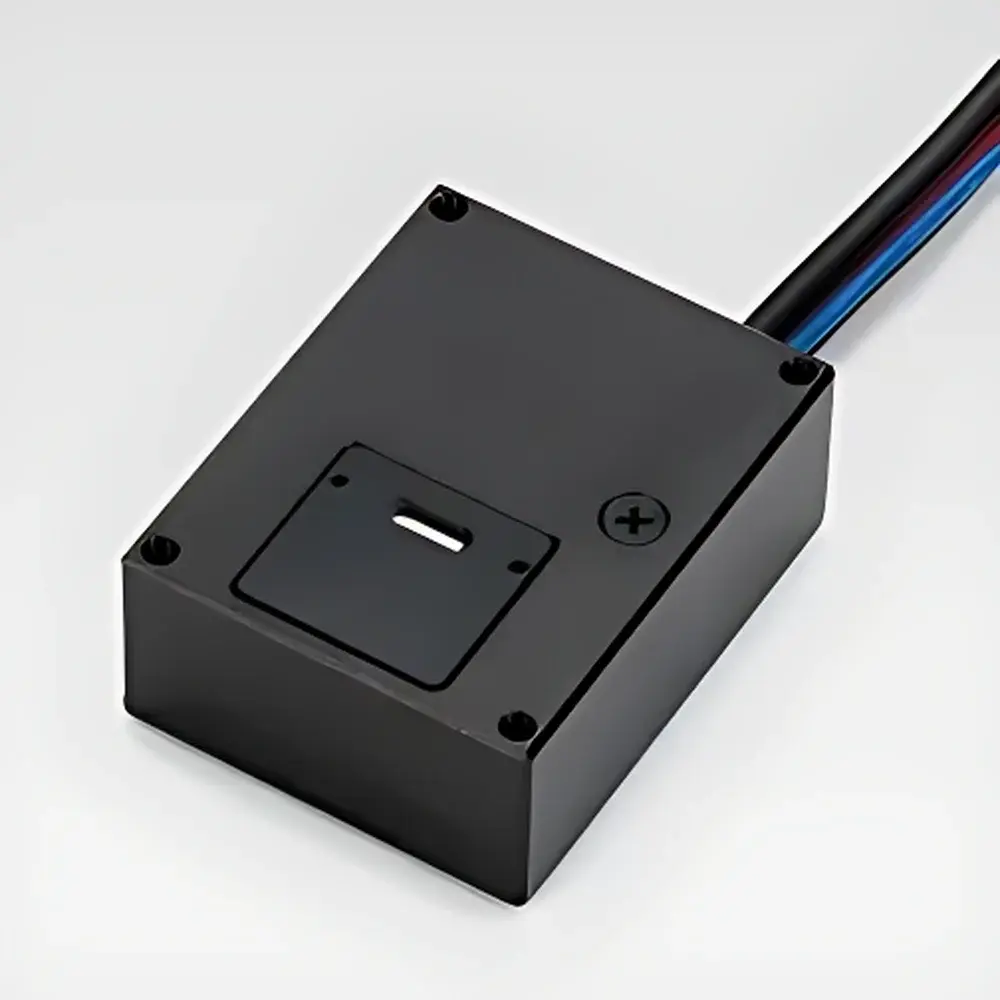
Hamamatsu H12406 Miniature Photomultiplier Tube Photon Counting Head
| Brand | Hamamatsu |
|---|---|
| Origin | Japan |
| Manufacturer Type | Original Equipment Manufacturer (OEM) |
| Product Category | Imported Optical Component |
| Model | H12406 |
| Component Type | Optical Detector Module |
| Operating Voltage | +5 V DC (single-supply) |
| Output Interface | TTL-compatible digital pulse output |
| Typical Dark Count Rate | <100 cps (at 20 °C) |
| Cathode Luminous Sensitivity | ~80 µA/lm (typ.) |
| Spectral Response Range | 300–650 nm |
| Rise Time | <2.5 ns |
| Pulse Width (FWHM) | ~10 ns |
| Active Area Diameter | 2 mm |
| Housing Material | Stainless steel with magnetic shielding |
| Dimensions (L × W × H) | 30 × 20 × 18 mm |
Overview
The Hamamatsu H12406 is a compact, integrated photon counting head engineered for high-sensitivity, low-light detection in demanding optical measurement applications. It combines a miniature side-on photomultiplier tube (PMT), a miniaturized high-voltage power supply circuit, and a fast, low-noise photon counting discriminator circuit into a single hermetically sealed module. Unlike conventional PMT assemblies requiring external HV supplies and pulse processing electronics, the H12406 operates from a single +5 V DC supply and delivers clean, standardized TTL-level digital pulses for each detected photon event—enabling direct interfacing with counter/timer modules, data acquisition systems, or microcontroller-based readout platforms. Its design adheres to fundamental principles of vacuum photodetection: incident photons strike a photocathode (bialkali type), generating photoelectrons via the external photoelectric effect; these electrons are accelerated and multiplied through a 10-stage linear-focused dynode chain, yielding gain on the order of 1 × 10⁶. The resulting anode pulses are shaped and discriminated in real time to suppress noise while preserving timing fidelity—critical for time-resolved measurements such as fluorescence lifetime spectroscopy (FLIM), time-correlated single-photon counting (TCSPC), and quantum optics experiments.
Key Features
- Monolithic integration of PMT, HV generator, and photon counting circuit in a 30 × 20 × 18 mm stainless-steel housing
- Single +5 V DC operation—eliminates need for external high-voltage supplies or bias networks
- Low dark count rate (<100 counts per second at 20 °C), optimized for ultra-low-light environments
- Fast temporal response: rise time <2.5 ns, full-width at half-maximum (FWHM) pulse width ~10 ns
- Bialkali photocathode with peak quantum efficiency >25% at 420 nm and spectral responsivity spanning 300–650 nm
- Magnetic shielding integrated into housing to minimize sensitivity to ambient magnetic fields
- TTL-compatible digital output ensures compatibility with standard counter/timer cards (e.g., National Instruments PCIe-6612) and FPGA-based timing systems
- Hermetic metal-ceramic construction ensures long-term stability and resistance to humidity-induced gain drift
Sample Compatibility & Compliance
The H12406 is designed for use with free-space optical paths or fiber-coupled configurations (with optional SMA-905 or FC/PC adapters). It accepts collimated or moderately focused beams incident on its 2 mm diameter active area. No sample preparation is required—its function is purely photonic detection, not spectroscopic analysis or imaging. As an OEM detector module, it complies with IEC 61000-6-3 (EMI emission limits) and IEC 61000-6-2 (immunity to electrostatic discharge and RF fields). While not certified as a medical device or industrial safety instrument, its performance characteristics align with requirements for research-grade instrumentation under ISO/IEC 17025-accredited laboratories when integrated into validated measurement systems. Traceable calibration reports (cathode luminous sensitivity, dark count rate, pulse amplitude distribution) are available upon request for GLP-compliant deployment.
Software & Data Management
The H12406 does not include embedded firmware or proprietary software—it functions as a “dumb” digital pulse source. Integration relies on host-side software tools capable of handling TTL pulse trains: LabVIEW (with DAQmx counter tasks), Python (via PyVISA or GPIO libraries with Raspberry Pi/Arduino), MATLAB (Data Acquisition Toolbox), or dedicated TCSPC platforms such as Becker & Hickl SPCM or PicoQuant HydraHarp. All supported drivers provide timestamped event lists with sub-nanosecond resolution when paired with appropriate time-to-digital converters (TDCs). Audit trails, data provenance, and electronic signatures are implemented at the system level—not within the probe itself—ensuring compliance with FDA 21 CFR Part 11 when deployed in regulated QC/QA workflows.
Applications
- Time-resolved fluorescence spectroscopy and lifetime mapping in biophysics and materials science
- Single-molecule detection and fluorescence correlation spectroscopy (FCS)
- Laser-induced breakdown spectroscopy (LIBS) signal gating and gated detection
- Quantum key distribution (QKD) receiver modules and entanglement verification setups
- Ultra-low-light radiometry and scintillation counting in nuclear physics experiments
- Confocal and multiphoton microscopy photon counting channels
- Calibration reference sources for photodetector linearity and dynamic range validation
FAQ
Can the H12406 be used with analog signal acquisition systems?
No—it outputs only digital TTL pulses and lacks analog current/voltage output. For analog readout, consider Hamamatsu’s H10721 series or discrete PMT bases with transimpedance amplifiers.
Is temperature stabilization required for stable photon counting?
While not mandatory, operating within 15–30 °C is recommended; dark count rate increases approximately 1.8× per 10 °C rise above 20 °C.
What is the maximum sustainable count rate?
The module supports sustained input rates up to ~5 × 10⁵ counts per second with <5% dead-time loss; higher rates require pulse pile-up correction algorithms.
Does it support coincidence timing between multiple units?
Yes—its <2.5 ns rise time and jitter <300 ps enable precise inter-unit synchronization when driven by a common clock and processed with multi-channel TDCs.
Are custom spectral response filters available?
Hamamatsu offers factory-installed interference filters (e.g., 488 ± 5 nm, 532 ± 3 nm) as optional accessories; contact OEM support for part-numbered variants.




