
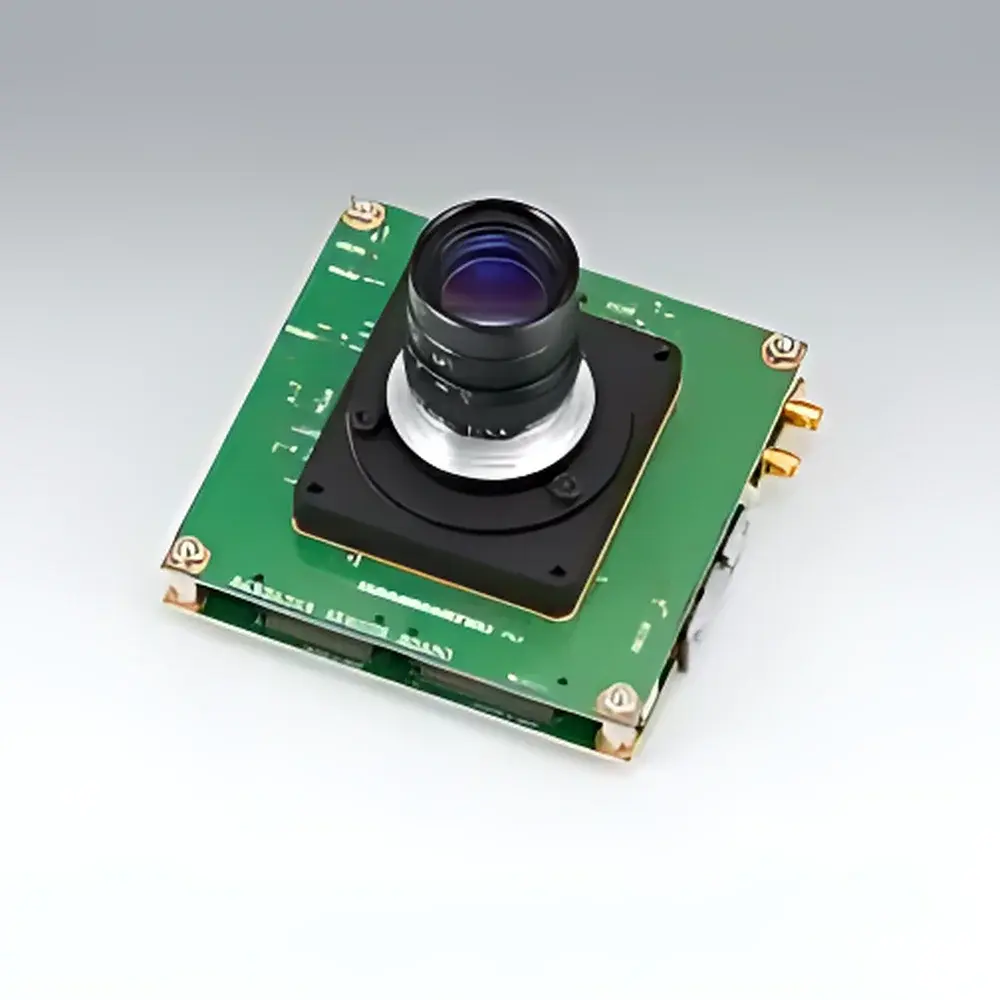
Hamamatsu C11440-52U Scientific-Grade Board-Level CMOS Camera
| Brand | Hamamatsu |
|---|---|
| Origin | Japan |
| Manufacturer | Hamamatsu Photonics K.K. |
| Type | Imported Board-Level Camera |
| Model | C11440-52U |
| Sensor | FL-400 Scientific CMOS |
| Resolution | 2048 × 2048 (4.0 MP) |
| Pixel Size | 6.5 µm × 6.5 µm |
| Effective Area | 13.312 mm × 13.312 mm |
| Full Well Capacity | 30,000 e⁻ (typ.) |
| Readout Speed | 30 fps (full frame) to 25,655 fps (512 × 8 ROI) |
| Read Noise | 2.3 e⁻ rms / 1.6 e⁻ median |
| Quantum Efficiency | >70% at 600 nm |
| Dynamic Range | 18,000:1 |
| Exposure Time | 1 ms – 30 s (recommended ≤100 ms) |
| Interface | USB 3.0 |
| Mount | C-mount |
| Power Supply | DC 12 V, 1 A |
| Operating Temperature | 0 °C to +40 °C (optimal ≤+35 °C) |
| Storage Temperature | −10 °C to +50 °C |
| Humidity | ≤70% RH (operating), ≤90% RH (storage), non-condensing |
| Trigger Modes | Edge, Level, Sync-Readout, Start |
| Programmable Outputs | 3 timing outputs + exposure sync + trigger-ready + fixed-level output |
| Onboard Binning | 2×2, 4×4 |
| Subarray Readout | Centered ROI support |
| A/D Conversion | 16-bit |
Overview
The Hamamatsu C11440-52U is a high-performance, board-level scientific CMOS camera engineered for demanding optical imaging applications requiring high quantum efficiency, low noise, and flexible temporal resolution. Built around the FL-400 second-generation scientific CMOS sensor, it delivers photon detection sensitivity optimized for visible-to-near-UV wavelengths—achieving >70% quantum efficiency at 600 nm. Its 2048 × 2048 pixel array features uniform 6.5 µm pixels, yielding a 13.3 mm × 13.3 mm active area ideal for integration into compact optical systems such as microscopes, spectrographs, and automated inspection platforms. Unlike consumer-grade sensors, the FL-400 architecture incorporates correlated double sampling (CDS), on-chip analog-to-digital conversion, and advanced pixel design to minimize fixed-pattern noise and dark current—enabling quantitative intensity measurements with high reproducibility across extended acquisition sequences.
Key Features
- Scientific CMOS sensor (FL-400) with peak QE >70% at 600 nm and broad spectral response from 200 nm to 1100 nm
- Low-noise readout: 2.3 e⁻ rms (33 ms exposure, typical), 1.6 e⁻ median—critical for low-light quantification in fluorescence and bioluminescence
- Flexible frame rate range: 30 fps at full resolution (2048 × 2048) up to 25,655 fps in region-of-interest (ROI) mode (512 × 8), supporting both static imaging and ultrafast dynamic capture
- 16-bit A/D conversion with 18,000:1 dynamic range (calculated from full-well capacity of 30,000 e⁻ and mean read noise)
- Compact mechanical footprint (90 mm × 90 mm × 25 mm) and lightweight design facilitate OEM integration into space-constrained instruments
- USB 3.0 interface ensures high-bandwidth data transfer (>350 MB/s sustained) with deterministic latency and plug-and-play compatibility under Windows and Linux environments
- Programmable triggering and synchronization: four external trigger modes (edge, level, sync-readout, start) plus three user-configurable timing outputs for precise coordination with lasers, shutters, or motion stages
- Onboard image processing including 2×2 and 4×4 binning, centered subarray readout, and exposure-controlled blanking to suppress artifacts during long integrations
Sample Compatibility & Compliance
The C11440-52U is designed for use with standard C-mount optics and supports a wide range of sample illumination modalities—including transmitted light, epi-fluorescence, structured illumination, and X-ray scintillator coupling (e.g., CsI:Tl or Gd₂O₂S). Its thermal management architecture maintains stable dark current below 0.01 e⁻/pixel/s at ≤+35 °C ambient, ensuring consistent performance during multi-hour acquisitions required in genomics or cell biology workflows. The camera complies with IEC 61000-6-2 (immunity) and IEC 61000-6-4 (emission) standards for industrial environments. While not certified for medical device use, its deterministic firmware behavior, repeatable gain/offset calibration, and traceable exposure control support GLP-aligned documentation practices. Data integrity is preserved through lossless USB packet transmission and optional metadata embedding (exposure time, temperature, ROI coordinates) in each frame header.
Software & Data Management
Hamamatsu provides the HCImage Live software suite (Windows) and SDKs for C/C++, Python, MATLAB, and LabVIEW—enabling full control over acquisition parameters, ROI definition, trigger sequencing, and real-time histogram analysis. The SDK supports memory-mapped frame buffers and zero-copy DMA transfers to minimize CPU overhead during high-throughput streaming. All acquired images are saved in TIFF or HDF5 format with embedded EXIF-like metadata, facilitating interoperability with ImageJ/Fiji, CellProfiler, and commercial analysis packages. For regulated environments, optional audit-trail logging (user actions, parameter changes, timestamps) can be enabled to align with FDA 21 CFR Part 11 requirements when deployed within validated laboratory information management systems (LIMS).
Applications
- DNA electrophoresis and blot imaging—leveraging high QE and low noise for sensitive ethidium bromide or SYBR Safe detection
- High-content screening (HCS) in drug discovery—supporting multi-well plate imaging with automated focus and exposure optimization
- Live-cell time-lapse microscopy—enabled by fast ROI readout and minimal phototoxicity due to high sensitivity
- Automated wafer inspection—utilizing sub-pixel registration accuracy and distortion-corrected flat-field calibration
- X-ray imaging via scintillator coupling—where high dynamic range and radiation-hardened sensor architecture ensure stable response under pulsed X-ray sources
- Single-molecule localization microscopy (SMLM)—benefiting from precise electron-counting capability and low background variance
FAQ
What is the recommended maximum exposure time for optimal image quality?
For best signal fidelity and minimal fixed-pattern artifact formation, Hamamatsu recommends limiting exposure to ≤100 ms. Longer exposures (up to 30 s) are supported but may introduce white-spot defects due to thermal charge accumulation.
Does the camera support hardware synchronization with external devices?
Yes—the C11440-52U offers four programmable trigger input modes and three independent TTL-compatible output signals, enabling tight synchronization with lasers, shutters, or translation stages.
Is cooling available for extended dark-current suppression?
No—this is an uncooled board-level camera. Stable operation is maintained within 0–40 °C ambient; for sub-0.005 e⁻/pixel/s dark current, active thermoelectric cooling must be implemented externally.
Can the camera be used with third-party microscope software?
Yes—via Hamamatsu’s TWAIN and GenICam-compliant drivers, the C11440-52U integrates seamlessly with Micro-Manager, NIS-Elements, and ZEN Blue.
What lens mount does the camera use?
It features a standard C-mount interface with 17.526 mm flange focal distance, compatible with industry-standard achromatic and apochromatic objectives.




