
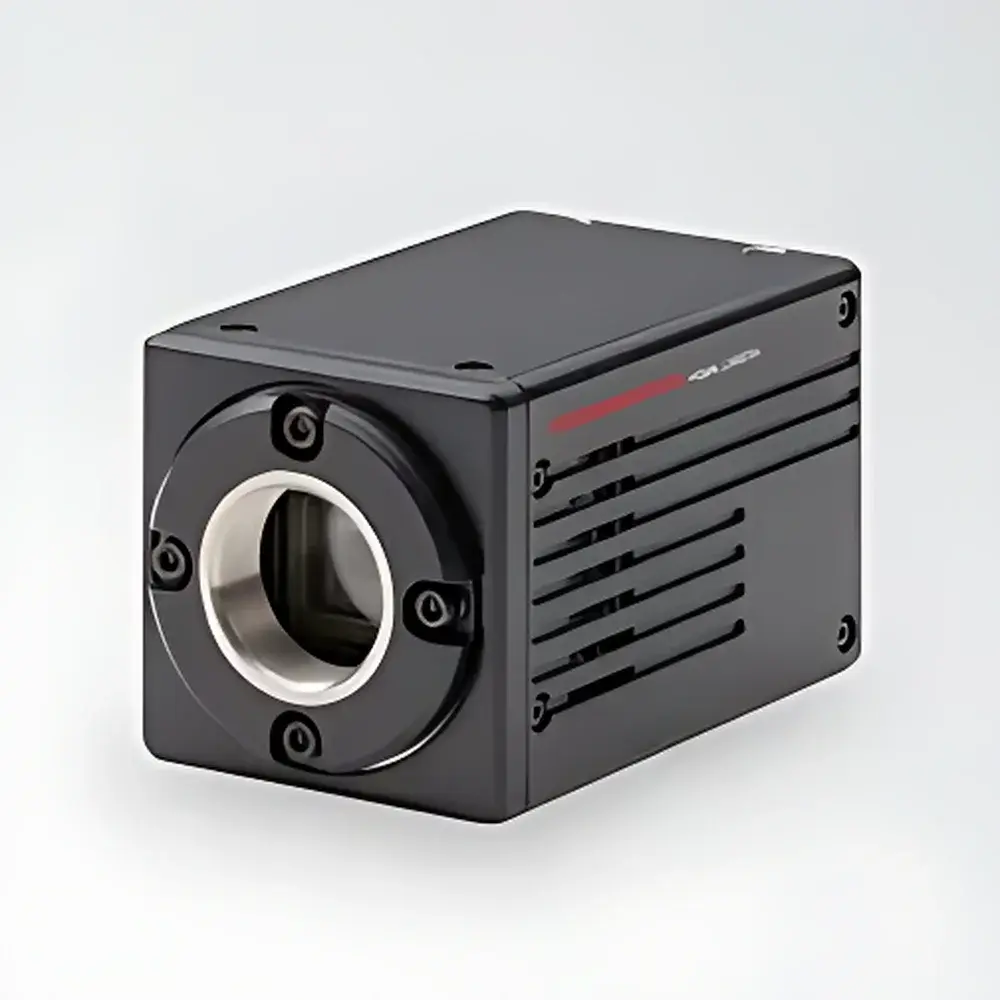
Hamamatsu C16741-40U InGaAs SWIR Camera
| Brand | Hamamatsu |
|---|---|
| Origin | Japan |
| Manufacturer Type | Original Equipment Manufacturer (OEM) |
| Import Category | Imported |
| Model | C16741-40U |
| Price | Upon Request |
| Effective Pixels | 1280 (H) × 1024 (V) |
| Pixel Size | 5 µm (H) × 5 µm (V) |
| Effective Area | 6.40 mm (H) × 5.12 mm (V) |
| Readout Speed | 71.53 fps |
| Exposure Time | 20.46 µs to 1 s (step size: 13.09 µs) |
| Cooling Method | Forced-air / natural convection with Peltier thermoelectric cooler |
| Sensor Operating Temperature | +15 °C ±0.5 °C (forced-air mode, ambient +25 °C ±3 °C) or +20 °C ±0.5 °C (natural convection mode, ambient +25 °C ±3 °C) |
| External Trigger Modes | Edge-trigger, level-trigger, start-trigger |
| Trigger Input Connector | SMA |
| Trigger Delay Range | 0 µs to 10 s (1 µs step) |
| Image Processing Functions | Background subtraction, shading correction |
| Interface | USB 3.1 Gen 1 (USB Type-C connector) |
| ADC Resolution | 12-bit / 8-bit selectable |
| Lens Mount | C-mount |
| Power Supply | DC +12 V |
| Power Consumption | ~15 W |
| Operating Temperature | 0 °C to +35 °C |
| Storage Temperature | −10 °C to +50 °C |
| Operating Humidity | 30% to 80% RH (non-condensing) |
| Storage Humidity | ≤90% RH (non-condensing) |
| Spectral Response Range | 400 nm to 1700 nm |
Overview
The Hamamatsu C16741-40U is a high-performance short-wave infrared (SWIR) imaging camera based on an indium gallium arsenide (InGaAs) focal plane array (FPA) sensor. Engineered for precision scientific and industrial applications, it delivers broadband spectral sensitivity from 400 nm (visible) through the near-infrared (NIR) into the SWIR region up to 1700 nm—enabling non-destructive inspection of materials opaque to visible light. Unlike silicon-based CCD or CMOS sensors, the InGaAs detector provides intrinsic quantum efficiency above 1000 nm, making the C16741-40U particularly suitable for applications requiring photon detection in spectral bands where silicon response drops below 1%. Its monolithic sensor architecture, combined with integrated thermoelectric (Peltier) cooling, ensures low dark current and high signal-to-noise ratio (SNR), critical for quantitative intensity analysis and long-exposure imaging.
Key Features
- 1280 × 1024 pixel InGaAs sensor with uniform 5 µm × 5 µm pixel pitch and 6.4 mm × 5.12 mm active area
- Programmable exposure control from 20.46 µs to 1 s in fine 13.09 µs increments, supporting both pulsed and continuous illumination regimes
- Stabilized sensor temperature at +15 °C ±0.5 °C (forced-air mode) or +20 °C ±0.5 °C (natural convection), minimizing thermal drift during extended acquisition sequences
- USB 3.1 Gen 1 interface (USB Type-C) enabling sustained 71.53 fps full-frame readout without data loss or frame buffering artifacts
- Onboard image processing including real-time background subtraction and pixel-wise shading correction—essential for radiometric consistency across heterogeneous illumination fields
- C-mount lens interface compatible with industry-standard SWIR optics, facilitating integration into custom optical benches or OEM systems
- Hardware-level external triggering via SMA connector with configurable edge/level/start modes and programmable delay (0–10 s, 1 µs resolution)
Sample Compatibility & Compliance
The C16741-40U supports non-contact, label-free characterization of optically semi-transparent and scattering media. It is routinely deployed in semiconductor metrology workflows compliant with SEMI standards for wafer inspection, and its spectral range aligns with key ISO/IEC 17025-accredited test methods for photovoltaic module evaluation (e.g., IEC 62788-7-2 for IR imaging of solar cell defects). The camera’s stable thermal management and calibrated linearity support GLP-compliant documentation when integrated with traceable NIST-traceable reference sources. While not FDA-cleared as a medical device, its performance parameters meet technical prerequisites for use in research-grade food moisture mapping (per AOAC 992.15 methodology) and cultural heritage documentation under controlled museum-grade environmental protocols (ISO 11799).
Software & Data Management
Hamamatsu provides the HCImage Live software suite, offering SDK support for C/C++, Python (via PyHamamatsu), and MATLAB for custom algorithm development. All acquired frames are timestamped with microsecond precision and stored in standard TIFF or HDF5 formats—ensuring compatibility with third-party analysis platforms such as MATLAB Image Processing Toolbox, Python OpenCV, or commercial machine vision libraries. The SDK implements audit-trail logging for parameter changes and trigger events, satisfying basic requirements for 21 CFR Part 11–aligned environments when deployed with validated configuration management practices. Raw 12-bit data can be exported without compression or gamma correction, preserving dynamic range for post-acquisition calibration against reference reflectance targets.
Applications
- Semiconductor process control: Internal defect detection in silicon wafers, bond wire inspection, MEMS cavity visualization, and flip-chip underfill void analysis
- Laser beam profiling: M² measurement, spatial mode analysis, and alignment verification for fiber-coupled 1064 nm, 1310 nm, and 1550 nm laser sources
- Photovoltaic R&D: Electroluminescence (EL) and photoluminescence (PL) imaging of crystalline Si, perovskite, and tandem solar cells
- Industrial sorting and quality assurance: Moisture content mapping in agricultural grains, pharmaceutical tablet coating uniformity assessment, and polymer layer thickness estimation
- Cultural heritage science: Subsurface pigment layer visualization in oil paintings, parchment degradation analysis, and ink differentiation in historical manuscripts
FAQ
What spectral range does the C16741-40U cover, and is it sensitive below 900 nm?
The sensor exhibits measurable quantum efficiency from 400 nm to 1700 nm, with peak responsivity between 900 nm and 1600 nm. Sensitivity below 900 nm is confirmed but attenuated relative to dedicated visible-range cameras; users should validate SNR for specific visible-band applications using calibrated light sources.
Can this camera operate in vacuum or high-humidity environments?
No. The unit is rated for operation at 30–80% RH (non-condensing) and ambient pressure only. Extended exposure to humidity >80% RH or vacuum conditions may compromise the integrity of the Peltier cooler and internal optical coatings.
Is the USB interface compatible with Linux or ARM-based embedded systems?
Yes—Hamamatsu provides Linux kernel drivers and user-space APIs for x86_64 and ARM64 architectures. Integration with Jetson Orin or Raspberry Pi Compute Module 4 requires verified power delivery (>12 V @ 2 A) and USB 3.1 Gen 1 signal integrity validation.
Does the camera support synchronized multi-camera acquisition?
Yes, via hardware trigger distribution using the SMA input. Synchronization jitter is <1 µs between units when driven by a common TTL-compatible master clock source.
How is calibration performed for quantitative radiometry?
Hamamatsu offers optional NIST-traceable responsivity calibration reports (model-specific). Users must perform system-level calibration—including lens transmission, illumination uniformity, and ambient thermal offset—using certified reference targets (e.g., Labsphere Spectralon panels) for absolute irradiance measurements.





