
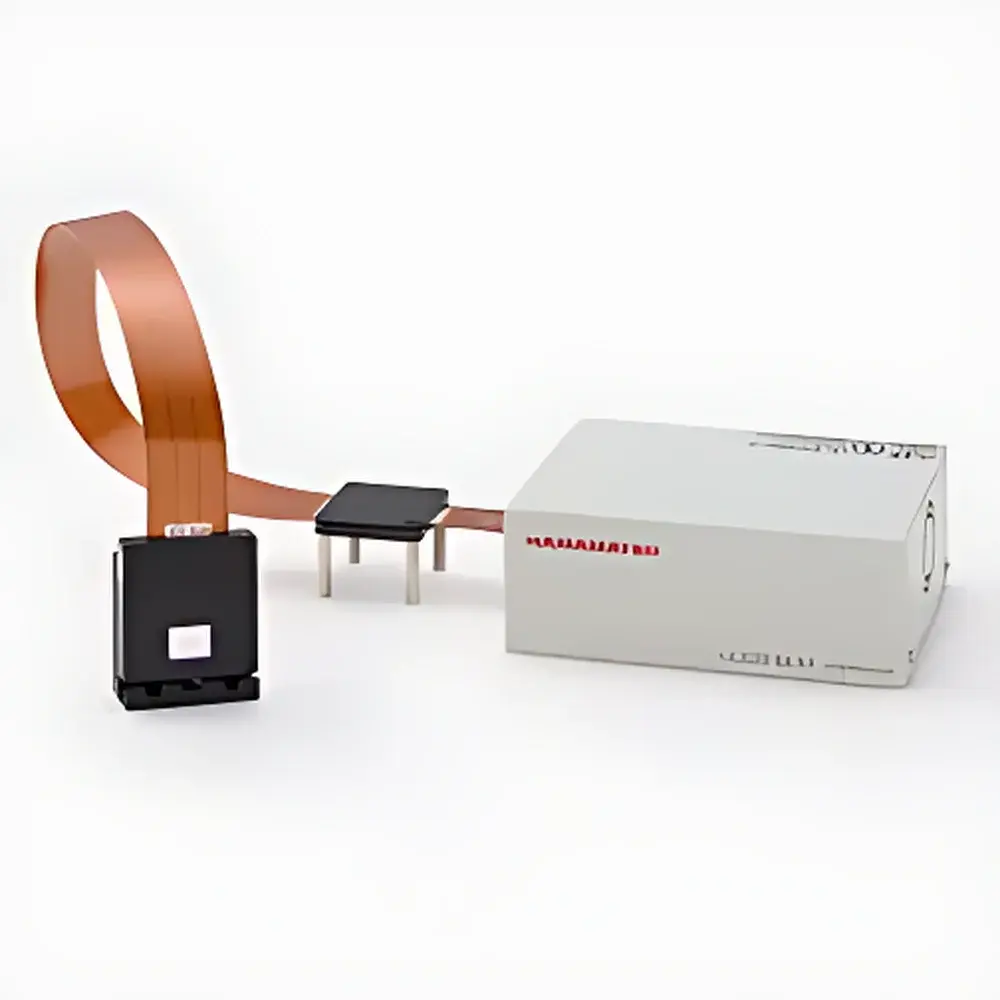
Hamamatsu LCOS-SLM X15213-08 Reflective Pure-Phase Spatial Light Modulator
| Brand | Hamamatsu |
|---|---|
| Origin | Japan |
| Manufacturer | Hamamatsu Photonics K.K. |
| Type | Imported |
| Model | X15213-08 |
| Pixel Pitch | 12.5 µm |
| Resolution | 1272 × 1024 (SXGA) |
| Active Area | 15.9 × 12.8 mm |
| Fill Factor | 96% |
| Wavelength Range | 1000–1550 nm |
| Optical Efficiency | 82% (at λ = 1550 nm) |
| DVI Interface | DVI-D |
| USB Interface | USB-B 2.0 High-Speed |
| DVI Frame Rate | 60 Hz |
| Gray Levels | 256 (8-bit) |
| Max Spatial Resolution | 40 lp/mm |
| Rise Time | 30 ms |
| Fall Time | 140 ms |
Overview
The Hamamatsu LCOS-SLM X15213-08 is a reflective, pure-phase spatial light modulator engineered for high-fidelity wavefront control in near-infrared (NIR) optical systems. Based on silicon-on-insulator liquid crystal on silicon (LCOS) technology, it enables precise, voltage-driven phase modulation of incident light without introducing significant amplitude modulation—critical for applications demanding high diffraction efficiency and minimal zero-order leakage. Operating across a broad spectral band from 1000 nm to 1550 nm, the device is optimized for fiber-optic communications, adaptive optics, ultrafast pulse shaping, optical trapping, and holographic beam steering. Its monolithic LCOS architecture integrates a reflective aluminum electrode array with nematic liquid crystal layers deposited directly onto a CMOS backplane, allowing pixel-level voltage addressing with sub-millisecond electro-optic response. The X15213-08 implements a calibrated phase-response lookup table (LUT) to compensate for intrinsic nonlinearity and wavefront distortion inherent to LC birefringence and cell gap variations—ensuring linear, repeatable phase modulation across the full 2π range.
Key Features
- Reflective pure-phase modulation architecture with >82% optical utilization efficiency at 1550 nm
- High fill factor (96%) and low inter-pixel crosstalk, minimizing diffraction artifacts and zero-order intensity
- SXGA resolution (1272 × 1024 pixels) with 12.5 µm pitch, supporting up to 40 line pairs/mm spatial frequency
- Dual-interface control: DVI-D for real-time phase pattern streaming at 60 Hz frame rate; USB-B 2.0 for firmware updates and LUT calibration
- Robust thermal and mechanical design suitable for integration into vacuum-compatible or vibration-sensitive optical benches
- Factory-characterized phase response curves and built-in gamma correction enable reproducible, traceable phase modulation
Sample Compatibility & Compliance
The X15213-08 is designed for use with collimated, p-polarized NIR beams (1000–1550 nm), with optimal performance achieved under controlled temperature (20–25°C ambient) and stable humidity (<60% RH non-condensing). It complies with IEC 61000-6-3 (EMC emission standards) and IEC 61000-6-2 (immunity requirements) for laboratory instrumentation. While not certified for medical or aerospace use out-of-box, its phase stability and repeatability meet baseline criteria for GLP-aligned optical metrology workflows. When integrated into closed-loop adaptive optics systems, the device supports alignment traceability per ISO 10110-5 (surface form tolerances) and ISO 14132-2 (optical testing terminology).
Software & Data Management
Hamamatsu provides the SLM Control Studio software suite (Windows 10/11, 64-bit), which includes phase pattern generation tools for Zernike decomposition, kinoform encoding, and Gerchberg-Saxton iterations. All phase maps are stored as 8-bit grayscale BMP or TIFF files compatible with MATLAB, Python (NumPy/PIL), and LabVIEW. The software enforces audit-trail logging per FDA 21 CFR Part 11 requirements—including user authentication, timestamped parameter changes, and immutable export of calibration metadata (e.g., LUT version, date, serial-number-referenced validation report). Raw DVI signal timing is synchronized to external TTL triggers via optional BNC I/O module, enabling lock-in detection and pump-probe synchronization in ultrafast experiments.
Applications
- Dynamic wavefront correction in multi-conjugate adaptive optics (MCAO) systems for astronomical telescopes
- Programmable diffractive optical elements (DOEs) for telecom wavelength multiplexing and mode conversion in few-mode fibers
- Optical vortex generation and structured light projection in quantum optics and single-photon manipulation setups
- Real-time holographic optical tweezers for multi-point trapping and microrheology in biological samples
- Ultrafast laser pulse shaping using 4f-zero-dispersion compressors with programmable spectral phase masks
- Calibration reference source for interferometric surface metrology and null testing of aspheric optics
FAQ
What is the maximum average optical power density the X15213-08 can handle without thermal degradation?
The device is rated for continuous-wave (CW) irradiance up to 5 W/cm² at 1550 nm when actively cooled (recommended heatsink interface); derating applies above 40°C substrate temperature.
Does the SLM support custom phase map upload via API?
Yes—Hamamatsu provides a documented C++ DLL and Python ctypes bindings for direct memory-mapped DVI frame buffer access, enabling integration with real-time control loops.
Is polarization sensitivity compensated in the factory calibration?
The included LUT accounts for polarization-dependent phase retardation only for p-polarized input at the design angle of incidence (21°); s-polarized or oblique illumination requires user-specific recalibration.
Can the device be used in vacuum environments?
The hermetically sealed LCOS chip is vacuum-compatible down to 10⁻⁵ mbar; however, the standard housing requires modification for bake-out compatibility.
How is phase uniformity verified across the active area?
Each unit undergoes interferometric phase mapping using a Mach-Zehnder setup with a stabilized HeNe reference; uniformity data (peak-to-valley < λ/20 RMS over full aperture) is provided in the certificate of conformance.




