
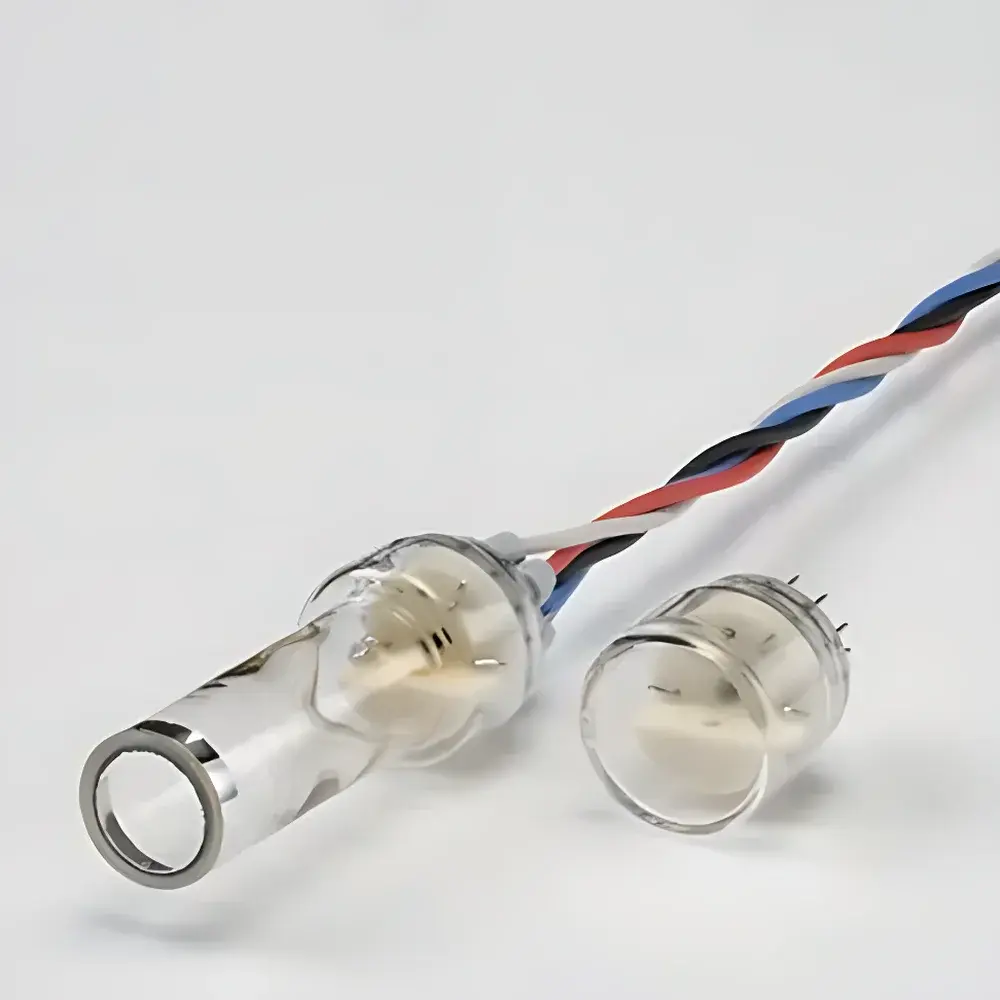
Hamamatsu S2D2 Deuterium Lamp
| Brand | Hamamatsu |
|---|---|
| Origin | Japan |
| Manufacturer Type | Original Equipment Manufacturer (OEM) |
| Product Origin | Imported |
| Model | S2D2 |
| Light Source Type | Continuous-wave Deuterium Arc Lamp |
| Illumination Mode | External (Side-Illuminating) Configuration |
| Physical Form Factor | Compact Benchtop Module |
Overview
The Hamamatsu S2D2 deuterium lamp is a high-performance, compact continuous-wave ultraviolet (UV) light source engineered for precision optical instrumentation requiring stable, broadband UV emission from 190 nm to 400 nm. Unlike pulsed or LED-based alternatives, the S2D2 operates on the principle of deuterium gas discharge under low-pressure conditions, generating intense molecular continuum radiation through electron-impact excitation and subsequent radiative decay. Its design prioritizes spectral stability, long-term output reproducibility, and mechanical robustness—critical attributes for applications in UV-Vis spectrophotometry, HPLC-UV detection, spectroscopic calibration, and optical system alignment. The lamp integrates a sealed quartz envelope with optimized cathode-anode geometry to minimize arc wander and thermal drift, ensuring consistent centroid wavelength positioning and intensity stability (< ±0.5% RMS over 8 hours at constant current).
Key Features
- Compact Form Factor: Engineered with a reduced footprint—approximately 40% smaller than standard deuterium lamps—enabling integration into space-constrained optical benches, portable analyzers, and OEM spectrometer modules without compromising optical throughput.
- High Radiance & Spectral Stability: Delivers >1.2 mW/nm radiant flux at 220 nm (measured at 1 m distance, 1 nm bandwidth), with < ±0.3% short-term intensity fluctuation (100 ms sampling) and < ±0.7% drift over 12-hour continuous operation under regulated current drive.
- Dedicated Electrode Architecture: Features a proprietary dual-cathode configuration with tungsten-rhenium alloy filaments and nickel-coated anode surfaces, extending operational lifetime beyond 2,000 hours while maintaining spectral profile integrity across aging cycles.
- Thermal Management Integration: Incorporates passive heat-sinking geometry and low-thermal-resistance mounting interfaces compatible with standard TO-8 or custom flange configurations, minimizing thermal lensing effects in collimated beam paths.
- Electrical Interface Standardization: Supports industry-standard DC current regulation (150–300 mA nominal, 10 V max forward voltage) with built-in ignition assist circuitry; compatible with Hamamatsu C12131-series and third-party lamp drivers meeting IEC 61000-6-3 EMC requirements.
Sample Compatibility & Compliance
The S2D2 is designed for use with fused silica optical components, UV-grade lenses, and reflective optics rated for 190–400 nm transmission. It complies with RoHS Directive 2011/65/EU and meets IEC 62471 Photobiological Safety Classification for Risk Group 2 (RG2) UV sources. While not classified as a medical device, its output characteristics align with ASTM E275–22 (Standard Practice for Describing and Measuring Performance of UV–Vis Detectors) and supports traceable calibration workflows compliant with ISO/IEC 17025:2017 for testing laboratories. No special sample preparation is required; the lamp functions as a primary irradiance reference when paired with NIST-traceable radiometric detectors.
Software & Data Management
As a hardware-level light source, the S2D2 does not incorporate embedded firmware or digital control interfaces. However, it is fully interoperable with host instrument software platforms that manage lamp power sequencing, warm-up timing, and duty-cycle logging—including Thermo Fisher OMNIC, Agilent OpenLab CDS, and LabVIEW-based custom DAQ systems. When integrated into GLP/GMP-regulated environments, lamp operating hours, ignition count, and current/voltage telemetry can be recorded via external data acquisition units supporting FDA 21 CFR Part 11 audit trail functionality. Hamamatsu provides detailed lamp aging curves and spectral degradation profiles in its technical documentation suite (Document No. TPS-S2D2-EN Rev. 3.1) for predictive maintenance scheduling.
Applications
- UV-Vis spectrophotometers requiring high signal-to-noise ratio below 240 nm
- Chromatographic UV detectors (e.g., HPLC, UHPLC) demanding baseline stability for trace-level quantification
- Calibration standards for UV radiometers, monochromators, and array detectors
- Photochemical reactor illumination where narrow-band UV excitation is unnecessary but broad continuum coverage is essential
- OEM integration into environmental monitoring sensors (e.g., NOx, SO2 absorption analyzers) and semiconductor wafer inspection tools
FAQ
What is the typical warm-up time to achieve spectral stability?
The S2D2 reaches 95% spectral output stability within 15 minutes of ignition under constant-current operation at 250 mA.
Can the S2D2 be operated in pulsed mode?
No—it is designed exclusively for continuous-wave operation; pulsing may induce electrode sputtering and accelerate envelope darkening.
Is ozone generation a concern during operation?
Minimal ozone is produced under normal ambient conditions; however, operation below 200 nm in enclosed spaces requires active ventilation per OSHA 29 CFR 1910.1200 guidelines.
Does Hamamatsu offer spectral irradiance calibration certificates?
Yes—NIST-traceable spectral irradiance calibration (200–400 nm, ±1.5% uncertainty) is available as an optional service (Order Code: CAL-S2D2-IRAD).
What is the recommended current setting for optimal lifetime versus output trade-off?
For maximum longevity (>2,500 h), operate at ≤220 mA; for highest UV radiance at 220 nm, 280 mA is nominal, with corresponding lifetime reduction to ~1,600 h.




