
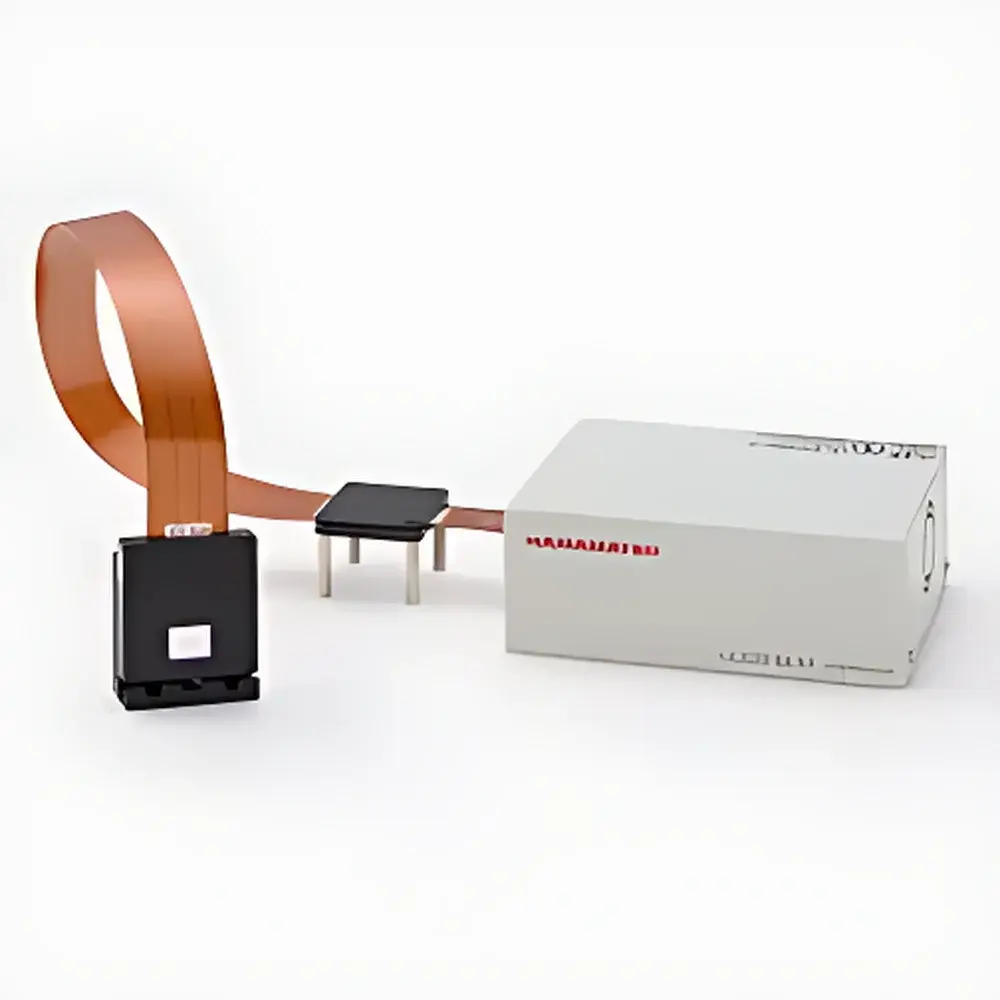
Hamamatsu LCOS-SLM X15213-15L
| Brand | Hamamatsu |
|---|---|
| Origin | Japan |
| Manufacturer Type | Original Equipment Manufacturer (OEM) |
| Import Status | Imported |
| Model | X15213-15L |
| Pricing | Available upon Request |
| Pixel Pitch | 12.5 µm |
| Active Area | 15.9 × 12.8 mm |
| Resolution | 1272 × 1024 pixels (SXGA) |
| Fill Factor | 96% |
| Input Interface | DVI-D + USB-B (USB 2.0 High-Speed) |
| DVI Frame Rate | 60 Hz |
| Gray Levels | 256 (8-bit) |
| Maximum Spatial Resolution | 40 lp/mm |
| Rise Time | 26 ms |
| Fall Time | 135 ms |
| Operating Wavelength | 1550 ± 50 nm |
| Optical Efficiency | 97% (measured at λ = 1550 nm) |
| Modulation Type | Reflective Pure-Phase |
Overview
The Hamamatsu LCOS-SLM X15213-15L is a high-performance reflective liquid crystal on silicon (LCoS) spatial light modulator engineered for precision wavefront control in demanding optical systems operating at the 1550 nm telecom band. Unlike transmissive SLMs, this device leverages a reflective architecture where incident light is phase-modulated by voltage-controlled nematic liquid crystal layers deposited directly onto a silicon backplane with integrated CMOS addressing circuitry. The X15213-15L implements pure-phase modulation—minimizing amplitude coupling—enabling high-fidelity beam shaping, holographic projection, adaptive optics correction, and coherent control applications. Its design prioritizes optical throughput and fidelity: with a 96% fill factor, sub-13 µm effective pixel pitch, and >97% optical utilization efficiency at 1550 nm, it delivers exceptional light conservation critical for low-noise interferometry, quantum optics experiments, and high-power laser beam manipulation.
Key Features
- Reflective pure-phase LCoS architecture optimized for 1550 ± 50 nm operation—ideal for fiber-optic communications, mid-IR pumping, and ultrafast pulse shaping
- High-resolution active array of 1272 × 1024 pixels (SXGA format) with 12.5 µm pixel pitch and 15.9 × 12.8 mm clear aperture
- 97% optical efficiency measured at λ = 1550 nm, achieved through anti-reflection coatings, minimized inter-pixel gaps, and low-loss dielectric mirror stack
- DVI-D video interface compatibility enables plug-and-play integration with standard industrial PCs—no proprietary frame grabbers or drivers required
- Integrated USB-B (USB 2.0 High-Speed) port supports real-time firmware updates, calibration data loading, and bidirectional status monitoring
- On-board correction algorithms compensate for inherent LC nonlinearity, pixel crosstalk, and static wavefront aberrations—ensuring linearized phase response across full 2π range
- Robust thermal management and hermetic packaging support continuous-wave (CW) and pulsed laser operation up to multi-watt average power levels
Sample Compatibility & Compliance
The X15213-15L is compatible with collimated, quasi-monochromatic beams within its specified wavelength band (1550 ± 50 nm), including output from erbium-doped fiber amplifiers (EDFAs), distributed feedback (DFB) lasers, and optical parametric oscillators (OPOs). Its reflective configuration eliminates substrate birefringence concerns common in transmissive devices and permits use with high-numerical-aperture (NA ≤ 0.3) illumination geometries. The device conforms to IEC 61000-6-2 (immunity) and IEC 61000-6-4 (emissions) standards for laboratory instrumentation. While not certified for medical or aerospace deployment, its design adheres to ISO 9001-compliant manufacturing practices and supports traceable calibration protocols aligned with NIST-traceable interferometric verification methods. All firmware and control logic are designed to operate within GLP-compliant environments when paired with validated host software.
Software & Data Management
Hamamatsu provides the proprietary SLM Control Studio suite (Windows 10/11, 64-bit), which supports real-time phase pattern generation—including Zernike polynomials, kinoforms, and Gerchberg-Saxton iterations—with sub-frame latency optimization. The software includes built-in tools for gamma calibration, flat-field correction, and temporal response profiling using synchronized photodiode feedback. Export formats include BMP, TIFF, and binary raw arrays for integration with MATLAB, Python (via PyHamamatsu SDK), and LabVIEW environments. Audit trails, user access logs, and parameter versioning comply with FDA 21 CFR Part 11 requirements when deployed with electronic signature modules and networked authentication servers. All phase maps are stored with embedded metadata (wavelength, exposure time, calibration timestamp) to ensure experimental reproducibility.
Applications
- Adaptive optics systems for atmospheric turbulence compensation in free-space optical communication terminals
- Holographic optical trapping and dynamic micromanipulation of dielectric particles in near-infrared biophotonics
- Programmable diffractive optical elements (DOEs) for spectral beam combining and multi-channel laser processing
- Wavefront sensing via computational shearing interferometry and Shack–Hartmann reconstruction
- Quantum state engineering—e.g., orbital angular momentum (OAM) mode sorting and entanglement distribution in fiber networks
- Real-time optical encryption using dynamic phase-only masks in physical-layer security architectures
FAQ
What is the maximum average optical power the X15213-15L can handle without thermal distortion?
The device is rated for continuous-wave operation up to 5 W/cm² at 1550 nm under collimated illumination with proper heat sinking; derating is recommended above 2 W/cm² without active cooling.
Does the SLM support external trigger synchronization for pulsed laser systems?
Yes—via TTL-compatible input on the USB-B interface, enabling precise alignment of phase updates with laser pulse arrival (jitter < 50 ns).
Can custom phase calibration profiles be loaded via USB without restarting the controller?
Yes—the firmware supports hot-swappable calibration tables stored in non-volatile memory, allowing field updates during experimental runs.
Is there a native Linux driver available for headless operation?
Hamamatsu provides a C/C++ API with POSIX-compliant wrappers; Python bindings are community-maintained and verified on Ubuntu 20.04+ and RHEL 8.x.
How is pixel-to-pixel phase uniformity characterized and guaranteed?
Each unit undergoes interferometric phase mapping using a Mach–Zehnder setup referenced to a stabilized HeNe laser; RMS phase error across the active area is ≤ 0.05π (±10 mrad) after factory calibration.




