
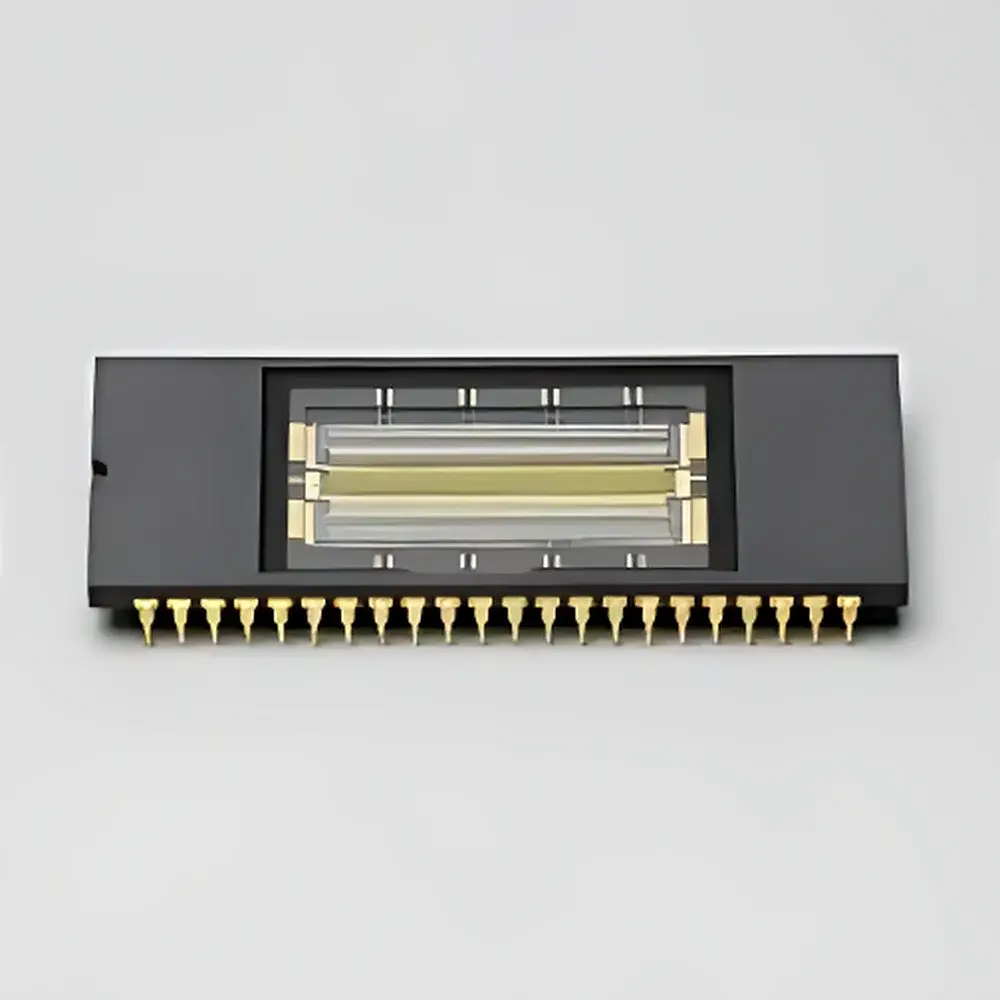
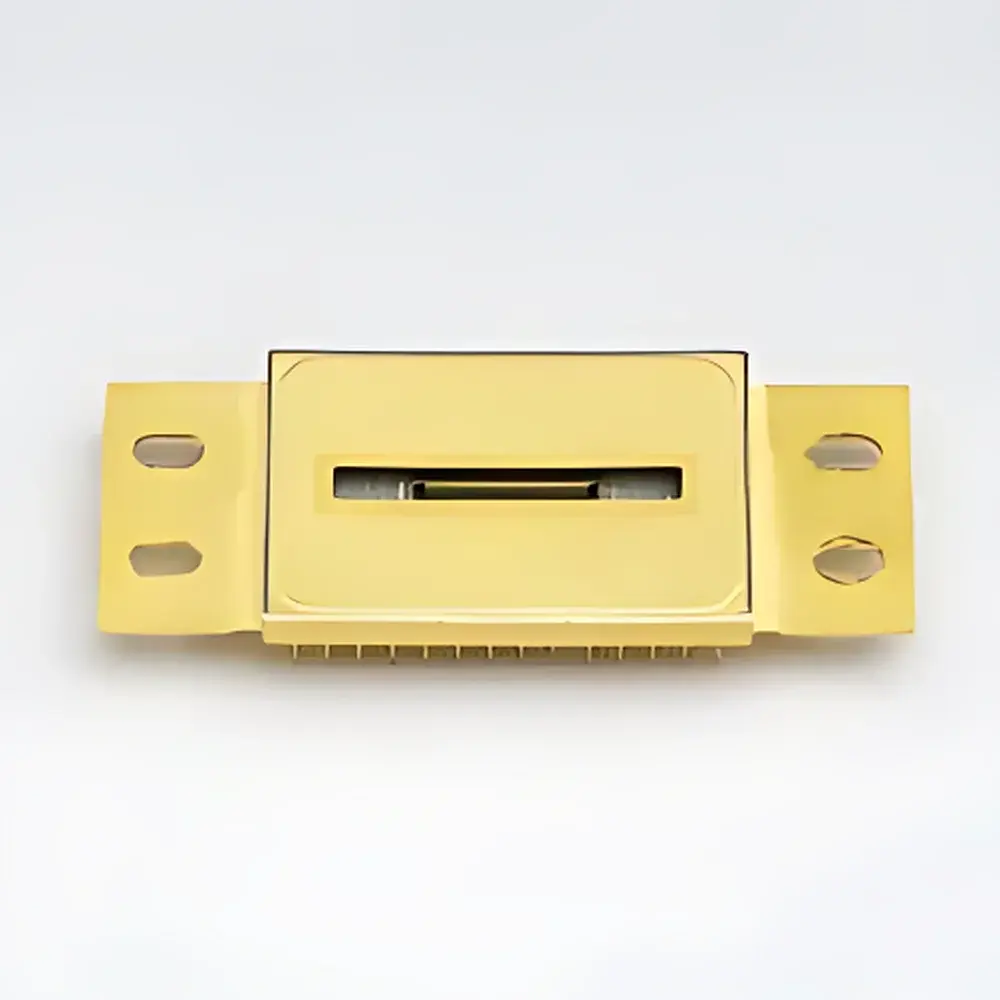
Hamamatsu G1 Series InGaAs Linear Image Sensors
| Brand | Hamamatsu |
|---|---|
| Origin | Japan |
| Manufacturer Type | Original Equipment Manufacturer (OEM) |
| Import Status | Imported |
| Model | G1 Series |
| Component Category | Optical Component |
| Spectral Range | 900–1700 nm |
| Pixel Count | 256 to 1024 |
| Pixel Pitch | 25–50 µm |
| Readout Rate | 970–39,000 lines/s |
| Cooling | Uncooled or Single-Stage TE-Cooled |
| Active Area | Up to 25.6 × 0.5 mm |
Overview
The Hamamatsu G1 Series InGaAs linear image sensors are high-performance photodetector arrays engineered for precision spectroscopic and imaging applications in the short-wave infrared (SWIR) spectral region. Based on lattice-matched indium gallium arsenide (In0.8Ga0.2As) epitaxial material grown on InP substrates, these sensors deliver stable quantum efficiency (>70% typical) across 900–1700 nm — a critical range for chemical identification, moisture analysis, semiconductor inspection, and laser beam profiling. Unlike silicon-based detectors, InGaAs sensors operate without vacuum cooling or complex optical upconversion, enabling compact, robust integration into OEM spectrometers, process monitoring systems, and laboratory-grade hyperspectral platforms. Each G1 sensor incorporates monolithically integrated CMOS readout circuitry, supporting correlated double sampling (CDS) for low-noise analog signal extraction and flexible timing control via TTL-compatible trigger inputs.
Key Features
- Monolithic InGaAs photodiode array with integrated CMOS readout IC for simplified system integration
- Multiple configurations: 256-, 512-, and 1024-pixel variants with pixel pitches of 25 µm or 50 µm
- Active area options spanning 12.8 × 0.025 mm to 25.6 × 0.5 mm, optimized for slit-coupled spectrometer designs
- Uncooled operation for low-power, portable instrumentation; optional single-stage thermoelectric (TE) cooling for reduced dark current in long-integration applications
- High line rate capability: up to 39,000 lines/s (G10768-1024D), supporting real-time industrial sorting and dynamic spectral acquisition
- Low crosstalk design with metal light-shielding layers and deep trench isolation between pixels
- Hermetically sealed ceramic package with AR-coated window (optional broadband or custom SWIR-optimized coating)
Sample Compatibility & Compliance
The G1 series is compatible with standard C-mount and custom optical interfaces, and supports direct coupling to diffraction gratings, fiber bundles (e.g., 200–600 µm core), or free-space collimated beams. Devices meet JEDEC J-STD-020 moisture sensitivity level (MSL) 3 and are qualified for industrial ambient operating temperatures (−20 °C to +60 °C). While not certified as medical devices, G1 sensors comply with RoHS Directive 2011/65/EU and REACH Regulation (EC) No. 1907/2006. Their stable responsivity and low temporal drift support traceable calibration against NIST-traceable blackbody sources, facilitating compliance with ISO/IEC 17025 requirements for accredited testing laboratories. For regulated environments, raw sensor output data can be logged with timestamped metadata to satisfy basic GLP audit trail expectations.
Software & Data Management
Hamamatsu provides the open-source HCPL (Hamamatsu Camera Programming Library) SDK for Windows and Linux, offering full register-level control over integration time, gain, offset, and trigger modes. The library includes C/C++, Python, and LabVIEW APIs, enabling seamless integration with third-party DAQ platforms such as National Instruments PXI systems or Keysight U1000-series digitizers. All G1 sensors output analog voltage signals (typically 0–5 V) proportional to photon flux per pixel; external ADCs (16-bit minimum recommended) digitize the signal for spectral reconstruction. Metadata—including exposure time, ambient temperature (via on-chip sensor), and firmware revision—is accessible via I²C interface. Raw frame data is structured as contiguous 16-bit integer arrays, compatible with HDF5, TIFF, and MATLAB .mat formats for downstream chemometric analysis (e.g., PLS regression, PCA) in tools like Unscrambler X or Python’s scikit-learn.
Applications
- Process Analytical Technology (PAT): Real-time monitoring of polymer melt index, pharmaceutical tablet coating uniformity, and food moisture content using NIR-SWIR reflectance spectroscopy
- Materials Characterization: Bandgap mapping of III-V semiconductors, wafer defect detection, and photoluminescence lifetime imaging (PLIM) in perovskite solar cells
- Laser Metrology: M² measurement, focal spot profiling, and wavelength-stabilized diode laser characterization at 1064 nm, 1310 nm, and 1550 nm
- Environmental Sensing: Open-path gas detection (e.g., CH₄, CO, NH₃) via tunable diode laser absorption spectroscopy (TDLAS) with wavelength modulation
- Astronomical Instrumentation: Low-light adaptive optics wavefront sensing and exoplanet transit spectroscopy in ground-based observatory feed systems
FAQ
What is the maximum recommended integration time for uncooled G1 sensors?
For optimal dynamic range and linearity, integration times should remain below 10 ms at room temperature (25 °C); extended exposures increase dark current nonlinearity and require pixel-wise offset correction.
Can G1 sensors be used in vacuum environments?
Yes — the ceramic LCC package is vacuum-compatible up to 10⁻⁵ Pa; however, thermal management must account for reduced convective cooling, and TE-cooled variants require modified heat-sink mounting.
Is spectral calibration data provided with each sensor?
Hamamatsu supplies relative spectral responsivity curves (normalized to peak) measured under controlled conditions; absolute calibration requires user-specific traceable source characterization per ISO 15739.
How does pixel binning affect noise performance?
Hardware binning is not supported; software binning of adjacent pixels improves SNR by √N but reduces spatial resolution and may introduce interpolation artifacts in high-contrast spectral edges.
Are evaluation boards available for rapid prototyping?
Yes — Hamamatsu offers the C12792 series evaluation kits, including FPGA-based timing controllers, low-noise power supplies, and USB 3.0 frame grabbers with real-time FFT and spectral display software.





