
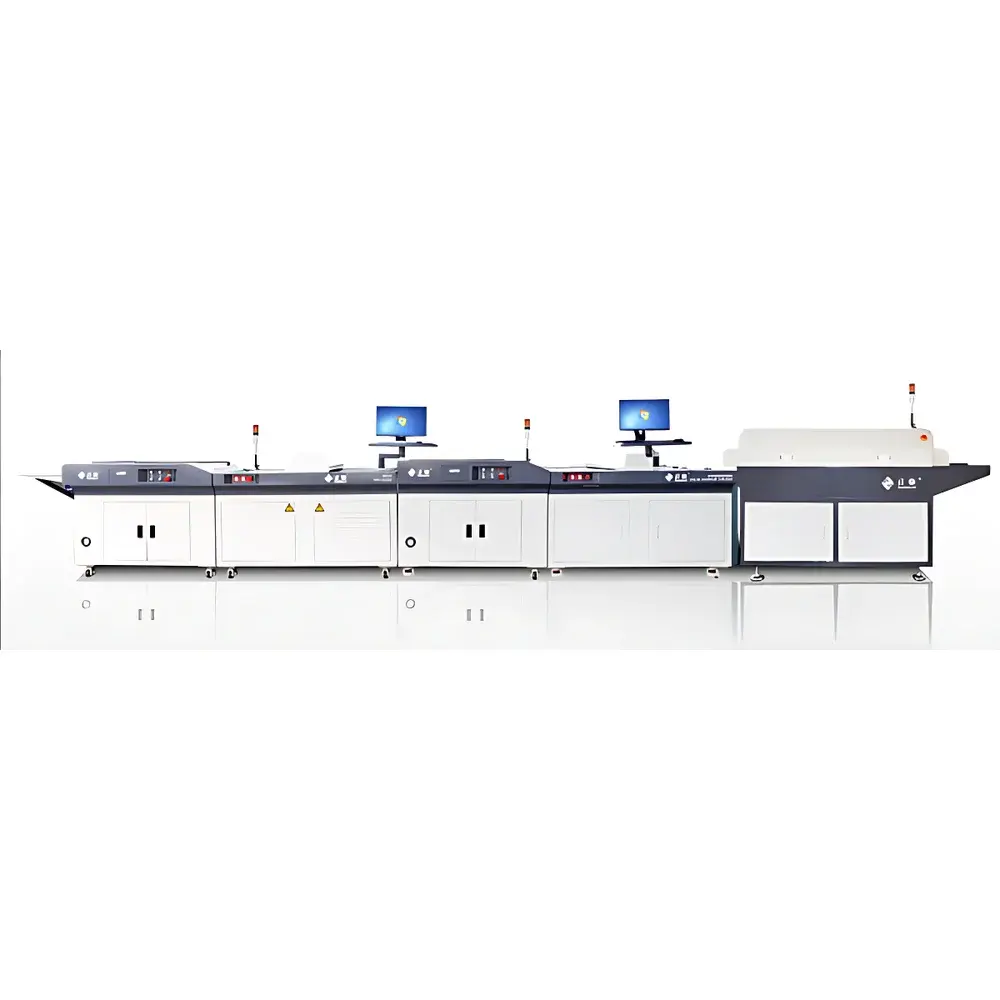
PCB Warpage Correction & Inspection System – Zhengye PCW-3000
| Brand | Zhengye |
|---|---|
| Origin | Guangdong, China |
| Manufacturer Type | OEM/ODM Manufacturer |
| Country of Origin | China |
| Model | PCW-3000 |
| Pricing | Upon Request |
Overview
The Zhengye PCW-3000 is an integrated inline metrology and mechanical correction system engineered for printed circuit board (PCB) manufacturing lines. It combines three functionally distinct yet synergistically synchronized modules: thermal-mechanical warpage correction, non-contact optical warpage quantification, and high-resolution automated drill-hole inspection. The system operates on the principle of controlled infrared heating followed by precision roller-based mechanical stress application to reverse elastic-plastic deformation in rigid and flex-rigid PCBs. Warpage measurement employs structured-light profilometry or laser triangulation (configurable per customer specification), delivering quantitative bow and twist data referenced to IPC-6012 and IPC-A-600 standards. Drill inspection utilizes high-magnification telecentric imaging coupled with sub-pixel edge detection algorithms to assess hole count, diameter distribution, positional accuracy, and defect morphology—including plugging, debris, slot length deviation, and annular ring integrity.
Key Features
- Triple-function architecture: simultaneous real-time warpage correction, quantitative warpage metrology, and drill-hole quality verification in a single footprint
- Infrared heating module with dual-zone top/bottom emitters enabling rapid, uniform thermal conditioning (up to 120 °C surface temperature) without thermal shock or resin degradation
- Programmable roller pressure profile (0.2–2.5 MPa adjustable) with closed-loop force feedback to prevent over-compression of thin-core or high-Tg laminates
- Non-contact warpage measurement resolution: ≤10 µm Z-axis repeatability across 610 × 460 mm PCB formats (standard); optional support for panel sizes up to 660 × 510 mm
- Automated pass/fail classification per IPC-6012 Class 2/3 criteria: bow ≤0.75% L/W, twist ≤0.5% L/W; configurable tolerance bands for automotive (IPC-6012DA) or aerospace (AS9100D-aligned) applications
- Drill inspection engine supports ≥200,000 holes per panel at 5 µm pixel resolution; detects voids, misregistration, smear, and micro-burrs via multi-threshold segmentation and morphological analysis
- Modular design enables independent operation of any subsystem—e.g., warpage correction-only mode for reflow-damaged panels, or standalone inspection for pre-shipment QA
Sample Compatibility & Compliance
The PCW-3000 accommodates standard FR-4, high-frequency laminates (Rogers RO4000®, Isola I-Tera®), and flexible/hybrid substrates (polyimide, LCP) with thicknesses from 0.2 mm to 6.0 mm and aspect ratios up to 20:1. It complies with CE machinery directive 2006/42/EC, electromagnetic compatibility EN 61000-6-2/6-4, and safety requirements per UL 61010-1. Data integrity protocols align with FDA 21 CFR Part 11 Annex 11 expectations: audit trails, electronic signatures, and role-based access control are embedded in the HMI firmware. All measurement algorithms are traceable to NIST-traceable calibration artifacts, and system validation documentation supports GLP/GMP environments.
Software & Data Management
The embedded Linux-based control software (Zhengye VisionSuite v4.2) provides full SPC integration, including X-bar/R charts, Cp/Cpk calculation, and OEE tracking per shift. Raw warpage point-cloud data exports in .STL or .XYZ format for FEA correlation studies. Drill inspection logs include per-hole metadata (X/Y coordinates, diameter, roundness, plating thickness estimate) stored in SQLite databases with SQL query interface. OPC UA server enables bidirectional communication with MES platforms (Siemens Opcenter, Rockwell FactoryTalk). Calibration history, maintenance logs, and operator actions are recorded with ISO/IEC 17025-compliant timestamping and immutable hashing.
Applications
- Final QA gate for HDI and IC substrate manufacturers prior to SMT assembly—ensuring coplanarity compliance for 01005 and 0.3-mm pitch BGA placement
- Re-work station for post-reflow warped panels in automotive electronics lines (AEC-Q200 qualified)
- Process capability assessment during lamination and drilling process development—correlating thermal cycle profiles with residual warpage
- Supplier qualification audits requiring objective, repeatable warpage metrics beyond manual dial indicator checks
- Failure analysis labs performing root-cause investigation of solder joint fatigue linked to board-level mechanical strain
FAQ
What warpage standards does the PCW-3000 reference for automatic OK/NG classification?
It implements IPC-6012 Section 3.8 (bow/twist limits), IPC-A-600G Section 2.12 (visual acceptability), and optionally user-defined thresholds aligned with JIS C 5012 or GB/T 4677.22.
Can the system handle sequential lamination panels with copper-filled microvias?
Yes—thermal correction parameters are programmable per layer stack-up; optical inspection uses adaptive focus stacking to resolve vias down to 25 µm diameter.
Is offline calibration supported for metrology verification?
Yes—NIST-traceable ceramic warpage reference plates (±0.02% flatness certified) and drilled aluminum test masters are supplied with annual recalibration services.
How is data security maintained during networked operation?
All communications use TLS 1.2 encryption; local database encryption follows AES-256; no cloud upload occurs unless explicitly enabled via air-gapped configuration.
Does the system support integration with existing factory automation protocols?
Native support for EtherNet/IP, PROFINET, and Modbus TCP; custom driver development available for SECS/GEM or HSMS interfaces.



